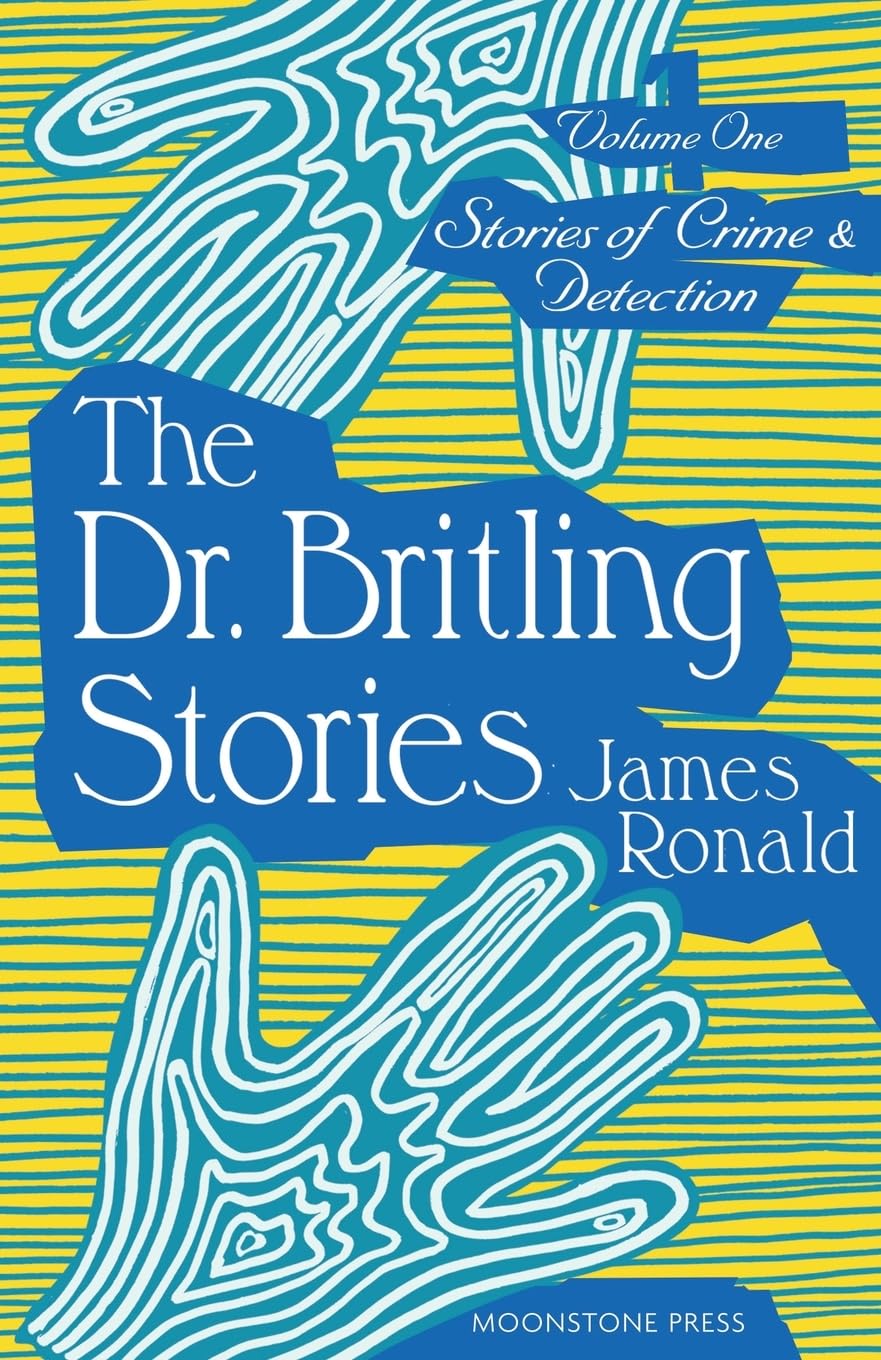
A second foray into the first volume of the criminous work of James Ronald, which is being reprinted by Moonstone Press — much to my immense excitement.
The titles in this first volume are:
- ‘The Green Ghost Murder’ (1931)
- ‘Too Many Motives’ (1930)
- ‘Find the Lady’ (1930)
- Six Were to Die [n] (1932)
- ‘Blind Man’s Bluff’ (1929)
‘Find the Lady’ (1930) is clearly a direct sequel to ‘Too Many Motives’ (1930), since one of the characters from that story here consults Dr. Daniel Britling — police surgeon with a sideline in amateur detection — asking that he track down an errant relative who has vanished from her swish Brighton hotel.
The woman in question, Lady Frances Dorian, has clearly led something of a wilful existence, and her many adventures brought to mind the untrammelled life of Mona McClane from The Wrong Murder (1940) by Craig Rice:
“[Frances] was kidnapped and held to ransom by bandits in Morocco a few years ago. There is a scar on her left shoulder, a souvenir of a narrow escape from death at the hands of a jealous woman in Naples last spring. She is an extraordinary woman, even in this age of extraordinary women…She is an orphan, has a large income, and does exactly as she pleases.”
Quite how, then, this extraordinary woman managed to vanish from her hotel at almost a moment’s notice — the exits were all watched by multiple employees who knew her on sight, and would certainly have been aware of her passage — is what so confounds Lord Clavering and his Aunt, Lady Agatha Dorian. And that Lady Agatha has been stirring up all manner of discontent, accusing the Royal Lancaster Hotel in Brighton of allowing her niece to be murdered on their premises, only adds to the problem. Might Daniel get to the bottom of the matter with his more delicate touch?

The tale unfolds as Britling attends various locations associated with Lady Frances, interviews the people he meets there, and gradually pieces together the series of events — in short, as classic a piece of amateur sleuthing as you could wish for. Of course, it would appear on the surface, even to the least practised of crime fiction readers, that there’s only really one explanation for events…and Ronald does well once again not to make mystery where none exists, acknowledging up front the likely turn of events but also admitting that these conclusions are rather previous without the key piece of evidence required to support them.
Some nice little clues are sprinkled in — the contents of a fireplace will have made more sense to the audience in 1930, I’m sure, but full credit for including it…let’s not be churlish and criticise Ronald for failing to appreciate what would no longer be common knowledge 90 years later — and as a result, despite a few minor exclusions, this feels like a more deliberate attempt to write something that the reader is brought along on, playing as fair as Ronald is comfortable doing. Or perhaps he’s excluding information on purpose so that the reader will jump to an early, wrong conclusion…who knows? The pulps are not renowned for their clewing, but Ronald is doing as good work in that direction as you feel the market would allow.
What really commends this, though, is the writing, which bristles with wonderful thumbnail descriptions:
The Royal Lancaster Hotel in Brighton is lavish with plate glass and long mirrors and gold paint, its architecture is Georgian but it has been renovated and remodelled and brought up to date until it resembles nothing so much as an elderly roué who has produced an appearance of decayed youth on his flabby body and withered cheeks and corsets and paint.
Ronald also shows his witty side once again in sly little moments, like the hotel manager pointing out Lady Agatha to Britling, or the reason that Lady Frances refers to Lord Clavering as ‘Ted’. He does good, important, light work in acknowledging the snobbery of the age, too, and captures his characters through idiomatic and phonetic speech that, for me, really works:
“Yus, I saw ‘er. Monday afternoon, it was, abaht a quarter pars’ two. She came dahn them steps luggin’ a great ‘efty suitcase.”
And then there are little touches which please me simply for their slightness, like the throwaway moment that the disguise of a telephone in a hotel room is described like we all understand it, or the fact that Ronald clearly has a couple of set paragraphs for explaining Daniel Britling to the reader — that line about the plum from ‘The Green Ghost Murder’ (1931) comes out again (well, I say “again” — that story was published after this one, though feels like it was written earlier), as does the description of his physical appearance from ‘Too Many Motives’. Ronald would be far from the first author to do this, I’m aware, but there’s something about knowing he’s simply repeating exactly what has been said before in order to get the essential point across and then move on which appeals to me.
And, in the final instance, the plot might have a surprise or two up its sleeve — certainly the ending was unexpected for me, and the final moment are going to linger where it would have been easier to simply round this out in a more forgettable, crowd-pleasing way. We’re still early in Ronald’s career, but it’s easy to see why Moonstone selected these stories as the way to introduce him to readers: so much interest ripples beneath the surface, and so many interesting ideas present themselves and then playing out in perhaps unexpected ways…what a way to whet the appetite!
My excitement remains high, then, to read further into Ronald’s career — sure, I’m not going to like everything he wrote, but the potential on show here, and my knowledge of how that potential paid off in some of his later works, is more than enough to keep me engaged. The next few years of picking through his criminous writings are going to be a delight, I have no doubt.
~
The James Ronald Stories of Crime and Detection, published by Moonstone Press:
- The Dr. Britling Stories (1929-31)
- Murder in the Family (1936)
- This Way Out (1939)
- They Can’t Hang Me (1938)
- The Dark Angel (1930)
- Cross Marks the Spot (1933)
- Death Croons the Blues (1934)
- Hard-Boiled (1937)
- Murder for Cash (1938)
- Counsel for the Defence (1932)
- The Sealed Room Murder (1934)
- She Got What She Asked For (1941)
 The Invisible Event
I thought I was going crazy when I saw that you had reviewed two stories from this collection – being absolutely certain that The Green Ghost Murder was last Tuesday – and the mention of Too Many Motives cemented in my mind that I was losing it. It wasn’t until after I finished the post and went back and clicked the link that I realized it was a five year old review.
LikeLike
Five years ago, back when Ronald was a mere curiosity and no-one was going to have a chance to read him…
LikeLike