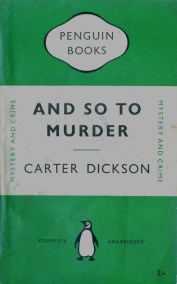
First, some context: when I began investigating the works of John Dickson Carr/Carter Dickson, I read a review of And So to Murder (1940) — his tenth novel to feature Sir Henry ‘H.M.’ Merrivale — which lambasted it so roundly that I decided there and then never to read it. Obviously this was in my pre-The Case of the Constant Suicides (1940) and Death Watch (1934) days, two books which convinced me I’d read the transcript of an old shipping forecast had JDC been the one to deliver it, but I still came to this with a certain…apprehension. Merrivale is on a pretty blistering run up to now, so would this be the point where it all starts going wrong?
We’re back in Boston again this week, in another large house with murder insinuating its way among the denizens. Everyone is snowed in when the death occurs, and so good-ol’-boy Asey Mayo must counter the cunning devilry of an ingenious and unscrupulous killer with his own brand of misleadingly languid style, plenty of homespun wisdom, and lot and lots of phonetic dialogue — in fact, this is the first time I’ve actively wondered whether an author was on some sort of pro rata arrangement for the number of times an apostrophe could be used where a letter would be equally good. So that’s another benchmark reached, I guess.
I feel as if I’m encroaching on the territory of John Norris at Pretty Sinister by reviewing a book that isn’t all that easy to come by; worry not, John, I don’t have well-enough stocked shelves to support this kind of habit, so it’s back to normal next week. This title is one that — like What a Body! (1949), The Rynox Mystery (1930), Death Has Many Doors (1951), and Dead Man Control (1936) — was brought to my attention by the Roland Lacourbe library of highly-regarded impossible crime novels, though due to the absence of a French translation did not qualify for the main list. Well, as you can see from the rating above, I think our Francophone brethren are missing out.
You’ll of course be aware that the birth stone for July is the ruby which — apologies for going over something we all know — signifies contentment. And so for Tuesdays in July I shall be putting forth a series of lists that, as a GAD fan, would go some way to enhancing my own content with the world.
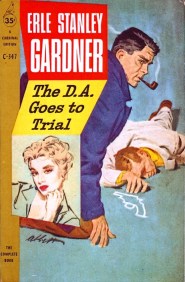
I maintain that the Doug Selby novels of Erle Stanley Gardner stand as probably his best work, and only the genius of Raymond Burr, that awesome theme music, and the fact that the Perry Mason novels outnumber the Selby ones by a mind-blowing 9:1 ratio have led to the relative obscurity of this better series. “What about the Cool and Lam books?” you want to know? Well, as soon as I’m done with Selby I’m going to go and read all 30 of those in order, too, because probably two-thirds of them eluded me back when I started reading Gardner and so there are plenty of gaps to fill. So officially the jury is still out, but the Selby books remain fabulous nonetheless.
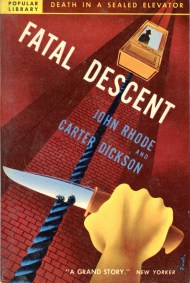
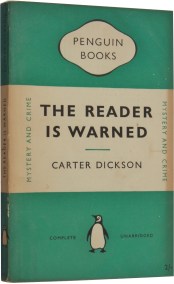
In the style of Sesame Street, today’s review is brought to you by In Search of the Classic Mystery Novel‘s Puzzle Doctor, who kindly leant me this book following years of me failing to find an affordable copy. And, boy, what an exciting prospect it is: no mere “one chapter each” in the style of ‘Behind the Screen’ (1930), ‘The Scoop’ (1931), or The Floating Admiral (1932), this is a proper collaboration between two of the Golden Age’s titans: Carter Dickson, a.k.a. John Dickson Carr, and John Rhode, a.k.a. Miles Burton — two gentlemen who individually devised a greater library of brilliant means of criminal dispatch than almost any other pair you’d care to name.
I will admit the chance that I am overrating this book slightly, but, dude, I loved it. The central premise — that Herman Pennik can both read the minds of others and kill people just by thinking about them, using a hitherto-unexplored scientific principle he calls Teleforce — has the absurdity of overwroughtness that distinguishes the Henry Merrivale books under John Dickson Carr’s Carter Dickson nom de plume (see: The Unicorn Murders (1935), The Punch and Judy Murders (1936), etc). But Carr plays it remarkably straight, keeping his phantasmagorical flourishes to a minimum and concentrating on plot and glorious atmosphere.
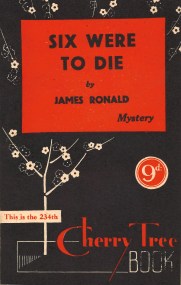
Every so often someone will email me to let me know of books that may pique my interest: Kate at CrossExaminingCrime has brought several Freeman Wills Croftses to my attention, and Ben of The Green Capsule has also informed me of some bargains, including today’s title that, it’s fair to say, we’re still not sure who was most excited to discover existed.
An orphaned young man who lives with his red-haired best friend’s family, all the while having adventures…yeah, okay, no, the Harry Potter similarities stop (and indeed, don’t even start — he’s not an orphan, his father’s just away a lot) there. But it’s interesting to reflect, as these YAGAD novels are making me do, on the format that adventures for younger readers take and how little the classic tropes have needed to change in the intervening decades.




 The Invisible Event