John Dickson Carr
#59: On Locked Rooms and Impossible Crimes in fiction – something of a ramble

 Existing somewhere between an early 2000s romantic comedy – probably starring Chris O’Donnell or Matthew McConnaughaghay – and The Count of Monte Cristo, John Dickson Carr’s The Bride of Newgate was his first foray into the historical mysteries that would come to typify his later career. You never write Carr off – like Christie he waned as he wore on, but there are enough flashes of fire after his peak for everyone to have two or three Later Carr highlights – but these dalliances with the extra detail required show a different side to our man. Mainly they show that he was a massive history nerd – detailing not just what people are wearing, say, but also what they would have removed from their outfit to be left with what they’ve got on – and that he was able to fit this into his wonderful brain and stir up something both necessarily of its setting that also fulfilled the expectations raised by his name on the cover.
 Marcus Chesney doesn’t have much faith in human observation. To prove his point, he arranges to put on a short demonstration for three witnesses, after which he will ask them questions about what they saw – secure in the knowledge, he says, that they’ll get the answers wrong. The demonstration goes ahead, as part of which a disguised figure enters the room…and poisons Chesney in front of everyone before vanishing. It swiftly becomes apparent that the murderer must not only be responsible for a spate of recent poisonings in the village but must also have somehow been one of only four people. The only problems are that one of them has a rock-solid alibi and the other three were all watching the performance…
 The heart of John Dickson Carr’s The Crooked Hinge – previously voted the fourth-best impossible crime of all time – is this: a man standing alone at the edge of a pond surrounded by sand has his throat slit, and the two witnesses who had him in their sight both swear no-one was anywhere near him at the time. It is, of course, impossible. But then the incidence of that which cannot be done is the bailiwick of Dr. Gideon Fell… Something a little different this week, as two venerable gentlemen of the blogosphere – Puzzle Doctor of In Search of the Classic Mystery Novel, and Sergio of Tipping My Fedora – have kindly agreed to allow me to append my thoughts to their own joint review of this title from last year by way of providing some alternative perspectives on what is a hotly-debated topic: just how classic is The Crooked Hinge?
 The Case of the Constant Suicides (1941) Hey, you; yes, you, with the cup of tea. I want you to write a book about people inexplicably hurling themselves out of a window when sleeping alone in a room at the top of a tower. I want it to be creepy, I want it to be fast-moving, I want it to have an undertone of threat; it also has to be fairly-clued, the culprit responsible must be a complete surprise and you can kill as many characters as you like. Oh, and make it funny. Make it laugh out loud, technicolour funny, but light enough to take up residence in your brain without leaving so much as a shadow and without undoing the threat mentioned above. What’s that? It’s already been done? Oh, forget it, then I’ll just read that book instead. [Available from Rue Morgue Press in print only]
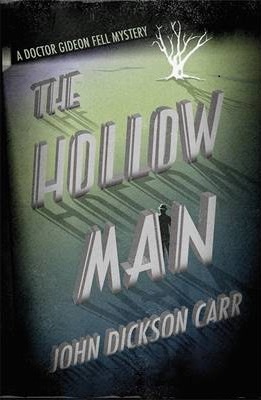 While I technically popped by blog Carr cherry a few weeks ago in recommending Death-Watch, it was at best a passing thumbs-up to the man and his achievements. And, following the disappointment of my intended novel under review, the time is probably ripe to dive in, get the first Carr review up and prop open the floodgates. And why not The Hollow Man (a.k.a. The Three Coffins)? Carr’s most well-known work, an arguable masterpiece of detective and impossible crime fiction, surely the most widely written about impossible crime novel on the internet…why not trot out the usual platitudes, recommend it unreservedly and fill the gap in my schedule?
