#1284: The Dead Man’s Knock (1958) by John Dickson Carr


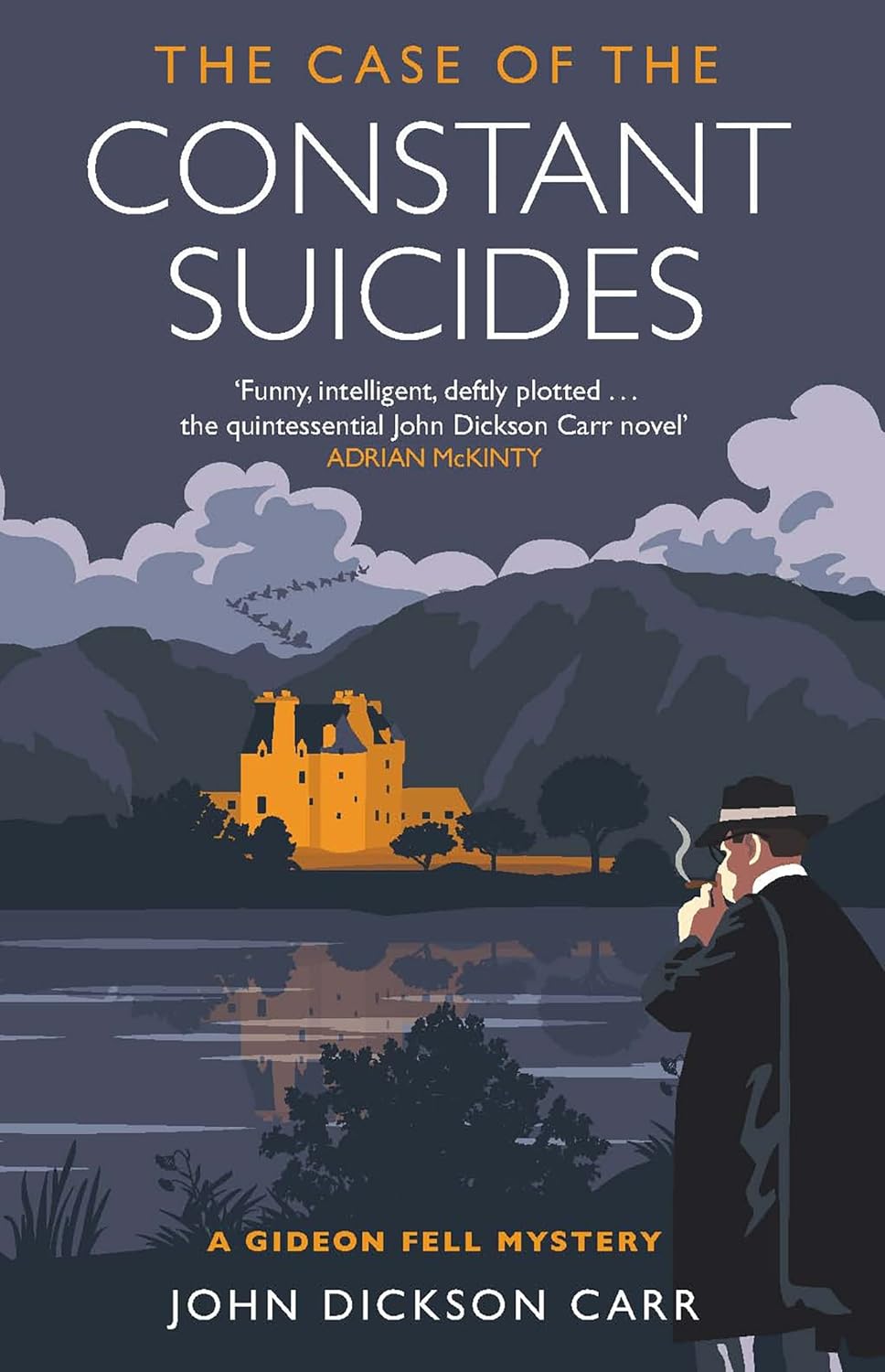
As my grandfather used to say, “Good god, it’s tough being a John Dickson Carr fan — he wrote some of the genre’s best and most enduring masterpieces, and yet the decline in his later works like Behind the Crimson Blind (1952) and The Cavalier’s Cup (1953) means that when you get to that end of his career he can prove to be frustrating and unenjoyable to read. But try The Dead Man’s Knock (1958), which at least features Dr. Gideon Fell, a character I’m sure you’ll like when you encounter him.” And, over 40 years later, his prophecy has been borne out, with The Dead Man’s Knock arresting a recent slide in quality where my Carr reading is concerned.

Continue reading

#1244: To Take a Backward Look – My Ten Favourite Mysteries of the 1930s

I picked my ten favourite crime and detective novels published in the 1930s a little while ago for my online book club, but I only do a Ten Favourite… list every four months or so and thus am only just getting round to writing it up now. I am so late to the party that it might as well never have happened, but I ironed a shirt specially so, dammit, I’m going to dance. Or something.

Continue reading

#1243: The Judas Window, a.k.a. The Crossbow Murder (1938) by Carter Dickson

The Judas WIndow

star filledstar filledstar filledstar filledstar filled
One of many classic detection titles I read before I started this blog, The Judas Window (1938) is arguably among the most popular books John Dickson Carr ever wrote, under his nom de plume Carter Dickson or otherwise. The seventh book to feature his barrister-detective Sir Henry ‘H.M.’ Merrivale, and the only time H.M. enters the courtroom in all his cases, this was actually the first Merrivale book I read, way back when, and so a revisit seemed on the cards, especially with the British Library Crime Classics adding Dickson’s The Ten Teacups, a.k.a. The Peacock Feather Murders (1937) to their stable next month. Might this one follow suit? Lord knows it deserves to.

Continue reading

#1220: “About ghosts in particular he was a blatant and contemptuous sceptic.” – Wicked Spirits [ss] (2024) ed. Tony Medawar

Let’s take a moment to reflect on what Tony Medawar has done in recent years for GAD fans, with Wicked Spirits (2024) being the eighth collection of lost, forgotten, and so-rare-they-doubt-their-own-existence stories by GAD luminaries Medawar has edited under the …from the Library label. Whether we get any more after this or not, and I sincerely hope we do, it’s a wonderful body of work, and only the tip of an iceberg of effort he has been putting in for decades now.

Continue reading

#1209: For This New Value in the Soul – My Ten Favourite Orion Crime Masterworks

I’ve written before about the impact the long-defunct Orion Crime Masterworks series had on my discovery of classic-era crime and detective fiction, and a recent pruning of my shelves brought back to me many of the happy memories from those books. So today, I’m going to run through the ten which left, perhaps, the strongest impression on Young Jim.

Continue reading

#1199: “There was undoubtedly method in the old boy’s madness…” – The Punch and Judy Murders, a.k.a. The Magic Lantern Murders (1936) by Carter Dickson

I have in the past referred to The Punch and Judy Murders, a.k.a. The Magic Lantern Murders (1936) — the fifth book to feature Sir Henry ‘H.M.’ Merrivale under John Dickson Carr’s Carter Dickson nom de plume — as an underacknowledged masterpiece in the oeuvre of an author who produced more than his fair share of masterpieces in the genre. So let’s examine that, eh? That sort of claim can’t possibly backfire.

Continue reading

#1168: Patrick Butler for the Defence (1956) by John Dickson Carr

Patrick Butler for the Defence

star filledstar filledstar filledstarsstars
It is perhaps fitting — though, I assure you, completely accidental — that a locked room murder in a novel by John Dickson Carr, doyen of the apparently undoable nevertheless rationally explained, is the focus of the 500th post on this blog to be tagged “impossible crimes“.  Sure, upon realising this I could have chosen one of Carr’s acknowledged masterpieces to reread, but I enjoyed the divisive barrister Patrick Butler, K.C. at first encounter, and was intrigued to see how the character fared without the support of Carr’s frequent and best sleuth, Dr. Gideon Fell. And, having given up on the two Carr novels I tried to read prior to this, I’m pleased to report that I enjoyed a fair amount of what Carr did here.

Continue reading