Crime-solving couples
#635: A Taste for Honey (1941) by H.F. Heard
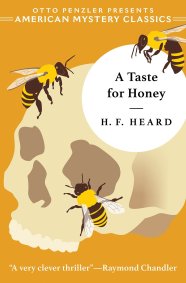


It’s difficult to know where to begin with A Taste for Honey (1941), the first of three ‘Mr. Mycroft’ novels by H.F. Heard. The core conceit is delightfully barmy — I shall avoid naming it in this review to preserve it for the curious — and played with an impressively straight face, but beyond that there’s really only a short story’s worth of content here, spread thinly over 189 generously-margined pages. With only one plot-line, only really three characters, and nothing to widen the universe or engage the mind in any meaningful way past the halfway point (when the ending will already be painfully obvious to anyone), this really is just a latter-day Holmes pastiche with verbal diarrhoea.
Continue reading
#631: Adventures in Self-Publishing – Murder Brewed at Home (2015) by Belle Knudson

It is a truth universally acknowledged that the most unpleasant character in any murder mystery typically ends up dead. The cozier the mystery, the truer this adage becomes. And the more hobby-based the mystery is, the cozier it tends to be…so welcome to Murder Brewed at Home (2015).
Continue reading
#628: Adventures in Self-Publishing – Murder Most Scottish (2018) by Blake Banner

Well, well, well, 200π posts — or 100τ if you’re a weirdo. Let’s celebrate with two locked room murders…
Continue reading
#627: A Little Help for My Friends – Finding a Modern Locked Room Mystery for TomCat Attempt #14: The Darker Arts (2019) by Oscar de Muriel

A certain amount of debate continues to rage — “rage” might be too strong a word — over whether the impossible alibi qualifies as a true impossible crime. I suggest that, should it eventually be inducted into future Locked Room Murders supplements, we do so on a ‘one out, one in’ policy and retire the “death by unknown means” to make space.
Continue reading
#622: Adventures in Self-Publishing – The Phantom Ragdoll (2019) by DWaM

The joy of self-publishing must be the freedom to live or die solely on your own efforts. There’s most likely no-one looking over your shoulder to advise you, and while that may be the key factor that ruins a lot of SP fiction, if you can get it right on your own I imagine it’s rather thrilling.
Continue reading
#620: The D.A. Breaks a Seal (1946) by Erle Stanley Gardner
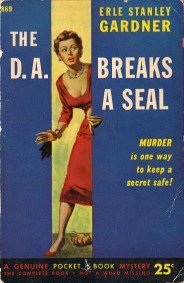
In a recent conversation on the GAD Facebook group, I was reminded that I haven’t read any of Erle Stanley Gardner’s Doug Selby novels in a while. In fact, it’s been a year — where does the time go? So, Project One for 2020 is to get these Selby novels finished so that I can move on to the 30 cases featuring Bertha Cool and Donald Lam. And then the eighty-four Perry Mason cases, which, at this rate, will keep me in blogging material until I’m about 146 years old. But, for today and my belated return to Gardner’s world, we enter a very different Madison County: one where D.A Doug Selby isn’t the D.A — I suppose The Guy Who Used to Be D.A. Breaks a Seal just ain’t that catchy…
Continue reading
#617: The Black Honeymoon (1944) by Constance and Gwenyth Little [a.p.a by Conyth Little]
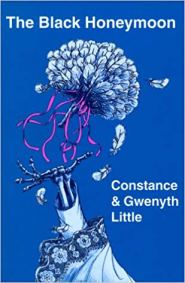
Sisters Constance and Gwenyth Little occupy an unusual place in the firmament of GAD. Together they wrote 21 novels and, thanks to the Rue Morgue Press reissuing them in the early 2000s, there’s sufficient awareness around them for the term “forgotten” to be thoroughly inappropriate…but you’d have to be a genre nerd to name more than a handful of their books. Their lack of a series character and the fact that they wrote no short stories (and a single novella, presumably harder to anthologise) doubtless play a part, but I think more telling is the fact that they’re remarkably difficult to pigeonhole. You’re never quite sure what you’re getting, and that cuts both ways.
Continue reading
#615: And the Knights are No More and the Dragons are Dead – Viewing the Detective Through a Glass, Darkly via The Hero (2019) by Lee Child

 The Invisible Event