
#677: “You must forgive me if I repeat that which you know already…” – The Old Man in the Corner [ss] (1908) by Baroness Orczy
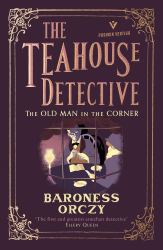
You are three weeks away from, but I have just recorded, an episode of In GAD We Trust with a focus on short stories, part of the preparation for which got me reflecting on the works by Baroness Emmuska Orczy about the old man found in the corner of the A.B.C Teashop holding forth on unsolved crimes. And the more I thought about them, the more I wanted to write about them. So here we are.
Continue reading
#676: The Heel of Achilles (1950) by E. & M.A. Radford
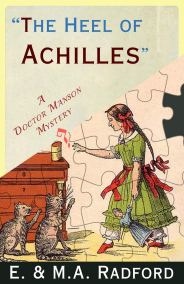


When a man wrongly implicated in criminous deeds finds himself at the mercy of a blackmailer, is pushed to the limit by the blackmailer’s avarice, kills said blackmailer and goes to great lengths to cover up the crime only to find himself pursued by a highly-observant criminologist…you’re not the only one getting Mr. Pottermack’s Oversight (1930) vibes. And, Pottermack being one of my most delighted discoveries of the last couple of years, you’d expect The Heel of Achilles (1950) by E. & M.A. Radford to suffer by comparison, but it is in fact simply proof of how much richness the Golden Age was able to find in the same material.
Continue reading
#675: Adventures in Self-Publishing – Atmosphere (2018) by Robert Innes
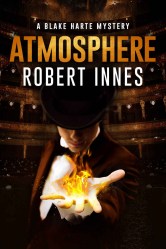
As we approach the (current?) end of Rob Innes’ Blake Harte series of impossible crime stories, I have to confess that one of its major successes has been getting me, a man who will take a finely-crafted plot over minutely-observed character, engaged in the lives of his core cast.
Continue reading
In GAD We Trust – Episode 5: GAD in the Time of COVID-19 [w’ Brad @ AhSweetMysteryBlog]

As the COVID-19 pandemic rolls into its 348th week, Brad from AhSweetMysteryBlog is here with some salutary advice.
Continue reading
#673: Cut and Run (1941) by Martin Tanner
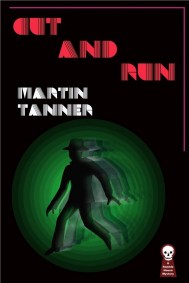
We tend to take it for granted that authors like John Dickson Carr and John Rhode created noms de plume effectively to enable them to produce double the amount of their usual fiction. Central character names aside, Rhode’s works don’t really differ from ‘Miles Burton’s nor Carr’s from that of ‘Carter Dickson’. You’d think they’d want a day off every now and then (and their critics might suggest they could have used one). One would expect a new identity to be quite freeing — see Agatha Christie occasionally escaping into the social concerns of ‘Mary Westmacott’, or Anthony Berkeley rearranging his palette as ‘Francis Iles’ — a chance to experiment in private, as it were.
Continue reading
#672: Adventures in Self-Publishing – Murder by Magic (2017) by Paul Tomlinson

Typical, eh? You wait years for a blog to talk about magic, and then suddenly three posts come along at once: the most recent In GAD We Trust episode with John Norris, and two self-published impossible crime stories — one this week, and one next. Sure, that’s stretching the definition of “at once” to an Orwellian degree, but that’s how I apparently roll.
Continue reading
#671: “At this point, everything seems too far-fetched to be taken seriously…” – The Invisible Circle (1996) by Paul Halter [trans. John Pugmire 2014]
A triptych of needs are being met here: firstly a last-minute replacement for the Modern Locked Room Mystery for TomCat I’d intended to write about, secondly the addressing of a Paul Halter book not yet reviewed on this blog, and thirdly some tangential research for next Saturday’s In GAD We Trust episode.
Continue reading
#670: Sleeping Murder (1976) by Agatha Christie
Agatha Christie famously wrote the final novels to feature her two biggest sleuths well ahead of their publication, and where Hercule Poirot’s swansong Curtain (1975) was a joyous return to the heights for a character she had grown weary of, Sleeping Murder (1976) — the last hurrah for Miss Jane Marple, a character you can’t help but feel Christie had a growing respect for as she aged — is…fine. Yes, it had a cogency and precision that At Bertram’s Hotel (1965) and Nemesis (1971) sorely needed, but in all honesty the sound and fury on display here signifies something that doesn’t even add up to a hill o’ beans, if you’ll forgive my mixing of classics.
Continue reading
#669: Adventures in Self-Publishing – Murder in a Watched Room (2019) by A.G. Barnett

 The Invisible Event