#324: Murder in the Melody (1940) by Norman Berrow
 As I wend my merry way through the works of Norman Berrow — this is the seventh book of his I’ve read, thanks to the wonderful efforts of Ramble House in republishing his entire catalogue — I’m forced into a certain awareness: I really like his style of mystery, even though they fall slightly below the standard I’d typically expect. His characters are fun, his situations inventive, he doesn’t bog you down in mucilaginous prose, and the fact that he jumped between five different (albeit short) series plus standalones in his career invited a certain variation in his approaches that stops things getting samey. If the plots occasionally fall short of full brilliance…I can live with that. But it makes things a little tricky from a reviewing perspective.
Continue reading
#323: Reflections on Detection – ‘Why Do People Read Detective Stories?’ (1944) and ‘Who Cares Who Killed Roger Ackroyd?’ (1945) by Edmund Wilson [feat. Gladys Mitchell]
In October 1944 and January 1945, the American newspaper columnist, writer, and critic Edmund Wilson published two essays entitled, respectively, ‘Why Do People Read Detective Stories?’ and ‘Who Cares Who Killed Roger Ackroyd?’. The second was in response to the exhortations from readers who, appalled by the first, sent him recommendations to improve his outlook…recommendations which, by all accounts, failed miserably.
Continue reading
#322: A Little Help for My Friends – Finding a Modern Locked Room Mystery for TomCat Attempt #5: The Real-Town Murders (2017) by Adam Roberts
My previous attempt at finding a modern locked room mystery for TomCat ended in frank disaster when it turned out TomCat had, of course, already read the book chosen. Well I’m back, baby, and this time I’ve done my homework. Hours of research went into choosing this title, including an algorithmic analysis of TomCat’s reading habits over the past five years. I in no way just happened to see it at my local library, no sir. Why would you even suggest that?
Continue reading
#321: The Maze, a.k.a. Persons Unknown (1932) by Philip MacDonald
 Much like in one of those hilarious romantic comedies from the early 2000s starring Ben Stiller or Jennifer Lopez, Philip MacDonald and I got off to a rocky start that seemed to be improving, on the way to falling lovingly into each other’s arms by the end credits. It began badly with X v. Rex (1933), showed signs of improvement with Murder Gone Mad (1931), and so by now we’re at the montage stage — I’m the aggressive go-getter, he won’t compromise where his family’s concerned…how can two such different souls ever hope to find common ground? Can’t I see that his brand of innovation is made for me? Won’t he just do the decent thing and write a novel of detection with actual clues? Hairy Aaron, we’re so stubborn…
Continue reading
#320: Reflections on Detection – The Golden Age of Murder (2015) by Martin Edwards
We live in a world where the 80 novels and collections of short stories by Agatha Christie are in no doubt — she wrote them, they were published, and they will doubtless be available in perpetuity. This is equally true of the work of John Dickson Carr, though less readily available, or Miles Burton or Christianna Brand; the work is closed, finished, and while an occasional unknown one may appear at some point, it’s reasonable to assume that there’s nothing meaningful to be added to these bibliographies.
Continue reading
#319: A Call to Arms – ‘The Running Dead’ (1985) by Soji Shimada [trans. Ho-Ling Wong & John Pugmire 2017]
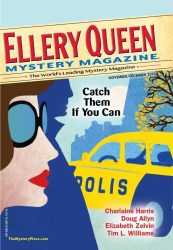
Given that an overwhelming majority of modern crime writing really isn’t my thing, it’s always lovely to see Ellery Queen’s Mystery Magazine publish some short fiction for me to get excited about, like a new Paul Halter story or, as in the current November/December 2017 issue, something from Japanese master Soji Shimada (I’ll Westernise his name herein, since that’s what I’ve done previously).
Continue reading
#318: The Sinister Six – Murder Begins at Home in ‘Behind the Screen’ (1930)
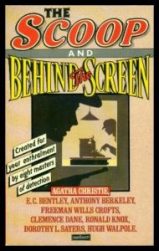
Slightly belatedly, here are my thoughts on the companion piece to ‘The Scoop’ (1931), another portmanteau mystery written for radio by some of the luminaries of the Golden Age. This time around, Hugh Walpole sets the problem of a dead body found in your typical Stage 3 suburban household, and Agatha Christie, Dorothy L. Sayers, Anthony Berkeley, E.C. Bentley, and Ronald Knox contribute to its unpicking.
Continue reading
#317: The Burning Court (1937) by John Dickson Carr
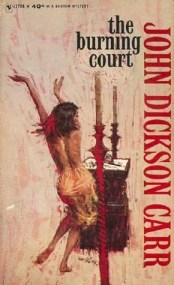 In a career that does not exactly lack for belauded titles, The Burning Court might just be the most belauded of John Dickson Carr’s oeuvre. Opinions diverge sharply on what I would consider all-time classics like The Plague Court Murders (1934) or The Hollow Man (1935), but arguably only this and perhaps She Died a Lady (1943) seem to enjoy universal adoration. So for the Carr acolyte like myself, approaching every book fully intent on getting the most possible out of it, there’s now the extra twinge of almost needing to love this so as to be taken seriously when discussing the man and his work. Five years from now, you don’t want “Yeah, but you didn’t enjoy The Burning Court” being thrown in your face like the castigation it is.
Continue reading
#316: Stand Back, Detective Novelist at Work in The Mystery of the Invisible Thief (1950) by Enid Blyton