#263: A Little Help for My Friends – Finding a Modern Locked Room Mystery for TomCat Attempt #2: First Class Murder (2015) by Robin Stevens

This gets a little convoluted: at the recent Bodies from the Library conference, I was discussing impossible crime novels with Dan of The Reader is Warned when conversation turned to Siobhan Dowd’s very, very good impossible disappearance for younger readers The London Eye Mystery (2007). Dan mentioned that, following Dowd’s death in 2007, the series was to be continued (The Guggenheim Mystery is due out in August) by Robin Stevens, author of the Murder Most Unladylike series. Then he mentioned that one of the MMU books was a locked room and, well, I was in.
Continue reading
#262: The Duke of York’s Steps (1929) by Henry Wade
Last week, I was moved to reflect upon the end of the archetypal Golden Age detective novel, and this week I’m moved to reflect on its beginning. The essential ludic air at the heart of the best of the genre is not quite there in The Duke of York’s Steps, but one can feel the inalienable ingredients of the form straggling into line to give shape to a story that retains fidelity to a type of plot that, at this stage, was understood if not quite mastered. If anything, the mystery feels almost over-subtle — like Antidote to Venom, it seems a trifle unlikely that such a set of circumstances as these would come to warrant criminal investigation — and so approximately the first quarter is spent trying to manufacture the necessary traction for the detection to begin in earnest.
Continue reading
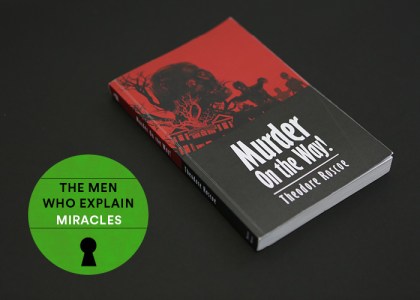
#261: Judging a Book – Rejected Cover Art for Murder on the Way! (1935) and I’ll Grind Their Bones (1936) by Theodore Roscoe
As you may be aware, it was recently my most honoured pleasure to be involved with Bold Venture Press in the editing and republication of two novels by Theodore Roscoe. It’s not something I had any experience of before — and, to be fair, Rich and Audrey were so good about so many aspects that I don’t really have any transferable experience now — but I thought I’d offer a glimpse behind the curtain today and share with you some suggested covers for both books that we didn’t end up using.
Continue reading
#260: Wilders Walk Away (1948) by Herbert Brean
At some point between 1940 and 1960, puzzle-oriented detective fiction began an inexorable shift into what has now become know as crime fiction, wherein plot machinations took a back seat and character, setting, and ambience became more prevalent. Where detective fiction was mostly interested in the fiendish puzzle, crime fiction was more about the challenge to the status quo, and the effect this has on the people involved. And Wilders Walk Away, Herbert Brean’s debut novel, might just be the perfect peak between the two, because I do not remember having read a puzzle that was so intricately invested in the status quo. What emerges is necessarily a little confused about what it wants to be.
Continue reading
#259: ‘The Yellow Book’ (2017) by Paul Halter [trans. John Pugmire 2017] and Categorising No Footprints Murders
Of late, I have found myself surrounded by invisible men. Entirely fictional, of course, but there have been a lot of them: shooting someone in an empty room in You’ll Die Laughing (1945) by Bruce Elliott, disappearing into darkness in I’ll Grind Their Bones (1936) by Theodore Roscoe, vanishing from rooms and beaches in Thursday’s forthcoming Wilders Walk Away (1948) by Herbert Brean, performing miracle appearances and disappearances as I reread Rim of the Pit (1944) by Hake Talbot…everywhere I look, people are vanishing.
Continue reading
#258: I’ll Grind Their Bones (1936) by Theodore Roscoe is Now Available from Bold Venture Press!

“There is no suspense in a bang,” said Alfred Hitchcock, “only in the anticipation of it.” This applies to Stacey Bishop’s sole detective novel because, well, it wasn’t a book a sizeable proportion of GAD readers were aware even existed until Locked Room International conjured this reprint fittingly out of the ether — when John Norris at Pretty Sinister hasn’t read it, you know it’s rare. As such, the gleeful anticipation of its release was undercut somewhat by the fact that we hadn’t even heard of it, and so there’s no weight of expectation: we are free, in this connected age of everything being on demand and everything being remembered, to come into this entirely without preconceptions.
Stage magic and Golden Age detection go hand-in-hand: we go in knowing we’re being fooled in both cases, but there’s little more enjoyable than seeing it done well. Clayton Rawson and Hake Talbot were professional-level magicians who turned their minds to the dark arts of fictional (as far as we know…) murder and crafted some wonderful stories in doing so, and the name Bruce Elliott can also be added to the magician/detection-writer set with this country house mystery that benefits from his magical background by stirring in an impossible crime. This is yet another book that’s