
#344: Spoiler Warning – Coming in April: Invisible Weapons (1938) by John Rhode
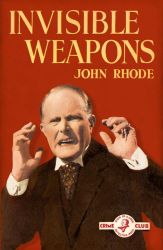
Right, the dust has settled on The Problem of the Wire Cage, so it’s time to pick another book to get all spoilerful over. There’s no mystery here, that book has been picked and its title is in the title of this post, but allow me a paragraph break otherwise I have no idea how I’ll work one in.
Continue reading
#343: He Wouldn’t Kill Patience (1944) by Carter Dickson
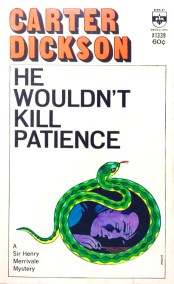


The result of a challenge between John Dickson Carr and magician-turned-author Clayton Rawson to write a murder in a room whose inaccessibility is assured by paper taped across the inner door jamb, He Wouldn’t Kill Patience (1944) also has GAD brethren in Freeman Wills Crofts’ zoo-set, poisonous-snake-centric Antidote to Venom (1938). Carr and Rawson take more puzzle-oriented routes, of course, and both happen to feature magicians, but the Reptile House subgenre is off to a good start with these two novels in it. And since you’re going to ask, in the head-to-head of this and Rawson’s ‘From Another World’ (1948), Carr wins. Boy, does Carr ever win.
Continue reading
#342: Highs & Lows – Tremendous Tricks and Terrible Tropes
I don’t know about you, but I read detective fiction mainly because I find the game-playing fun. If we accept certain components like fair declaration of clues, the killer being someone with whom we are familiar, and the freedom of a genius amateur to wander round crime scenes as a given, there are aspects within this that cause me no end of delight when they occur. Indeed, the fact that I see them present so frequently is part of what keeps me coming back.
Continue reading
#341: The Case of the Historical Precedent – Is Tell No One (2001) by Harlan Coben an Impossible Crime Novel?
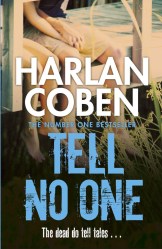
I’ll warn you now: even for me, this is niche. Following a reorganisation of books at Invisible Event Towers I stumbled across my copy Harlan Coben’s Tell No One (2001), which I read while at university, and got thinking about it in light of my more recent adoption of GAD an impossible crimes. And the above question struck me, but discussing it will require you, dear reader, to have done some rather specific reading…
Continue reading
#340: The Owner Lies Dead (1930) by Tyline Perry
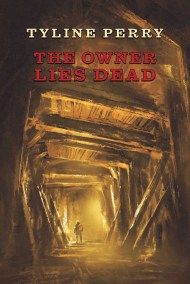
Fellow GAD blogger Noah Stewart has in the past talked about intertextuality in detective fiction, part of which is how each mystery’s solution feeds into a general awareness of all other mysteries and their solutions. Essentially, reading detective fiction is then a game: has the author been able to mislead you about the solution? And the more you read, the harder this game becomes for these authors, especially as many of them wrote their books close to a century ago and so don’t really get the right of response where later developments in the field are concerned. The best GAD plots stand up to all subsequent attempts to innovate, and remain surprising.
Continue reading
#339: Highs & Lows – Tall Tales and Subterranean Shenanigans
Okay, after three weeks of opinion, and with Tyline Perry’s murder-in-a-coalmine-centred The Owner Lies Dead (1930) up for review this Thursday, let’s have some much-needed objectivity: here is a selection of crimes where altitude plays a part.
Disclaimer: All heights are approximate. And fictional.
Continue reading
#338: Spoiler Warning 5 – The Problem of the Wire Cage (1939) by John Dickson Carr
Okay, here we go — do not read any further unless you are happy to be spoiled on the details of John Dickson Carr’s 1939 novel featuring the impossible “no footprints” problem of a man strangled in the middle of a clay tennis court.
#337: Foreign Bodies [ss] (2017) ed. Martin Edwards
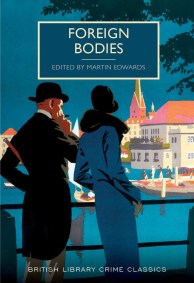
Had you asserted back in 2014 that the republication of two forgotten crime novels would lay the foundation for one of the most celebrated series of GAD reissues in modern times, well, people would have laughed. And yet the British Library Crime Classics collection, under the stewardship of Martin Edwards and Rob Davies, is now over 50 books deep and gathering momentum for another exciting year. And it’s a sure sign of the hale condition of the series that, far from simply reissuing books, they’re now branching out into original translations with this collection of overseas tales. In the words of Ira Gershwin, who’s got the last laugh now?
Continue reading
#336: Highs & Lows – Agatha Christie from The Mysterious Affair at Styles (1920) to Hallowe’en Party (1969)


