#414: The Four Defences (1940) by J.J. Connington
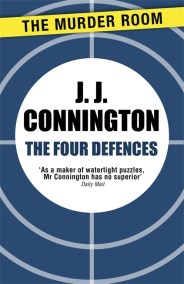


I had only read one previous novel by J.J. Connington — The Case with Nine Solutions (1928) — about which I remember one clever piece of misdirection and little else. I’ve had The Four Defences (1940) for ages, but his fellow-Humdrummer Mr. Freeman Wills Crofts captured my heart and swept me off my feet, so amends were here to be made. Thus, we have the remains of an unidentified body in a burned-out car, an obstreperous coroner insisting on felo de se, and a mystery on our hands. Cue an amateur detective — with the delightfully pleonastic name of Mark Brand, whose job seems to be giving relationship advice on the radio — to break the case…
Continue reading
#413: The Wants – Five Books on My TBR I Know Nothing About

If you’re anything like me, well, how do you manage? But also you probably have a book-buying compulsion which so-called “specialists” refuse to diagnose as a medical condition despite the prospect of going two weeks without adding to your TBR being sufficient to make you rush out and do something regrettable like snatching up a Gladys Mitchell omnibus.
Continue reading
#412: On the Appeal of Impossible Crimes – At Death’s Door…

I’ll he honest, I’m not really sure what this post is about. See, I’ve been mulling the appeal of the impossible crime novel for, well, years now, and having previously looked at what makes something an impossible crime the thing I’ve been mulling lately why the concept of an impossible crime is so appealing. This, then, is the end result of those lucubrations, unfocused as they are despite being pinned on a very small area of interest.
Continue reading
#411: Six Were to Die (1932) by James Ronald [a.p.a by Kirk Wales]
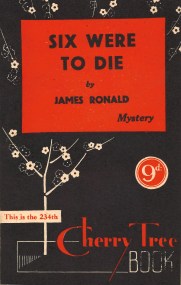
I feel as if I’m encroaching on the territory of John Norris at Pretty Sinister by reviewing a book that isn’t all that easy to come by; worry not, John, I don’t have well-enough stocked shelves to support this kind of habit, so it’s back to normal next week. This title is one that — like What a Body! (1949), The Rynox Mystery (1930), Death Has Many Doors (1951), and Dead Man Control (1936) — was brought to my attention by the Roland Lacourbe library of highly-regarded impossible crime novels, though due to the absence of a French translation did not qualify for the main list. Well, as you can see from the rating above, I think our Francophone brethren are missing out.
Continue reading
#410: The Wants – Five Authors in Need of a Second English Translation

Last week it was authors whose entire catalogues I’d love to see reprinted; this week I’ll set my sights a little lower: I’d like to see even just one more book by any of the following made available.
Continue reading
#409: A Little Help for My Friends – Finding a Modern Locked Room Mystery for TomCat Attempt #7: The Paris Librarian (2016) by Mark Pryor

I’m not entirely sure how I came across this title, but I picked it up because the blurb promises…well read it for yourself:
Continue reading