Before we get onto the book itself, it’s worth mentioning that this is the twenty-ninth publication from Locked Room International. Under the stewardship of John Pugmire, we’ve been brought a wonderful mix of classic and modern impossible crime novels and short stories from all corners of the globe, and — given the standard of their recent output — it certainly seems that the best is far from past. I anticipate a great many excellent, obscure, and previously-untranslated works coming our way in the years ahead thanks to LRI, and I wanted to take a moment to recognise the work that goes into making this happen.
Last Saturday was — as Kate, Puzzle Doctor, Moira, and Martin Edwards have already reported — the Bodies from the Library Conference 2018 at the British Library, and a superb day it was indeed.
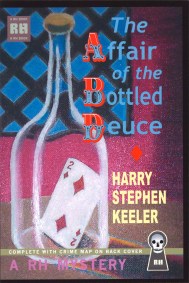
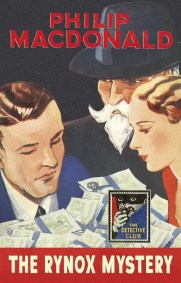
Emboldened by the experience of The Rynox Mystery (1930) by Philip MacDonald from last week — an author with whom I started poorly and have come to really enjoy — I turn to Harry Stephen Keeler. The only other Keeler I’ve read to date was…fine, and I’ve been admittedly reluctant to begin this despite its locked room murder being why I bought it in the first place. The superb introduction from Francis M. Nevins explains how and why this was unpublished in Keeler’s lifetime and only came into public being through Keelerite Fender Tucker’s Ramble House imprint in 2005. As you gather from my rating, I’m of the opinion the public would’ve coped perfectly fine without it.
Okay, the first one of these I took on wasn’t an impossible crime, and the second wasn’t any good. So, a new collection, shorter stories — hence two this week — how did we get on?
Well, who’d’ve thought it, eh? Philip MacDonald first featured in my reading life in 1-star ignominy, and here he is not just beating all-comers to feature my 400th blog post, but doing so with a book that I — against my better judgement, nature, and previous standards — unabashedly loved with every fibre of my being. Quite the turnaround, and part of why I persevere with intially-disappointing authors. Just to clear something up from the off: no, I would not classify this as an impossible crime, despite its inclusion on the Ronald Lacourbe list being what brought it to my attention in the first place, but that’s hardly the first time this has happened….
After the disappointment of last week’s ‘The Adventure of the Dead Cat’ (1946) not actually being an impossible crime story, I return this week to Calendar of Crime (1952) by Ellery Queen for the final story in the collection, Christmastime impossible theft ‘The Adventure of the Dauphin’s Doll’ (1948). Let’s hope we fare a little better this time around, eh?
A brief search of the interwebs reveals that David Beckham has thirty, Britney Spears twenty-three, Christina Aguilera fifteen, Beyoncé fourteen, Katy Perry 9, and Ariana Grande a mere 5 — it’s not my area of expertise, however, so some of those numbers may be a little out.
Whatever I thought of this book, I was committed to reading more of Dorothy Blair and Evelyn Page’s Roger Scarlett mysteries as I had already bought volume 2 of the Coachwhip reissues — comprising the novels Cat’s Paw (1931) and Murder Among the Angells (1932). Impetuous? I prefer optimistic: the promise on display in their debut augured well for their future, and I believed remuneration would be found somewhere in these pages. So it’s either my own foresight or my stubborn inability to admit a mistake that sees me having a hugely enjoyable time with this one…I shall leave it to the reader to choose.
Sometimes you go through every story in a collection and review them all. Sometimes you just want to talk about one of them. To engage in the second of these on a more thematic basis, I shall use my Tuesday posts this month to launch an occasional series of Little Fictions posts, and spend June with some of the impossible crime short stories written by Frederic Dannay and Manfred Lee under their Ellery Queen nom de plume.