-
Subscribe
Subscribed
Already have a WordPress.com account? Log in now.
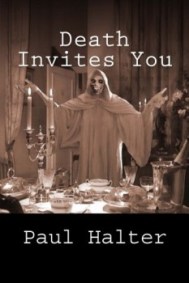 Death Invites You, the third novel published by Paul Halter – who is swiftly gaining a deserved reputation as a deviser of baffling locked room puzzles – is based around the murder of man found dead in his study with the door bolted from the inside, seated at a table set for a meal. The victim, Harold Vickers, is an author who has gained a deserved reputation as a deviser of baffling locked room puzzles and whose next novel – Death Invites You – was due to feature a victim found dead in his study with the door bolted from the inside, seated at a table set for a meal. It is unfortunately never revealed whether Vickers’ victim was an author of some repute working in the field of locked rooms and whose next novel was due to feature such a crime, but, given the hall of mirrors that you enter at the beginning of any Halter narrative, it frankly wouldn’t surprise me…
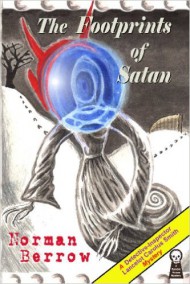 Lacking as I do the talent to devise my own fictional impossible crime and solution, I take refuge in those authors who have done it time and again to such success. The Footprints of Satan, my second Norman Berrow novel after the delightful surprise of The Bishop’s Sword, goes one even better: far from simply devising his own impossibility, he takes an unexplained one from real life, turns it to his own fictional purposes and then explains it away beautifully. Both the foreword and the plot here make reference to an incident from 1855 and reported in no less august a publication than The Times in which a trail of hoof-marks appeared in the snow as if from a cloven-footed creature walking on its hind legs.
 Marcus Chesney doesn’t have much faith in human observation. To prove his point, he arranges to put on a short demonstration for three witnesses, after which he will ask them questions about what they saw – secure in the knowledge, he says, that they’ll get the answers wrong. The demonstration goes ahead, as part of which a disguised figure enters the room…and poisons Chesney in front of everyone before vanishing. It swiftly becomes apparent that the murderer must not only be responsible for a spate of recent poisonings in the village but must also have somehow been one of only four people. The only problems are that one of them has a rock-solid alibi and the other three were all watching the performance…
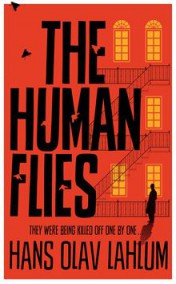 For those of you who lament the decline of the modern detective novel – and we are legion, to be sure – I have three words: Hans Olav Lahlum. The Human Flies, his debut novel, is by no means perfect – it’s in need of a good edit, as there’s a tendency to repeat ad infinitum information gleaned and interpreted elsewhere – but it’s honestly about as close to a classically-motivated, -structured, and -executed novel as I imagine you’ll find in the 21st century. The fact that it has almost the exact same setup as the likes of The Wooden Overcoat, The Black Shrouds and Our First Murder with a killing in a guest-house (here a small apartment block) of which one of the denizens is undoubtedly guilty certainly helps, but Lahlum is also smart enough to build on this base in very classical ways. But for a few dates and key events – it is set in 1968 – this could almost have been written in the late 1940s.
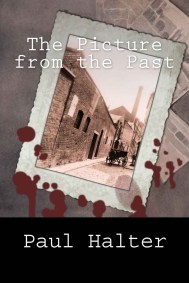 A man seeing an old photograph of an unremarkable street scene on the cover of a book and being struck by an overpowering reaction of uncertain origin doesn’t sound like a promising start to an impossible crime novel. However, it turns out that such an opinion is simply a sign of your lack of inventiveness, as Paul Halter can spin one hell of a tale from just that. Well, okay, not just that, as there’s also the notorious Acid Bath Murderer going around destroying the remains of murder victims by pouring acid on them – and John Braid, our photo-phobic protagonist, is curiously unwilling to tell his young, trusting and rather new wife what he gets up to every day when he leaves the house. And he’s rather keen on not letting his briefcase out of his sight…
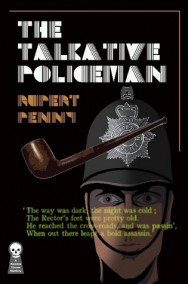 Aaah, Christmas. A time for cheer, goodwill to all men, on-trend ironic jumpers and spending time with the people you love. Look around the crime fiction blogosphere and these loved ones include a tremendous number of murderers, victims, stooges, detectives and classic authors, and so for me the time is ripe for a return to my overriding obsessions: this week it’s Ernest Basil Charles Thornett’s turn as his debut under the guise of Rupert Penny with The Talkative Policeman. And of course it’s a return to impossible crimes after a couple of weeks away with what the synopsis calls a “longer-than-usual impossible mystery,” and since Penny has written a couple of absolute doozys in this vein an extra bt of content is only to be a cause for celebration. Clap hands. Settle in. Let’s go.
 So, from one Australian author last week – the entertainingly bonkers world of Max Afford’s Owl of Darkness – to two this week – the entertainingly bonkers world of the Little Sisters. This is my first foray into the Monthly Challenge over at Past Offences, with the year for December being 1941 and so falling perfectly into my TBR pile, and it’s been a joy to reacquaint myself with these literary ladies after frankly too long away. Shades of my reviews from earlier this year – Pamela Branch’s The Wooden Overcoat and Torrey Chanslor’s Our First Murder – resurface here, with delightful overtones of everyone’s favourite crime-solving couple found in the echoes of Kelley Roos’ The Frightened Stiff, too, as a murder in a boarding house gives way to suspicion, fear, mistrust, confusion, doubt, terror and…laughter. Because as well as being a well-plotted and beautifully light mystery, this is also very, very witty indeed.
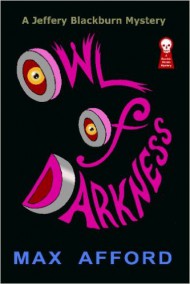 Regular readers of this blog – hello, Mum – will be aware of how much I appreciate die-hard devotees like Fender Tucker and Tom and Enid Schantz, whose (respectively) Ramble House and Rue Morgue Press imprints have for years been keeping the kind of classics everyone had long forgotten about in print just for the love of them. I won’t condescend to imply that everything they publish is of equal quality, but some of it is more equal than others and they have jointly brought some absolute delights to my attention. Unfortunately the latter’s Smallbone Deceased (1950) by Michael Gilbert proved not to be my kind of thing and so I couldn’t really review it having not read it, but it does give me a chance to talk about Max Afford’s Owl of Darkness which is published by the former and I read in those bleak and hazy dark days I now think of as ‘pre-blog’.
 John Pugmire’s continuing mission to bring us the best unheralded impossible crime stories from around the globe under the guise of Locked Room International now adds Sweden to Japan (Yukito Ayatsuji’s The Decagon House Murders), France (Noel Vindry’s The House That Kills, Henry Cauvin’s The Killing Needle, plus ongoing translations of the wonderful Paul Halter) and England (Derek Smith’s criminally ignored Whistle up the Devil and Come to Paddington Fair). Hard Cheese by Ulf Durling gives us something classically locked room – man dead in hotel room, door locked on the inside – and adds to it a knowing wink at just about every mystery convention going: the dying message, the inverted mystery, the had-I-but-known, the least likely suspect…even when these ideas aren’t being explicitly used, Durling is throwing out casual references to the tropes and traps of the genre. Add name-checks to John Dickson Carr, Agatha Christie, Freeman Wills Crofts and others, and clearly here is a man who knows whereof he writes.
 The Invisible Event