Reviews
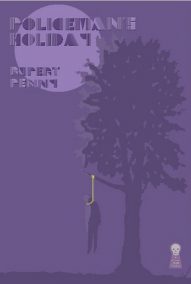 “If a man’s mind be wandering,” said Francis Bacon, “let him study the mathematics”. Well, the mathematics take up an unreasonably large amount of my time as it is, and for me nothing helps my wandering mind quite like classic detective fiction. So, with 2016 having been an underwhelming year in books so far, and coming back off a 2 month hiatus with my hand injury, I’m keen to get a bit of enthusiasm back into my reading. Hence I shall spend the next little while focussing on the sure-fire hits in my collection: expect much Max Afford, Leo Bruce, John Dickson Carr, Agatha Christie, Paul Halter and others, as well as some classic locked room nonplussing, in the weeks to come while I try to reorient myself within my chosen enthusiasm.
#82: The Blushing Monkey (1953) by Roman McDougald
Okay, I’ve had nearly two months off and have been promising this review for that whole time, so let’s see if I can remember how this works…
 Animals and their involvement in impossible crimes enjoy a long history, from the works of Edgar Allan Poe and Arthur Conan Doyle all the way up to the Jonathan Creek episode The House of Monkeys. Approximately halfway between these two we have Roman McDougald’s mandrill Geva, resident of your classical American Millionaire’s Household and on hand when said millionaire is found murdered in frankly baffling circumstances: in his office, stabbed in the back, with both doors into the room unlocked. Yes, unlocked. And yet he failed to leave the room while being attacked – the trail of blood he left leads from his desk to one door, then the other, and halfway back again – or raise the alarm in any way before the killer escaped.
This book would have completely passed me by but for TomCat’s list of favourite locked room novels over at Beneath the Stains of Time, which has proved a launching pad for my investigations into some of the less-heralded authors who dabbled in our shared passion. However, that erudite locked room expert and I are going to disagree on this one: I don’t really rate it. The puzzle of an unlocked room is a fantastic notion, and the later locked room murder of one of the suspects is a nice addition (if rather basic, and likely to infuriate S.S. van Dine), but mainly this is slightly over-long and moderately dull standard fare that offers little you can’t afford to miss.
Continue reading
#80: Murder on Wheels (1932) by Stuart Palmer
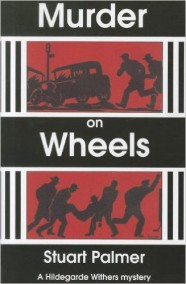 A little charm goes a long way – ask any bank teller or helpline operative, or indeed any fan of Golden Age crime fiction. Because, while a lot of absolutely wonderful books came out of this genre at that time, the fact is that a lot of what was published then and is popular now adhered to a particular school of writing and runs on very familiar rails. But the key thing is that so much of it is charming without having to innovate, and once you jettison any notions about every single book from the Golden Age being a complete game-changer you find a lot of joy there. Which astonishingly back-handed praise brings us to my first (but the chronological second) Hildegard Withers mystery by Stuart Palmer, possibly the first book I’ve really enjoyed for a long time in 2016 even though it does very little new or surprising.
A car crashes on a busy New York street, but the driver is not in evidence by the time the nearest policeman reaches it. Far from having fled the scene, a witness tells him, the driver actually jumped from his car long before the crash. And sure enough, a body is found back in the direction of the car’s origin…though with a noose around its neck and clearly dead from hanging. This setup, I have to say, is very arresting, but also probably the last point that the book displays any genuine originality. The dead man is part of a wealthy family, there’s a fiancée and a cousin and an elderly matriarch, and yes you pretty much know what you’re gonna get.
Continue reading
#78: Murder of a Lady (1931) by Anthony Wynne
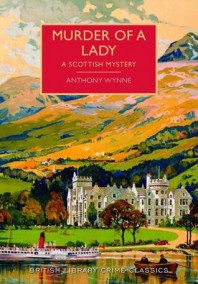 You’ll be aware by now, I hope, that I’m quite the fan of a locked room murder. That quantal aspect of something that can’t have happened but nevertheless did tickles me greater the more I read, and so the republication of anything from the classic era is always a cause for celebration. The British Library continue their excellent Crime Classics series with this, their first impossible crime, in which elderly spinster Mary Gregor is found dead in her locked and bolted bedroom (a nice touch with the door lock forestalls the prospect of jiggery, and indeed pokery, there) with no sign of a weapon and the blow that killed her containing the scale from a herring and so stirring up superstitious rumours of merman-like ‘swimmers’ finding their way in to dispatch her.
On the spot is Dr. Eustace Hailey, who by his reputation appears to be Wynne’s incumbent amateur sleuth, and so he is pulled into a Highland mystery at a gloomy old ancestral home that ends up the scene of plenty of mysterious comings and goings, clandestine meetings, false leads, and several further seemingly-impossible deaths. Obviously we know he’ll solve it in time, but who will be left to act as a suspect as the dramatis personae gets whittled down and down?
Continue reading
#75: The Border Line (1937) by Walter S. Masterman
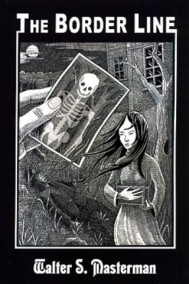 I am from a televisual generation and so struggle to comprehend the power radio held in its pomp – people actually believing that Orson Welles’ radio broadcast of The War of the Worlds was genuinely detailing an alien invasion of Earth, for instance. So, to me, the idea of presenting the haunting of a Spooky Old House as a radio show seems a bit…pointless. Nevertheless, Jack Hartley and his BBC radio chums descend upon Cold Stairs, the ancestral home of Sir John Harman (5 bed, 2 bath., stunning aspect in own woodland), to record ghostly goings on and bumps in the night with the intention of making a broadcast of it. Or that should really be ‘bumping offs in the night’ as some poor soul is murdered by the evil spirit that resides in the vicinity – the same spirit that shocked his housekeeper’s son so badly he fell down the stairs and crippled himself – and then it turns out that Harman’s introverted, reserved niece has been communing with something calling itself the King of the Forest, and that’s really the beginning of everyone’s problems.
Given that John Pelan’s superb introduction makes much of Masterman’s standing in the Science Fiction/Supernatural Horror genre, I wasn’t entirely sure what I’d be getting here: Ramble House are known for their commitment to the, er, more uncommon corners of genre fiction, after all, and so the deaths, photographs of skeletons, and blindfolded meetings with sinister wood-dwelling monsters all stirs a stew that could turn out to be a dream as easily as it could leave you with no explanation whatsoever.
Continue reading
#72: X v. Rex (1933), a.k.a. The Mystery of the Dead Police by Philip MacDonald
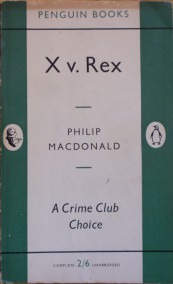 Philip MacDonald first came to my attention for having written a handful of impossible crime novels but this is not one of them, and nor does it feature his series sleuth Anthony Gethryn. I stumbled across my copy of X v. Rex in a second-hand bookshop a good while ago and, as he was out of print at the time (one Gethryn novel, The Rasp, has since been republished by Collins) I picked it up for future perusal. And so, with the Crimes of the Century at Past Offences dipping into 1933, here we are – with policemen in and around London being targeted by a killer, and a government sliding into disarray as the previously unimpeachable bastion of order is attacked seemingly at will.
This is decidedly more of a thriller than a crime novel – no small cast of suspects, no scattered clues, no sudden moment of retrospective reanalysis, no clever misdirection – you just sit and wait for the suspect to be apprehended three pages from the end and then that’s over and done with. There is one piece of sort-of misdirection, but it’s revealed fairly quickly and by that point I wasn’t really all that bothered. It certainly wasn’t clever enough to warrant a closer reading. Honestly, where’s the appeal?
Continue reading
#71: The Case of the Borrowed Brunette (1946) by Erle Stanley Gardner
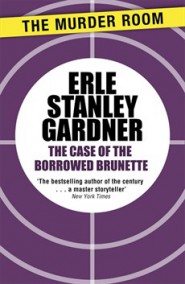 There’s an appealing irony in the assertion that you know an author has hit the big time when everyone remembers the name of their characters over that of the creator themself: Lisbeth Salander, Jack Reacher, Tarzan, Jason Bourne, we erudite types remember them, of course, but the world at large – fuelled no doubt by TV and films – associates more with their representations than their origins. Erle Stanley Gardner – a King of Crime, lest we forget – is not just less well-known than his character, but also the piece of music that character is himself overshadowed by; all together now… Frankly, he must be like the biggest-selling author in the world on those terms. Well, uh, yeah, he kinda is, actually. And yet, despite my avowed love of the man and his writing, it’s taken me 70 posts to get round to reviewing him here; what gives?
Well, two things. Firstly, I’d read a lot of Gardner before starting this blog and had sort of lost track of exactly what I had and hadn’t already encountered, and secondly a lot of it was written at high speed and with, er, some quality control issues and so some of what I’ve read since hasn’t exactly covered him in glory. However, The Case of the Borrowed Brunette is about as classic a Perry Mason – oh, yeah, that’s the famous character, but the way – novel as you’ll get, and showcases a lot of what Gardner did extremely well and also a lot of the flaws in his process.
Continue reading
#69: Death’s Mannikins, a.k.a. The Dolls of Death (1937) by Max Afford
 An isolated ancestral home ruled over by an eccentric patriarch with a keen interest in esoterica and a private museum of medieval weapons, into which an eager young man is brought by an acquaintance only for murder to insinuate its way among the denizens…yup, John Dickson Carr’s The Bowstring Murders (1933) certainly is a classic of the genre. What’s that you say? Death’s Mannikins? Oh, wow, uh, this is awkward. Okay, let’s start again: an isolated ancestral home ruled over by an eccentric patriarch with a keen interest in esoterica and a private museum of medieval weapons, into which an eager young man is brought by an acquaintance only for murder to insinuate its way among the denizens…yeah, no, there’s no getting away from those similarities. And, y’know what? I only bring it up because there’s more than a touch of Carr about this, Afford’s second Jeffery Blackburn novel, and that’s really not a bad thing.

I mean, take the following:
It was as though the second tragedy acted as sudden leaping flames under a simmering pot. The scalding, seething flux exploded and boiled over, galvanizing each person under that roof into an insane panic that throbbed and hummed and zoomed from cellar to tower with the horrible impotence of a monstrous and unclean bluebottle trapped against a window.

 The Invisible Event