-
Subscribe
Subscribed
Already have a WordPress.com account? Log in now.
 “The impulse for this novel,” says Adam Roberts “was a desire to collide together some of the conventions of ‘Golden Age’ science fiction and ‘Golden Age’ detective fiction, with the emphasis more on the latter than the former.” Well, count me in! Sure, the authors he then cites (Margery Allingham, Ngaio Marsh, Dorothy L. Sayers, Michael Innes) don’t all fill me with delight, but this is a collision of my two favourite genres plus impossible crimes — how could I pass it up?! And it would have passed me by entirely had not blog-commenter ravenking81 brought it to my attention, so my most genuine thanks for that; at its best it’s a fascinatingly successful attempt at merging the two genres in a way that recalls both Isaac Asimov and John Dickson Carr, who, y’know, are the two finest authors to have worked in their respective genres. So that’s a good thing. By definition, however, it is not always at its best. Continue reading
  People hold weird beliefs: that the moon landings have all been faked, for instance, or that the moon is hollow, or that the phases of the moon have anything at all to do with your love life or finances. Some people might even hold weird beliefs not about the moon. Here’s one: I firmly believe that for the remainder of human history there will never again be anyone who writes the detective novel as well as did John Dickson Carr at his peak. When I eventually narrow my ten favourite detective novels of all time down to a list that is actually ten books long, there’s a real chance all ten of them will be by Carr. And, I’ll tell you now, it will definitely feature The Problem of the Green Capsule, which in my current mood I consider to be the pinnacle of the form.
 After many years reading, talking about, reviewing, and now blogging on the subject of detective fiction I am presented with a real difficulty here: I honestly don’t know quite what to write about Noel Vindry’s classic The Howling Beast for fear of giving anything away. It is a balancing act of a book that, while probably not completely successful by today’s standards, is hugely enjoyable and absolutely something that those who count themselves as puzzle fans or lay claim to an interest in the emergence and development of detective fiction really should read. And I’m not just being vague here because I don’t want to criticise it — I really enjoyed it, and there’s one key thing it does absolutely brilliantly, and I’m especially keen to preserve that for those of you who should experience this pure. So, with that out of the way, here goes.
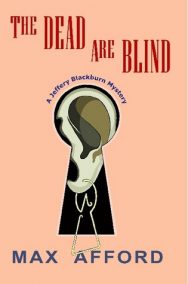 I believe the philosopher John Francis Bongiovi, Jr. said it best: “Keep the faith”. The Dead Are Blind is the third novel by Max Afford I’ve read and, having hugely enjoyed the other two, I found myself struggling to maintain interest through the opening chapters. Certainly from a historical perspective they have plenty to offer – our lead characters are invited to tour a radio studio on its opening night, something of a gala event at the time, and so this is chock-full of fascinating tidbits from Afford’s own experience of working in radio. But the mix of dense description and fixation on minute details that are hugely unlikely to become relevant later puzzled even my will and left me a bit apathetic by the end of chapter two.
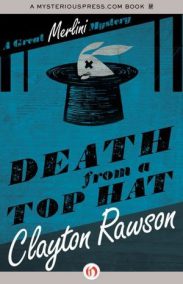 Well, where to start? Locked room murders (plural!), magicians, a hefty dose of self-reference, an extended John Dickson Carr homage-cum-lecture, a sprinkling of magical and mystical esoterica, and some really quite awesomely clever solutions…to be honest this — Rawson’s first novel to feature magician detective The Great Merlini and his Watson, journalist Ross Harte — should be a shoo-in for my favourite book of all time. Something about the conflation of conjuring and seemingly-impossible crimes just gets me all a-giggle with excitement, and Rawson wrote one of my favourite impossible crime short stories of all time (‘Off the Face of the Earth’, since you asked) so has previous with me, but this just comes up a little short to call it the masterpiece it probably should be.
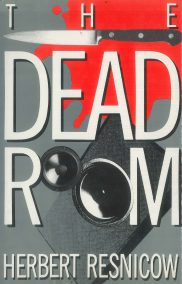 When the unpopular patriarch of a family is found stabbed to death in his locked study, it’s clear that one of the six family members gathered at the ancestral pile must be the murderer (the servants, of course, are excluded immediately). It’s up to our plucky amateur detective team to work out how he was killed and beat the police to the killer before it’s too late while also beginning to realise how they really feel about each other… So far, so Golden Age. Now substitute the following nouns: patriarch/inventor, family/hi-fi company, study/anechoic chamber (sound-testing room, if you will), family members/company executives, ancestral pile/company studio, and servants/technicians. What you have now is the plot of Herbert Resnicow’s The Dead Room. It’s that simple a switch – but for the trappings of its location, this could not be more of a Golden Age detective story, and the entire enterprise is undertaken in the same spirit as those classics. Continue reading
  There are times when it’s possible to pinpoint the exact moment when a novel doesn’t fulfil its promise, and given the intricacy of many novels of detection these can sometimes be very keenly felt. Perhaps the detective is an absolute duffer (an accusation frequently levelled at Freeman Wills Croft’s Inspector French), or the guilty party comes disappointingly out of nowhere (as in John Dickson Carr’s The Blind Barber), or perhaps the solution offered up to a brilliant problem is a shade on the simplistic side (the disappearance from the locked bathroom in John Sladek’s otherwise-superb Black Aura springs to mind). For this second novel by husband and wife team Kelley Roos, I’d say the main problem is in the selection of the victim: the setup is excellent, the characters are a delight, and come the murder…the most obvious victim is selected and the book never quite recovers.
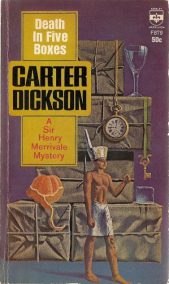 Four people are discovered sitting around a table as if at a dinner party, each with only a glass in front of them. Three of the four have been poisoned into a catatonic state and the fourth has been murdered by being run through with a narrow blade. Of the three who remain alive, one has two bottles of poison in their bag, one has the workings of an alarm clock in their pocket, and the third is carrying four pocket watches in various pockets about their person. At this point you are three chapters into the eighth Sir Henry Merrivale novel written by John Dickson Carr under his Carter Dickson byline and we haven’t even touched upon the revelation that greets you at the end of that chapter…suffice to say, boy are you in for a ride!
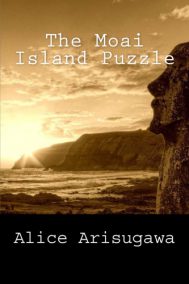 Children, incarnations of The Doctor, phases of the moon…generally I try not to play favourites. But if I had to pick one crime fiction conceit above all others it would undoubtedly be a group of people on an island getting killed off one by one. Sure, isolate them in some ancestral mansion via thunderstorm or on a train via unexpected snow and the effect is arguably the same, but there’s something about the island in itself that renders the idea all the more thrilling to my senses. And so this Japanese island-set puzzle, the second collaboration between Locked Room International’s John Pugmire and translator and crime fiction blogger Ho-Ling Wong after last year’s excellent The Decagon House Murders, would be just what the doctor ordered if the medical profession ever thought of prescribing books for those of us with the thrill of fictional murder in our hearts.
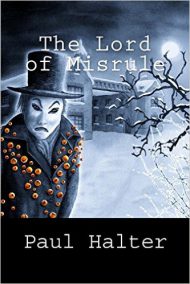 One dark and snowy night, a mysterious figure who is observed entering the home of an upright citizen commits a murder in an inaccessible room and vanishes without leaving so much as a footprint to tell of their presence, only for a second murder to then be committed outside in the snow but leaving only the victim’s footprints in evidence…you can’t tell me the similarities between Paul Halter’s The Lord of Misrule and John Dickson Carr’s The Hollow Man (a.k.a. The Three Coffins) are anything less than an absolute fanboying homage to the master. And Halter would know the risk he was running, but having established himself as an artisan of the impossible crime by this stage in his career (this was, by my estimation, his tenth published novel – though the first to be translated into English by John Pugmire) it was clearly a task he was happy to take on.
 The Invisible Event