Reviews
 Aaaah, the debut novels of celebrated authors. Would anyone read
 #147: What a Body! (1949) by Alan Green
 I dunno, I’m starting to think it’s me. For the second time in just over a month — the first being with T.H. White’s Darkness at Pemberley — I’ve read a novel famed for its impossible murder plot and come away going “Well, yeah, but that’s not really an impossible crime, though, is it.” The shooting of millionaire health guru Merlin Broadstone on the fourth floor of his hotel on his exclusive island health farm presents a couple of interesting points, but the fact that he was shot through an open window and that an obvious deduction is ignored for pretty much the entire duration of the case precludes any impossibility in my mind. One perplexing occurrence and the characters failing to consider a particular set of circumstances doesn’t make it an impossible crime. Maybe I’m too narrow-minded, but this doesn’t fly for me.
Continue reading
#144: The Corpse in the Waxworks, a.k.a. The Waxworks Murder (1932) by John Dickson Carr
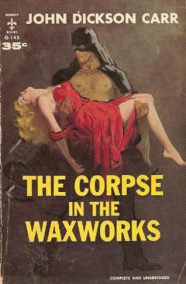 The penultimate case for John Dickson Carr’s first sleuth, Henri Bencolin, opens with a wonderful demonstration of the reputation which that juggernaut of justice enjoys among the less salubrious sections of French society: ‘Bencolin was not wearing his evening clothes, and so they knew that nobody was in danger.’ The palpable sense of relief this engenders in all who see him as he travels from tavern to tavern captures the character with a clarity that shows how much Carr grew as an author over his opening five books, and augurs well for the Fellian delights that would follow soon upon the heels of this as Carr hared his way up the detective fiction firmament and into history. And it sets the scene nicely for a deceptively complex little book that almost feels like a short story in its setup, but is wrought into something more by the expert pacing Carr has honed in the couple of short years since It Walks By Night (1930), showing here his emerging talent for taking a situation that many others would struggle to fill 20 pages with and making every nuance and moment of its 188 pages count.
Continue reading
#140: Death of Jezebel (1948) by Christianna Brand
 Apologies for my recent blogging absence; a combination of what I understand are referred to as ‘IRL’ circumstances and the fact that everything I picked up and tried to read was absolute dreck put something of a kibosh on things. The sensible thing seemed to be just to write off September and move on. So now I’m back with the oft-cited classic — and so inevitably hard-to-find outside of the USA, where the lovely Mysterious Press have published it — locked room mystery Death of Jezebel by Christianna Brand. Why this one? Well, it’s supposed to be awesome and I’m trying to get into Brand, having been thoroughly meh’d by Green for Danger (1944) and slightly more taken with Suddenly at His Residence (a.k.a. The Crooked Wreath) (1946). So, how did I fare?
Continue reading
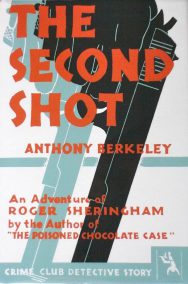
#138: The Second Shot (1930) by Anthony Berkeley
 Before Anthony Berkeley’s recurring sleuth Roger Sheringham appears at just past the halfway point of The Second Shot, we are told by narrator Cyril ‘Pinkie’ Pinkerton that we possess all the necessary information to work out who shot bounder and all-round bad apple Eric Scott-Davis. I have two problems with this: firstly it is not true, as there is sundry information revealed in the epilogue that we had no possible way of knowing, and secondly it renders the entirety of Sheringham’s investigation invalid for you, the reader, as you know there’s nothing new to be uncovered. It’s an odd decision for an author who strove hard to redefine the limits of the ‘mere’ puzzle novel, but then Berkeley has always been rather erratic in his output to my tastes.
Continue reading
#136: Darkness at Pemberley (1932) by T.H. White
 I’d like to get a fundamental contention out of the way: T.H. White’s sole detective novel Darkness at Pemberley came to my attention for the locked room murder that opens it, but I don’t feel it qualifies an impossible crime (the room can be unlocked at will, for one…). Had White made a couple of different narrative choices — not even in the scheme itself, purely in the structure of how he presents the problem — then it could be an ‘impossible alibi’ problem. But he doesn’t. You’re told the guilty party before they’ve had a chance to really fall under suspicion or even mention the alibi they’ve given themself, and so you have a well-that-would-have-been-impossible-if-they’d-been-given-a-chance-to-deny-it crime. Which I’m pretty sure is a new sub-sub-genre, though perhaps not one that we’ll get many further books in…
Continue reading
#134: A Puzzle for Fools (1936) by Patrick Quentin
 You’re writing a detective novel during the most productive and creative period that the genre has ever gone through, so pay attention — the tropes aren’t tropes yet, they’re still ingredients, and the standard mix requires the following: a murder or two, an amateur detective, a closed circle of suspects, an imminent sense of threat for our hero to fret over and be dismissed by the professional police, a love interest who must fall under suspicion before our hero realises she just might be his soul-mate…any questions? Okay, off you go. Keep the dunnage to a minimum, avoid long-winded and namby-pamby descriptions — this is entertainment, remember — and for pity’s sake keep it light.
Continue reading
#127: ‘The Third Bullet’ and Other Stories [ss] (1954) by John Dickson Carr
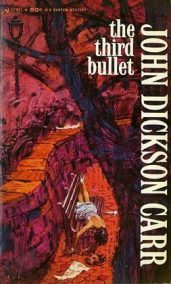 I haven’t reviewed (or read, come to that) a short story collection for a while, and it’s 1954 this month for Crimes of the Century at Past Offences meaning the time is ripe for a long-overdue (har-har) return to John Dickson Carr. I had read a couple of the stories contained herein before, but the majority were new to me, and as ever it’s a delight to see Carr’s imagination wrangle with the shorter form. Given how frequently stories of this ilk fail to conceal their workings and/or killer, it’s also great to see him do both over and over again with consummate ease, as if saying to his contemporaries “C’mon, guys, it’s simple –just do this“. We’ll take them one at a time as is my usual approach with collections — and, yes, most of these were originally published before 1954 and so might be inadmissible. Let’s just get on with it and an independent official enquiry can determine the eligibility of this at a later point.
Continue reading
#124: Invisible Green (1977) by John Sladek
 John Sladek is better known these days as a furiously inventive author of decidedly loopy SF — and I mean that as a compliment — but he did publish two detectives novels in the 1970s that each contained several impossibilities. The first, Black Aura (1974), has two disappearances and a man flying outside a third-storey window (without anything so amateur as wires holding him up, you cynic), and two-thirds of these are explained away superbly — the second disappearance in particular. It is a very good book, if perhaps a little slow in places, and boded well for the next time Sladek opted to dip his toe in our waters. Invisible Green, then, is very much the realisation of this potential, being superior in every single respect, and therefore something of a bittersweet read as we know now that nothing else followed it in the realm of the unachievable provably done.
Continue reading
#123: Not With a Bang by Matt Ingwalson

 The Invisible Event