-
Subscribe
Subscribed
Already have a WordPress.com account? Log in now.
 Writing a decent novel of detection is difficult enough, as evinced by the fact that the form virtually died out by the 1960s, so taking the classic detective story and turning into a pastiche of itself is even harder again — it has to be both a story of crime and detection and a cunning vehicle for transcending the tropes thereof while simultaneously wallowing in them. Leo Bruce did this near-perfectly in Case for Three Detectives (1936) and a great many luminaries of the form dipped their toe into such conceits with aspects of their books, plots, or characterisation, but for a full-length novel to take this on successfully is something of a challenge that it would be beyond the abilities of most mortals.
 Benjamin Disraeli had it right when he said “there are three kinds of lies: lies, damn lies, and publishers’ breathless comparisons to the classics”. I’ve been bitten once by this recently, so was doubly shy of the promise on the reverse of Warren B. Murphy’s sole detective novel to feature Dr. David Vincent Leonardo that it would introduce “a splendid new addition to the ranks of Holmes, Poirot, [and] Dupin”. To be upfront about it, obviously that’s not the case, but despite some flaws in the rendering of our genius amateur — of which more later — this is honestly a lot of fun, and joins the ranks of Hmmmm, What If They’d Written More of These? because, yeah, it lacks in artistry, but if you want a swift, reasonably smart, and engaging unheralded locked room puzzle you could do a damn sight worse.
 Well, this seems an odd choice of book to review the day after John Dickson Carr’s 110th birthday, right? The sensible thing would be to pick one of his novels, in keeping with the occasional Carr-related theme of my posts of late, right? Aha! Well, good job, then, because this is Carr-related: in 1946 Carr selected what he felt to be the 10 best detective novels published to date (writing an essay entitled ‘The Grandest Game in the World’ that, I believe, was intended to be published as an introduction to a run of reprints of the books…which never materialised due to copyright issues) and this was one of them. I really did not like the first MacDonald book I read (X v. Rex) and was warned in advance by both TomCat and Noah that this isn’t a particularly good book…so that all boded well, hey?
 Given the number of people who applied themselves to the challenge of writing a novel of detection during the Golden Age (precise dates pending…), it is to be expected that a fair number of wonderful novels, plots, ideas, and authors will have been lost in the tidal wave of creativity. Through the continued efforts of publishers like Ramble House — who were reprinting this stuff before it was cool again — we’ve been able to rediscover Max Afford, Norman Berrow, Rupert Penny, Hake Talbot, and others, and it’s this path of frank fabulousness that has brought me now to E.C.R. Lorac, author of some 70-odd novels under a couple of pseudonyms. Does she belong in the realm of How In The Hell Is This Stuff Overlooked? Well, on this evidence…maybe.
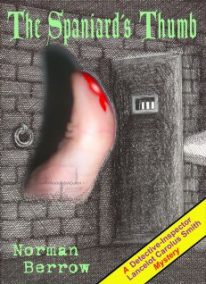 We should be thankful that Norman Berrow left behind him such wonderful novels as these that make it almost possible to get a glimpse into the workings of his mind. I mean, who else would predicate a novel on the grounds of a giant disembodied thumb vengefully crushing to death anyone who ventures into its lair? It’s a setup too barmy for John Dickson Carr’s fertile impossibilities, too outré for the straight-laced world of Agatha Christie, Miles Burton, Christianna Brand, and their ilk, and doesn’t have enough train journeys for Freeman Wills Crofts. It’s too comedic and explicit for the standard horror get-up of M.R. James or those who followed him…honestly, had Berrow not written this there’s really no-one else who could have.
 As a parody of the detective novel, the maverick cop genre, and the low Fantasy genre, Simon R. Green’s Hawk & Fisher takes quite some beating — it is an honestly hilarious take on the tropes of three. I don’t think I’ve laughed so much since reading…well, possibly anything; almost every page contains some wonderful joke or savage undercutting of the false sincerity of the situations encountered, not unlike William Goldman’s timeless The Princess Bride. For instance, Hawk is supposedly an expert in hand-to-hand combat with an axe, but he has only one functioning eye and therefore must lack any depth perception; it’s an absolutely genius piece of subversion, and such examples are rife. The only problem is that I have a sneaking suspicion — only a sneaking one, mind — that this book is in fact supposed to be taken seriously. Very Seriously Indeed.
 Since Soji Shimada’s The Tokyo Zodiac Murders was republished by Pushkin Vertigo, I’ve found myself reading increasing amounts of Japanese detective fiction: the shin honkaku of The Decagon House Murders by Yukito Ayatsuji and The Moai Island Puzzle by Alice Arisugawa from Locked Room International, The Salvation of a Saint by Keigo Higashino (yes, The Devotion of Suspect X will follow in due course…), and I’ve recently started Gosho Aoyama’s Case Closed (a.k.a. Detective Conan) manga. And authors such as Seicho Matsumoto and Kyotaro Nishimura are climbing ever-higher up by TBB list as I encounter more of the high-quality work that has been translated for our pleasure. And, of course, the proliferation of impossible crimes in these stories doesn’t hurt, with the added cross-cultural glimpses also offered simply making them an even more attractive proposition.
 Sometimes it can be difficult to know where to start. C. Daly King’s third detective novel Obelists Fly High is such a time in my life. Is it good? No. Is it terrible? Yeah, it probably is. Now I have to explain that, and give examples from the text to back up my opinions, and it should all just fall into place. But it’s not simply a case of hurling invective at King and his attempts, because in some regards this is very clever — well, no, there’s one development, at the start of the fourth…section (they’re not really chapters) which borders on the very canny indeed. At the same time, I really did not enjoy reading this; it is hideously overlong, here’s a competent short novella in here at best, but explaining why is going to be like nailing jam to the ceiling. Ah, well, here goes…
 The Invisible Event