Reviews
#257: You’ll Die Laughing (1945) by Bruce Elliott
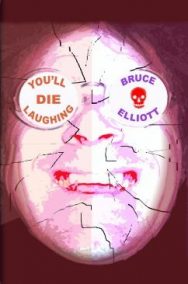 Stage magic and Golden Age detection go hand-in-hand: we go in knowing we’re being fooled in both cases, but there’s little more enjoyable than seeing it done well. Clayton Rawson and Hake Talbot were professional-level magicians who turned their minds to the dark arts of fictional (as far as we know…) murder and crafted some wonderful stories in doing so, and the name Bruce Elliott can also be added to the magician/detection-writer set with this country house mystery that benefits from his magical background by stirring in an impossible crime. This is yet another book that’s foisted an unexpected impossibility upon me, and while it’s not exactly perfect, it’s still a bloody good read.
Continue reading
#256: Catastrophic Protagonist Failure in Too Many Ghosts (1959) and The Hand of Mary Constable (1964) by Paul Gallico

A little while ago, while secondhand bookshop haunting as is my wont, I stumbled upon a copy of Paul Gallico’s The Hand of Mary Constable (1964) — a book I have recommended here before for the brilliant way it shows up the tricks of the séance through a combination of perspicuous writing and trusting its readers’ intelligence. My copy was a rat-eared, much-abused paperback and this was a lovely hardcover for a very reasonable price…and yet I vacillated for some time (like, a few weeks) before buying it.
Continue reading
#255: Abridged Too Far? Comparing Texts of The Unicorn Murders (1935) by Carter Dickson
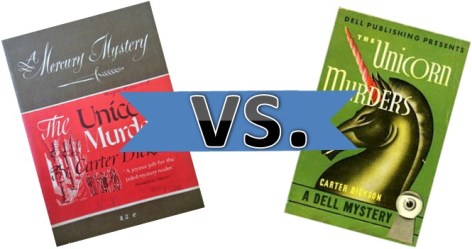
Among my at-times multiple versions of various John Dickson Carr titles, I have four Mercury Mystery editions like the one shown on the left above — The Plague Court Murders (1934), The Red Widow Murders (1935), The Unicorn Murders (1935), and The Department of Queer Complaints (1940) — which are of additional interest to me since the novels are all abridgements. So, having just read the unedited text of The Unicorn Murders, I thought it might be interesting to see what was excised from this abridged version.
Continue reading
#254: The Unicorn Murders (1935) by Carter Dickson
 When a man is found dead, stabbed between the eyes by a unicorn (of indeterminate nationality) — a, yes, fictional animal that can nevertheless apparently turn invisible at will — you don’t expect to find yourself in the GADU. And when a second victim is then killed in the same way but in full view of witnesses, if one can witness an invisible animal, you better hope you’re in the GADU or else things are about to get silly. Well, it’s your lucky day, because you are in a classic impossible crime mystery and things are about to get silly — this book is probably the final time John Dickson Carr had all the ingredients for a classic and didn’t actually write it, instead leaving a few edges untouched so that the overriding impression is slightly more “Er…what?” than “Hell, yeah!”.
Continue reading
#253: Beauty and the Beast – The Sublime and the Ridiculous in Devil’s Planet (1951) by Manly Wade Wellman

Like a latter-day Edgar Rice Burroughs, Manly Wade Wellman’s Earthman-out-of-his-element story casts the protagonist as a near-superhuman saviour who is hated by the powerful, championed by the underdog, and treated to sweet, sweet lovin’ by an appreciative female who’s clearly never experienced this sort of hunkiness before. Think Jack Reacher of Mars for best (?) results.
Continue reading
#251: Death in the Tunnel (1936) by Miles Burton
 While we can be thankful for real-life developments in forensic science that enable the speedier detection of criminals, there can be little argument that it was the death-knell of good detective fiction. Dull Inspector Arnold and his genius amateur sidekick Desmond Merrion spend so much time combing through the minutiae of the physical and mental aspect of the crime in Death in the Tunnel, and come up with such entertaining possibilities while doing so, that a crime scene tech in one of those all-over white body suits could never be a fifth as much fun. It makes me all the more appreciative of this kind of classic approach, knowing that this sort of book has seen its heyday pass.
Continue reading
#248: The Secret Dancer (1936) by Norman Berrow
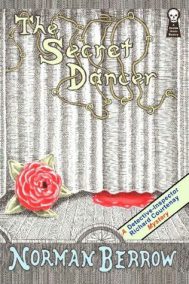 In a week that saw me start and quit three books in a row, it was a relief to open Norman Berrow’s third novel and be put immediately at ease by his nimble capturing of the pre-show backstage goings-on at the latest, most fashionable theatre in London. From the music described as “…a shamelessly stolen conglomeration of Mexican airs, assembled in Tin-Pan Alley, shipped to Europe, and played with astonishing variations” to the beautiful summation of leading lady Lili La Paz as “a miracle to watch; and hell to live with”, it’s the sort of opening salvo that reminds me why I return time and again to Berrow and his slightly disappointing impossibilities (the man does love a secret passage): simply put, he writes glorious prose.
Continue reading
#247: The Sister Ursula Stories of Anthony Boucher (1943-45)
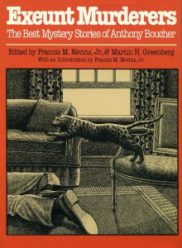
Having worked my way through Anthony Boucher’s short stories featuring the alcoholic yet still razor-sharp ex-cop Nick Noble, I’m now onto the second section of his collected short stories, comprising those featuring crime-solving nun Sister Mary Ursula of the Order of Martha of Bethany from Boucher’s locked room novels Nine Times Nine (1940) and Rocket to the Morgue (1942).
Continue reading
#246: On Failing to Engage with the Imperial Sherlock Holmes – The Chinese Maze Murders (1951) by Robert van Gulik

 The Invisible Event