Reviews
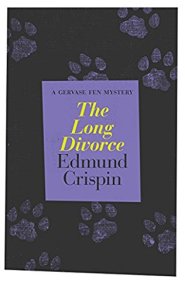 Never let it be said that I’m a stubborn man. Well, okay, no, not that so much, but only a short while ago I was owning up to the shame that
 #301: The Realm of the Impossible [ss] (2017) eds. John Pugmire and Brian Skupin – Week 3
The world tour that is Locked Room International’s newest impossible crime story collection continues, with me picking out stories by their approximate geographical groupings to explore the themes they raise. Elsewhere we have:
Continue reading
#300: The Lucky Policeman (1938) by Rupert Penny
 A man prone to bouts of lunacy escapes in unusual circumstances from the private sanatorium where he is a resident, and shortly thereafter a series of murders are committed, the left shoe removed from each victim…well, you join the dots. And yet, can it really be that simple? Ordinary GAD rules say no, but this is Rupert Penny, puzzle-maker par excellence, and thus such easy prehension could be both a feint and the actual intended explanation. So Scotland Yard’s Chief-Inspector Edward Beale is dispatched and brings amateur hanger-on Tony Purdon and Sergeant ‘Horsey’ Matthews with him, a crime-solving triumvirate likely to have even Inspector Joseph French quailing jealously at their ability to unpick complex schemes.
Continue reading
#299: The Realm of the Impossible [ss] (2017) eds. John Pugmire and Brian Skupin – Week 2
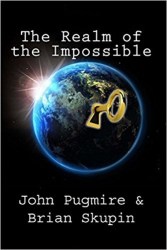
And so we return to the multi-national short story impossibility-fest that is The Realm of the Impossible from Locked Room International. Once again, I’m taking a different selection of stories each week by approximate geographical grouping and comparing and contrasting the themes and approaches.
Continue reading
#297: Murder in the Museum (1938) by John Rowland
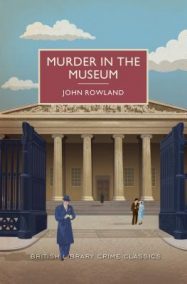 It is understandable that we, as readers, hope for everything we read to be good. However, it is also unlikely that this will be the case, and so sometimes we have to make do with what a book actually offers us. It may not be good, so is it interesting? Does it tell us something new about the era in which it is set or was written? Failing that, is it at least enjoyable? Murder in the Museum (1938), the first of two John Rowland books published as part of the British Library Crime Classics series, is not especially good, but it is a lot of fun. And I’ll take fun. Fun is underrated. I could broadside this for its many flaws and failings, but the truth is I ripped through it, didn’t take it too seriously, and had a great time.
Continue reading
#296: The Realm of the Impossible [ss] (2017) eds. John Pugmire and Brian Skupin – Week 1
As discussed previously, Tuesdays here on The Invisible Event will now pursue a particular theme each month, and throughout October I shall be looking at the new, multi-national short story collection The Realm of the Impossible (2017) from Locked Room International.
Continue reading
#294: The Arabian Nights Murder (1936) by John Dickson Carr
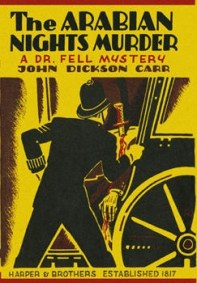 In the orchestra of John Dickson Carr’s detective fiction, his early years from It Walks by Night (1930) up to arguably The Arabian Nights Murder (1936) are very much the accordion section. Events occur in concentrated bursts, with clues and characters squeezed together to make the notes of the plot emerge, only to then be drawn apart before inexorably squeezing together again for another dense exposit you must pore over in order to follow the necessary developments. From The Punch and Judy Murders (1936) until the 1940s he wrote in the fine, clean, overlapping lines of the harp, and then the violins took over… but enough of this analogy, back to this book and the wheeze of a bellows working overtime.
Continue reading
#293: On Narrowness in Impossible Crimes, via ‘Locked In’ (1939) by E. Charles Vivian

I recently read, with no large amount of pleasure, Evidence in Blue (1938) by E. Charles Vivian. However, I’m not a man to write someone off after one bad book. So the presence of a locked room story by Vivian in the Martin Edwards-edited collection of such impossibilities Miraculous Mysteries (2017) from the British Library Crime Classics series was a chance to give him another go.
Continue reading
#291: Evidence in Blue (1938) by E. Charles Vivian
 Finding new authors to read is a curious mix of recommendations and speculation. I started reading Rupert Penny because he appeared on this list, but then the joy of Max Afford and Norman Berrow followed purely because they were reprinted by the same publisher, Fender Tucker’s Ramble House. Such an approach has typically gone well, and while the care of my choosing could be a factor here, I prefer to think that it’s because RH generally publish very good — and if not very good then at least interesting — books. Thus, picking up this book by Vivian at the end of last year was pure “Well, it’s a Ramble House reprint” speculation, and a simple hope to continue my generally good run from them.
Continue reading
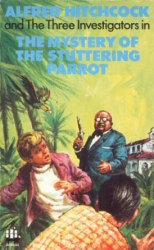
#289: The Literary Allusion That Wasn’t – Use of the Flying, Dying Message in The Mystery of the Stuttering Parrot (1964) by Robert Arthur
 The Invisible Event