Reviews
#596: The Dartmouth Murders (1929) by Clifford Orr


The name Clifford Orr first came to my attention on account of the Roland Lacourbe-curated ‘100 Books for a Locked Room Library’ list featuring Orr’s second and final novel, The Wailing Rock Murders (1932). So when that title cropped up in this twofer of Orr’s complete output, I snapped it up and just had to wait for sufficient snow to clear from the peak of Mount TBR. And, as it happens, I’m posting this review of his debut novel The Dartmouth Murders (1929) a mere two days after what would have been Orr’s 120th birthday — entirely by accident, as anyone who has met me in real life will be able to attest. Such organisation is not one of my strong points.
Continue reading
#594: The Punch and Judy Murders – A Case of Identity in Charade (1963) [Scr. Peter Stone; Dir. Stanley Donen]
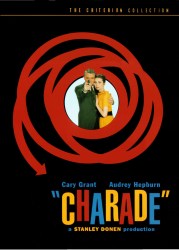
Approximately two months ago, Kate at CrossExaminingCrime invited a bunch of bloggers to contribute to a collaborative post on our favourite mystery movies. You can view the results here — without my contribution, because, despite being given plenty of warning, I couldn’t organise myself in time.
Continue reading
#593: Home Sweet Homicide (1944) by Craig Rice
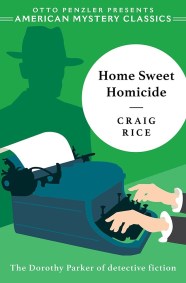
As a rule, I start getting a bit nervous if it takes me more than three days to finish a book. I read Home Sweet Homicide (1944), the first of Georgiana Ann Randolph Craig’s novels I’ve ever attempted, over one week and one day and, quite honestly, would have happily kept reading it for another month or two. I’ve never gotten a sense of her as an author from her short stories — largely, I’d imagine, because of the need to cram in character and plot in less space — and, if I’m honest, didn’t relish the screwball antics her reputation seemed to promise. Well, no fear. This isn’t screwball, it’s not especially tightly plotted, and it’s possibly the best book I’ve read in a long ol’ time.
Continue reading
#590: Mystery at Olympia, a.k.a. Murder at the Motor Show (1935) by John Rhode
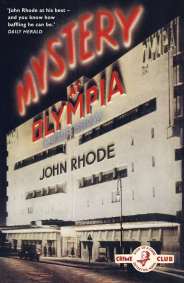
While Freeman Wills Crofts’ work has caused me much delight over the last few years, that of his fellow ‘Humdrum’ John Rhode/Miles Burton doesn’t inspire in me quite the same raptures. Rhode (as I’ll call him here) writes swift, events-focussed novels, and constructs plots with the same deliberation and consideration from multiple sides…so maybe it’s that his plots always feel like a single idea with some people bolted onto it. Here as in Death Leaves No Card (1944) or Invisible Weapons (1938) I come away with the impression that he read about a single obscure murder method and thought “Yeah, I can get 60,000 words out of that”.
Continue reading
#587: As If by Magic (2009) by Dolores Gordon-Smith
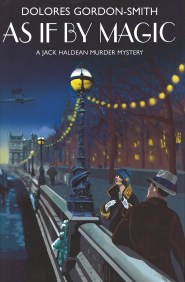
Disorientated, drenched, and on the verge of a fever, George Lassiter wanders the streets of London until attracted to a particular house which he breaks into in order to warm himself by the fire. While he is waiting in the darkness and warmth, three people enter, one of them apparently drops dead on the spot, and Lassiter beats a hasty retreat before being caught by a local bobby. Upon telling his story, the house is investigated and no sign of a body is found, so Lassiter is carted away to the local hospital. And when Lassiter’s friend, part-time sleuth and general man-about-town Jack Haldean, hears of his predicament, it’s the beginning of a complex and dangerous skein.
Continue reading
#586: Minor Felonies – Encyclopedia Brown Strikes Again, a.k.a. The Case of the Secret Pitch [ss] (1965) by Donald J. Sobol
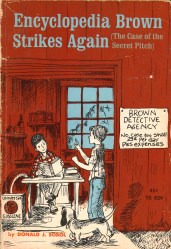
Since starting this blog, I have made the acquaintance of The Three Investigators, the Five Find-Outers, and several other juvenile sleuths, the majority of who have been an absolute delight to encounter; today, I add Leroy ‘Encyclopedia’ Brown to that list.
Continue reading
#585: Brother Mine, That Entertain’d Ambition – Mycroft and Sherlock: The Empty Birdcage (2019) by Kareem Abdul-Jabbar and Anna Waterhouse
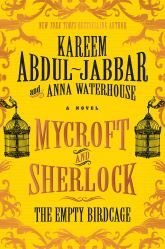
It was with tremendous excitement that I greeted the news of a third Mycroft Holmes novel from Kareem Adbul-Jabbar and Anna Waterhouse, as the continuation of this series brings joy to my old and weary heart.
Continue reading
#584: Inspector French and the Starvel Hollow Tragedy (1927) by Freeman Wills Crofts
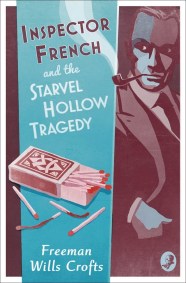
As his seventh published novel, Inspector French and the Starvel Hollow Tragedy (1927) shows Freeman Wills Crofts again subtly altering his approach to take us through the minutiae of crime and detection, introducing a structural change which addresses the issue of “whodunnit” that these early GAD trendsetters sometimes struggled with. While you may well be aware of the guilty party from about chapter 4, rest assured that Inspector Joseph French eventually cottons onto his target at around the halfway stage, and the final third of the book is then devoted to tracing the criminal. And a lot of fun is to be had along the way.
Continue reading
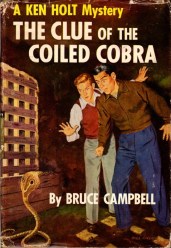
#583: Minor Felonies – The Clue of the Coiled Cobra (1951) by Bruce Campbell
 The Invisible Event