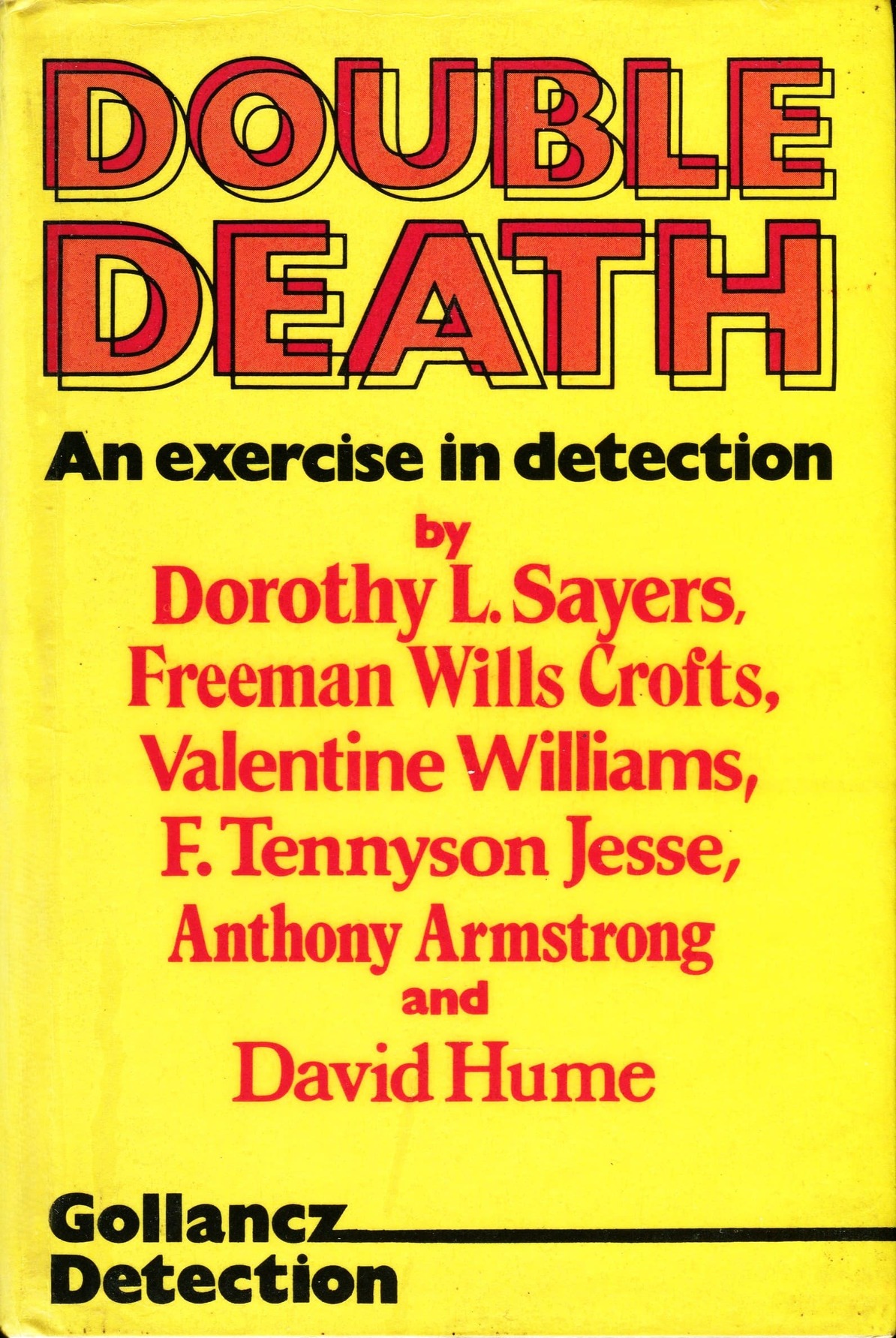
Look, it took me a long time to appreciate the intelligence of the inverted mystery, in which we know who committed the crime and have to watch both them struggle over it and their eventual discoverer working out the threads of the case. But the important thing is that I got there in the end.
Continue readingFreeman Wills Crofts
#1374: The Affair at Little Wokeham, a.k.a. Double Tragedy (1943) by Freeman Wills Crofts
![]()
![]()
![]()
![]()
![]()
The Affair at Little Wokeham, a.k.a. Double Tragedy (1943), was the last of Freeman Wills Crofts’s books to be recently reprinted by Harper Collins in these lovely paperback editions. Fear not, I have acquired the rest of Crofts’s oeuvre — though if you have an unread House of Stratus edition of Death of a Train (1946), do get in touch — and shall indeed complete the Full Crofts here on The Invisible Event, but let’s spare a thought for what might have been: when the Inspector French TV show seemed a likely prospect, we could have had all of Crofts’s novels for grown-ups in bookshops in the 21st century. Alas, Utopia must remain a dream.
#1357: What Liberty a Loosened Spirit Brings! – My Ten Favourite Juvenile Mysteries
While I wasn’t entirely sure what the focus of this blog would be when I started it — I knew there would be impossible crimes, but had no idea otherwise — I’d have been surprised if you told me I’d end up doing so much reading of and writing about mysteries for 9 to 12 year-olds.
Continue reading#1328: The Tenniversary – Ten Books That (Unwittingly) Shaped This Blog
On 18th August 2025, The Invisible Event will have been running for ten years. And while I’m not a big one for introspection — I read books, I write about those books, some people read what I’ve written, rinse, repeat — a decade feels like a notable achievement and so some introspection is going to be had, for today at least.
Continue reading#1318: “That’s the worst of these detective stories; every criminal knows that trick.” – The Long Arm of the Law [ss] (2017) ed. Martin Edwards
An earlier British Library Crime Classics short story collection today, with The Long Arm of the Law [ss] (2017) featuring 15 stories of professional police selected by the hugely knowledgeable Martin Edwards.
Continue reading#1311: Fear Comes to Chalfont (1942) by Freeman Wills Crofts
![]()
![]()
![]()
![]()
![]()
Your typical Freeman Wills Crofts protagonist — fallen on hard times, usually following the death of a loved one — young widow Julia Langley enters into a marriage of convenience with solicitor Richard Elton. He will provide for her daughter Mollie, and she will run his house, Chalfont, as hostess for social events that singularly fail to win his unprepossessing personality the acceptance he so craves. And so, Julia falls in love with wealthy novelist Frank Cox, throwing a wrench into the works of her agreeable if not desirable arrangement, and before long someone in the Elton ménage is found murdered and the various secrets in the household start to creep out.
#1309: Murderers Make Mistakes – Sudden Death Aplenty in Six Against the Yard [ss] (1936)
Today is the tenth Bodies from the Library Conference, at which, until other considerations intervened, I was due to present on the topic of inverted mysteries. And you can bet I would at some point have talked about Six Against the Yard (1936), in which six crime writers put their ‘perfect murder’ on paper and ex-CID man Superintendent Cornish picked holes in their plans.
Continue reading#1260: A Losing Game, a.k.a. The Losing Game (1941) by Freeman Wills Crofts
![]()
![]()
![]()
![]()
![]()
People will tell you that I lack critical faculties when it comes to the work of Freeman Wills Crofts, and, well, they might have a point: I find his flavour of rigorous investigation and patient construction exactly to my liking, and will start anything by him in the most positive frame of mind. But, well, even my optimism was dented by A Losing Game, a.k.a. The Losing Game (1941), which feels, for perhaps the first time, like a man trying to fulfil a deadline — not least because it’s poorly-constructed and, and in a late attempt to swing suspicion elsewhere, requires the reader to ignore one of the key tenets of the crime under investigation. This is not the Freeman Wills Crofts I have come to know and love.
#1244: To Take a Backward Look – My Ten Favourite Mysteries of the 1930s
I picked my ten favourite crime and detective novels published in the 1930s a little while ago for my online book club, but I only do a Ten Favourite… list every four months or so and thus am only just getting round to writing it up now. I am so late to the party that it might as well never have happened, but I ironed a shirt specially so, dammit, I’m going to dance. Or something.
Continue reading#1217: James Tarrant, Adventurer, a.k.a. Circumstantial Evidence (1941) by Freeman Wills Crofts

![]()
![]()
![]()
![]()
![]()
Having previously had a new business undertaking result in murder in Fatal Venture (1939), and having dealt in business manipulation in The End of Andrew Harrison (1938), Freeman Wills Crofts once again mixes his earlier experiences to bring us something similar to before but deliberately different enough to matter with James Tarrant, Adventurer, a.k.a. Circumstantial Evidence (1941). And so we have our eponymous chemist setting out “adventuring himself on a flowing tide, and instead [finding] himself floating in circles in a backwater,” and coming up with a canny idea to ride on the tails of a successful patent medicine brand. What could possibly go wrong?