#1430: Adventures in Self-Publishing – An Odyssey to the Castle of Vampires (2023) by DWaM

It’s been a while since I read any of the often boundary-straddling works of DWaM, and with a couple of self-published books by other authors proving hard going, common sense finally prevailed and I turned to An Odyssey to the Castle of Vampires (2023) — an epic which has been patiently waiting its turn for nearly three years now.

Continue reading
#1426: Adventures in Self-Publishing – The Locked Rooms (2025) by Alex Wagner

In an age where the term “locked room mystery” increasingly seems to mean “closed circle mystery” — as in, one of the limited number of characters in the story committed the crime, as if you’d want there to be an alternative — how refreshing to come across someone in Alex Wagner who actually demonstrates an awareness of what an impossible crime is.

Continue reading

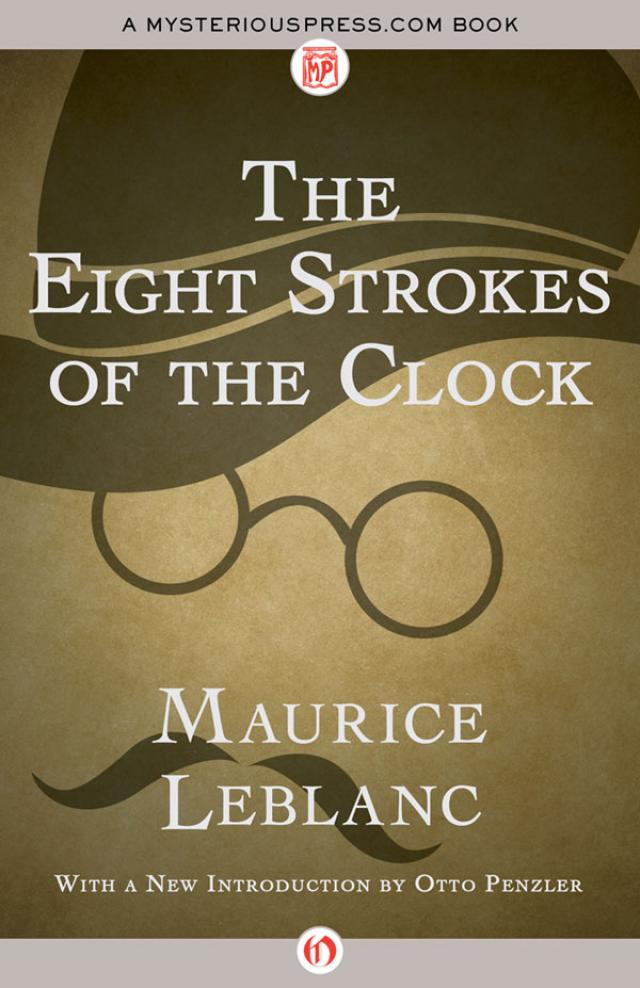
#1425: “The only pleasure that never flags is that of the fight itself.” – The Eight Strokes of the Clock [ss] (1922) by Maurice Leblanc [trans. Alexander Teixeira de Mattos 1922]

I recently acquired a boxset of 8 Maurice Leblanc novels and short story collections featuring his gentleman bastard Arsène Lupin, and so before I dig into those I thought I should revisit the first Leblanc book I read, the Haycraft-Queen Cornerstone collection The Eight Strokes of the Clock [ss] (1922).

Continue reading

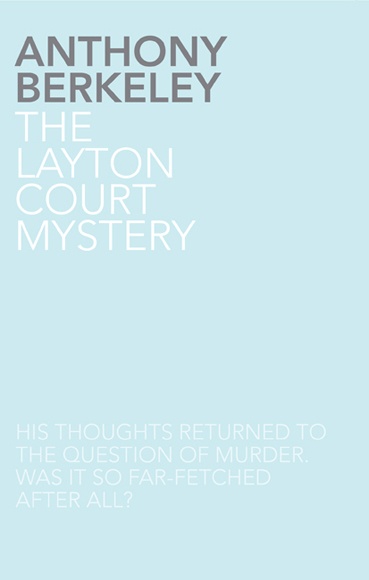
#1415: The Layton Court Mystery (1925) by Anthony Berkeley [a.p.a. by “?”]


Well, I am thoroughly enjoying revisiting the work of Anthony Berkeley, with Not to be Taken (1938) proving decidedly more fun at second assessment, and now his debut The Layton Court Mystery (1925) upgrading itself from ‘amusing but seriously flawed’ to ‘Holy hell, this is superb!’ after a reread. Indeed, I enjoyed this so much that I’m deliberately reviewing it on a Thursday so that I don’t go over my self-imposed 1,000 word limit, because I feel like I could talk about this book for weeks, and frankly no-one needs that. So, a gathering at a country pile, complete with one host found shot in the locked library…hit me with the classics.

Continue reading

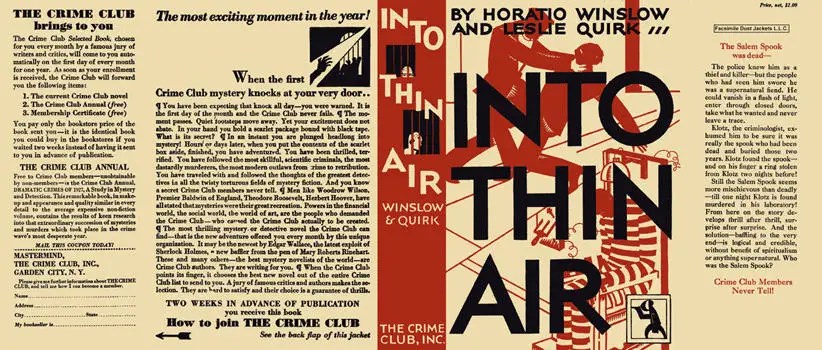
#1413: “You make me feel that the writing of a detective story is very complicated.” – Into Thin Air (1928) by Horatio Winslow and Leslie Quirk

Image from Facsimile Dust Jackets

The Roland Lacourbe-curated list of 100 impossible crime novels has held quite a sway in my reading life. Hell, I got one of the titles on it reprinted purely so I could read it myself. Until John Pugmire’s death, Locked Room International did a stalwart job bringing many of the foreign-language titles into English…but still some books on the list seemed frustratingly out of reach, no more so than Into Thin Air (1928) by Horatio Winslow and Leslie Quirk.

Continue reading

#1406: Black Aura (1974) by John Sladek


I hold John Sladek’s second and final detective novel Invisible Green (1977) in very high regard indeed, but have not read his first, the slightly less successful Black Aura (1974), for well over a decade. It’s pretty incredible that something which gave so much air to three baffling impossibilities was written as late as 1974 at all, and so revisiting it and finding a book which doesn’t quite fulfil the expectations of any idiom — it’s too puzzle-focussed for the gritty style that was popular at the time, but too nebulously handled to satisfy true puzzle heads — isn’t really a surprise. There’s still some enjoyable stuff in here, but this is very much the apprentice work for the masterpiece Sladek would produce three years later.

Continue reading

#1403: Too Many Magicians (1967) by Randall Garrett


When The Invisible Event hit 1,000 posts — ahh, back in the day — I put up a list of 100 recommended impossible crime novels and short story collections for those of you wishing to be a little more discerning when reading the best subgenre in the world. TomCat was disgruntled with my inclusion of Too Many Magicians (1967) by Randall Garrett, but I stood by it as an interesting take on both the crossover mystery and the impossible crime, with a neat little, expectation-subverting idea at is core, and I vowed to reread it in due course to reinforce these impressions. Well, I’ve reread it now, and while I stand by the locked room murder as clever and fun, the book itself is frankly so tedious that I wonder how I ever saw anything in it in the first place.

Continue reading