#287: The Equivocation of the Fiend That Lies Like Truth – Colloquialisms, Idioms, and Fair Play

i664659-7534154845834888203

I’ve spoken a lot about fair play in detective fiction.  I defined it, I defended it (twice, in fact), we voted for the books that best exemplify it, and here we are again.  See, the idea of presentation and declaration (which, yes, I’ve also spoken about before) occurred to me in a new way, and this blog operates on a sort of “Hey, I wonder what people would think about this thing I just thought of?” principle — so here we go…

Continue reading

#286: A Conscious Regiment of Women? – The Queens of Crime™, Representation, and the Golden Age

QoC

It is tremendously difficult to write about gender these days without appearing to be trying to sneak through some (usually unpleasant) agenda.  If anything in the following causes any reader jump to such a conclusion about my intentions, I urge that hypothetical reader to take a glance through any selection of posts on this site — all written by the author of what you’re reading now — to assure themselves that this in no way features in my plans.  I am simply, out of curiosity, asking a question that happens to involve gender.

And the question is this: Has Golden Age Detective fiction been subjected to a deliberate feminisation?  And, if so, to what end?

Continue reading

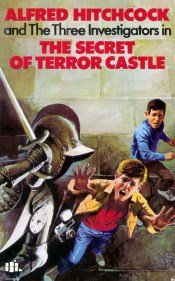
#277: The Temple of the Great Jupiter – The Three Investigators March in The Secret of Terror Castle (1964) by Robert Arthur
secret_of_terror_castle

My inability to walk past a secondhand bookshop without at least having a “quick glance inside” recently resulted in me purchasing a stack of the Alfred Hitchcock and the Three Investigators titles, books I was aware of but have not previously read.  So buying 22 of them in no way counts as a spontaneous over-commitment, oh no.  Anyway, The Secret of Terror Castle is the first of the series and here are some thoughts on it.

Continue reading

#269: The Road Not Taken – Thoughts on Minor Instances in the Thackeray Phin Short Stories of John Sladek

maps

Thanks to the beneficence of Dan at The Reader is Warned, I have been loaned a copy of Maps (2002), an anthology of short fiction and other reflections by John Sladek which were previously not anthologised elsewhere.  Sladek wrote two impossible crime novels — the excellent Black Aura (1974) and the exemplary Invisible Green (1977) — and Maps contains the two short-form tales to feature the same American dandy sleuth, Thackeray Phin.  Both could be discussed at length, but TomCat’s already done that very well indeed and I’m more interested in looking at small moments within them that don’t actually contribute to the plot.  I know, right, what am I like?

Continue reading

#266: ‘The Problem of the Emperor’s Mushrooms’ (1945) by James Yaffe – Five and a Half Alternative Solutions

I recently acquired one of the only 175 extant editions produced by Crippen and Landru of the short story ‘The Problem of the Emperor’s Mushrooms’ by James Yaffe, itself originally published in Ellery Queen’s Mystery Magazine in 1945.  And in the same manner of reflection upon Paul Halter’s ‘The Yellow Book’ (2017) from a few weeks ago, I thought I’d have another look at a short story…though this time to suggest possible alternative explanations for the impossible poisoning contained therein.

Continue reading

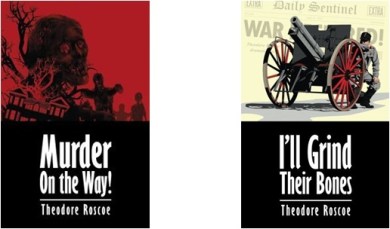
#261: Judging a Book – Rejected Cover Art for Murder on the Way! (1935) and I’ll Grind Their Bones (1936) by Theodore Roscoe

Roscoe Covers

As you may be aware, it was recently my most honoured pleasure to be involved with Bold Venture Press in the editing and republication of two novels by Theodore Roscoe.  It’s not something I had any experience of before — and, to be fair, Rich and Audrey were so good about so many aspects that I don’t really have any transferable experience now — but I thought I’d offer a glimpse behind the curtain today and share with you some suggested covers for both books that we didn’t end up using.

Continue reading

#259: ‘The Yellow Book’ (2017) by Paul Halter [trans. John Pugmire 2017] and Categorising No Footprints Murders

Of late, I have found myself surrounded by invisible men.  Entirely fictional, of course, but there have been a lot of them: shooting someone in an empty room in You’ll Die Laughing (1945) by Bruce Elliott, disappearing into darkness in I’ll Grind Their Bones (1936) by Theodore Roscoe, vanishing from rooms and beaches in Thursday’s forthcoming Wilders Walk Away (1948) by Herbert Brean, performing miracle appearances and disappearances as I reread Rim of the Pit (1944) by Hake Talbot…everywhere I look, people are vanishing.

Continue reading

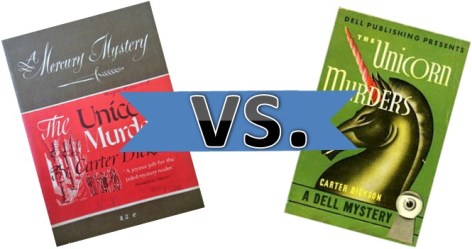
#255: Abridged Too Far? Comparing Texts of The Unicorn Murders (1935) by Carter Dickson

Unicorn Murders

Among my at-times multiple versions of various John Dickson Carr titles, I  have four Mercury Mystery editions like the one shown on the left above — The Plague Court Murders (1934), The Red Widow Murders (1935), The Unicorn Murders (1935), and The Department of Queer Complaints (1940) — which are of additional interest to me since the novels are all abridgements.  So, having just read the unedited text of The Unicorn Murders, I thought it might be interesting to see what was excised from this abridged version.

Continue reading

#252: Your Favourite Bad Solutions…

Bunny facepalm

In the comments of my post on reality and Golden Age Detective fiction from last Saturday, Harry shared his frustration with the solution to Murder on the Marsh (1930) by John Ferguson — it’s very spoilerific, be warned (though it also sounds terrible, so…) — and I in turn recounted a couple of awful solutions to locked room short stories in sympathy.  Because, let’s face it, we’ve all read some stinkers in our time, haven’t we?

Continue reading

#250: The Verdict of Us All 5: A Book You Love by An Author You Don’t…

Verdict of Us All

Last year, Kate at CrossExaminingCrime had the grand idea of putting the same question to several GAD bloggers and collecting their responses into one post under the title The Verdict of Us All.  This became a semi-occasional thing that a few different blogs hosted and, given a recent reading experience, I thought I’d mark my quarter-millennial by resurrecting it here to ask the following: Is there an author whose work you generally can’t stand but who has nevertheless written one book you absolutely love?

It turns out the answer is “yes” for some other people, too…

Continue reading