#122: Broken Bottles and Bloodspots: A guest post by Matt Ingwalson

Owl and Raccon #1 and #2

Author photo: Chris Sessions

The Owl and Raccoon novellas of Matt Ingwalson update the impossible crime to a modern setting and, as I have said previously, are hugely recommended reading for anyone with an interest in a good story convincingly told.  Ahead of the publication of the third story, Not With a Bang, I asked Matt if he would be willing to oblige us with an insight into his writing and he very kindly offered the following.

Continue reading

#121: On the Many Wonderful Faces of Dr. John H. Watson, MD – Part 2 of 2

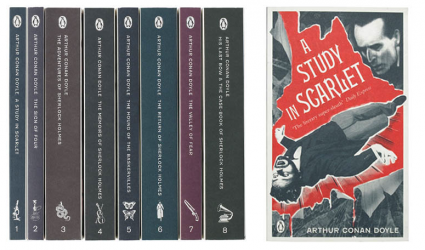
Sherlock Holmes collection covers

So, as established yesterday, there’s much more scope in Watson than there is in Holmes.  The obvious question then becomes: So what do you do with this?

Take the simple cosmetic changes out of the equation — the casting of Lucy Liu as Dr. Joan Watson in the US series Elementary, for instance, easily one of the least disruptive changes it’s possible to get away with — and what you’re left with is the fact that Watson, being our entry into the Holmesiverse, is allowed to do anything that reflects the experience and perspective of the reader.  As discussed yesterday, there are aspects of the character, the constants I referred to, that don’t become him — making him the proprietor of a burgeoning dog-walking business, or a respected scholar of nineteenth century Gothic poetry, or giving him a form of OCD which means he must always cross his legs in the opposite manner to Holmes unless it’s a Tuesday in which case…, etc — but let’s put this aside as given and look at the way certain authors have expanded on Watson without desecrating him beyond all recognition.

Continue reading

#120: On the Many Wonderful Faces of Dr. John H. Watson, MD – Part 1 of 2

Sherlock Holmes collectionLately I’ve read an unusually high concentration of Holmes pastiches — Caleb Carr’s The Italian Secretary (not good), Stephen King’s ‘A Doctor’s Case’ (not terrible), Colin Dexter’s ‘A Case of Mis-Identity’ (extremely good), Michael Kurland’s The Infernal Device (loadsa fun), Steve Hockensmith’s Holmes on the Range (fabulous) and a superb piece of unpublished fan fiction sent to me via email — and it’s made me realise that while Watson, and specifically the Watsonian voice, is vital in undertaking Holmes, no-one can quite agree what Watson is, how he should be written, and this makes him far and away the more interesting of the two men when it comes to analysis.

Continue reading

#119: An Undertaking – Ye Olde Book of Locked Room Conundrums

Ye Olde Book

So, earlier this week I put up this post lamenting the poor selection of stories for a ‘new’ locked room anthology edited by David Stuart Davies.  In response, the internet’s resident doyen of all things locked room, TomCat over at Beneath the Stains of Time, put up this post suggesting an alternative list of equally out-of-copyright stories suggested by a look through Robert Adey’s Locked Room Murders.  To wit:

I arranged an alternative line-up of fifteen titles for Classic Locked Room Mysteries or a hypothetical, non-existent anthology, called Ye Olde Book of Locked Room Conundrums…

Continue reading

#115: “You can’t change a person’s nature, especially at the end of a long life” – Perceptions of the elderly in Death at Crane’s Court (1953) by Eilís Dillon

Old age, and the perceptions thereof, is endlessly fascinating to me.  I don’t really know why and have no intention of going on the importance of recognising the experience of the individual rather than lumping an entire socio-economic group together — that’s how wars get started, after all — or maundering on about mortality.  Instead, following on from Agatha Christie’s reflections in the unexpectedly-enjoyable A Caribbean Mystery, I wanted to use Eilís Dillon’s debut novel, Death at Crane’s Court, as a counter-point because it takes an alternative view that makes the comparison worthwhile.  Hopefully.

Continue reading

#105: For Tau Day – John Dingbats Carr!

So in March this would have worked perfectly – the Tuesday Night Bloggers were looking at the novels of John Dickson Carr and with March 14th being Pi Day (albeit on a Monday, but that’s a mere trifle) I started putting this together.  Then my hand injury intervened and I had to shelve it,  much to my own consternation.

Today, however, is Tau Day, which is almost as good (though the mathematician in me wants to point out that pi makes a damn sight more sense as a constant…) and gives me the chance to put my work to good use, so here we go: dingbats of John Dickson Carr books using letters of the Greek alphabet (SPOILER: I am something of a nerd in real life)!

Continue reading

#103: Paul Halter Day – III: The Round-Up

Paul Halter Day 3

Well, as 60th birthdays go, I hope mine is this much fun.  And so as Paul Halter Day comes to an end – and given that you’ve already checked out my two posts on the beginning of the Locked Room International enterprise and then some unapologetic fanboying on Halter’s impossible crime mantle-bearing – here’s the round-up of what others who were generous enough to get involved had to say.

~

First up, and with thanks for his not taking legal action over me stealing his Crimes of the Century round-up idea for this post, Rich at Past Offences  tackled The Demon of Dartmoor, his first toe into the Halter Pool (see what I did there?), and liked what he found:

Continue reading

#101: Paul Halter Day – I: An Epistle of Paul the Impossible

Paul Halter Day 1

If I ran one of those clickbait-style websites, I would have been teasing this for at least a week now as the tautology of a ‘world exclusive never-before-seen Paul Halter translation’.  I mean, it is exactly that, but that’s not the point.

In order to help with the acknowledgement of Paul Halter’s 60th birthday, John Pugmire — perhaps better known under his stage name of Locked Room International — has, with M. Halter’s blessing, sent me a copy of the letter he received from Halter when mutual friend Roland Lacourbe first showed Halter the English translation John had done of his debut novel, The Fourth Door.  Lacourbe is, of course, the acknowledged overlord of the French impossible crime scene and compiler of the encyclopaedic reference 1001 Chambres Closes, the French equivalent of Robert Adey’s English language rundown of all things fictional and impossible, Locked Room Murders.

Continue reading