Author: JJ
#36: The Impossible Crimes of Sherlock Holmes – III: The Problem of Thor Bridge
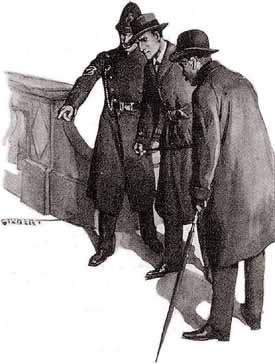
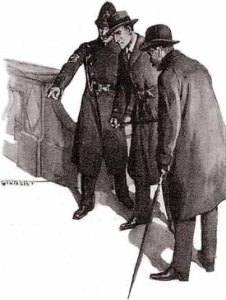 ‘The Problem of Thor Bridge’ gives us the classic impossible crime setup of a body that has been shot in the head but without any sign of a weapon to hand…and then manages to appear not at all impossible by finding the murder weapon hidden in the most likely suspect’s room, also throwing in a note from the suspected murderer arranging to meet the victim at the place of their demise and at around the time they are suspected of being having died. True, there are no footprints anywhere near the body, but – before you get too excited – “The ground was iron-hard, sir. There were no traces at all.” Oh, so that takes care of that, then.
Continue reading
#35: The Language of Sherlock Holmes – A Study in Consistency
In an attempt to broaden my approach to this blogging lark, I thought I’d turn my hand to some linguistic analysis. This presents a problem in the form of my being a qualified mathematician and therefore acutely aware of how easy it is to skew any set of data based on the interpretation it’s given, and thus how pointless it becomes to really bother. Nevertheless, I shall sally forth into the Sherlock Holmes canon with a quick sweep over some of the main points, and I can always come back to it later if I feel it warrants further investigation.
Continue reading
#34: The Impossible Crimes of Sherlock Holmes – II: The Adventure of the Empty House

I did accidentaly post this the other morning, so I have no idea whether this means you’ve already read it or not, but here goes…¹
Continue reading
#33: The Killing Needle (1871) by Henry Cauvin [trans. John Pugmire 2014]
 It is difficult to believe that Arthur Conan Doyle ever intended for his Sherlock Holmes stories to be as influential as they have proven to be. Not only are we still churning out variations on his characters in print and on radio, television and film but such is the fascination with his detective that something published before Conan Doyle even put pen to paper can achieve retrospective interest because of the similarities between the two. And so Locked Room International published this translation of Henry Cauvin’s debut novel The Killing Needle, wherein a skeleton-thin genius master of disguise who shuns social norms, declares “In my case, the brain dominates everything and is continually boiling over. This fire is eating me up and doesn’t leave a moment’s peace. The mind! The mind is a vulture that’s eating me alive” and takes opium (though in this case “to help me get some much-needed sleep”) has his adventures in crime-solving related by a doctor who becomes his confidant after being introduced by a mutual friend …yeah, okay, that’s a lot of overlap right there.

#32: The Impossible Crimes of Sherlock Holmes – I: The Adventure of the Speckled Band
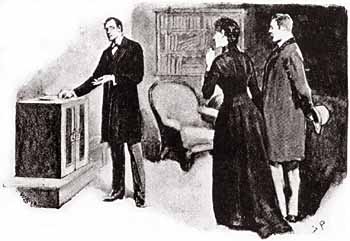
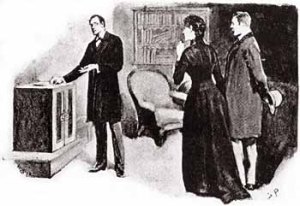 Since I can’t quite go the Full Sherlock – he’s out of my era, after all – I thought I could at least have a look at the three Arthur Conan Doyle-penned short stories that comprise the (official) entirety of his impossible crimes: ‘The Adventure of the Speckled Band’, ‘The Adventure of the Empty House’, and ‘The Problem of Thor Bridge’ (I’m excluding novella The Valley of Fear because it’s not technically an impossible crime, and remains a mystery for all of about six lines). It’s also a lovely excuse to get some of Sidney Paget’s gorgeous illustrations out for airing, too, and I don’t think anyone is going to mind that. So, first up going chronologically, is my least favourite of these three: nonsense-fest ‘The Adventure of the Speckled Band’.
Continue reading
#31: Mycroft Holmes (2015) by Kareem Abdul-Jabbar and Anna Waterhouse
Things are going a bit Holmesian here at The Invisible Event for the next week or so: a post every other day on something Sherlock-oriented. Why? For the simple reason that I feel like doing it. I should probably wait for the BBC special at Christmas to theme it up a bit more, but Christmas is a busy time and so I’m doing it now instead.
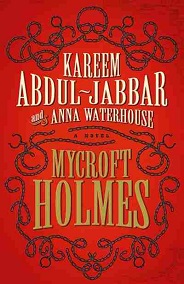 I wouldn’t call myself die-hard Sherlockian enough to immediately sign
 of up for anything produced in that universe – material enough to consume more than one lifetime – but the character and context retain so much potential that I will dip in where I believe someone might do something worth checking out. The reference-filling short stories written by Adrian Conan Doyle both with and without the help of John Dickson Carr, the entertaining Professor Moriarty books by Michael Kurland, the tales by short story specialist Ed Hoch, Laurie R. King’s Mary Russell books, Caleb Carr’s The Italian Secretary, and Anthony Horowitz’s Holmes pastiche The House of Silk and universe-widening Moriarty (among others like Colin Dexter’s sole Holmes story ‘A Case of Mis-Identity’) all testify to the presence of life in the old dog yet, and Arthur Porges wrote a couple of pastiches I’d like to track down, so there’s still more to try.
Continue reading
#30: The Tokyo Zodiac Murders (1981) by Soji Shimada [trans. Ross & Shika Mackenzie 2004]
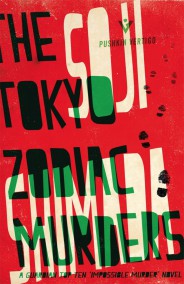 Some families have all the luck – take the Khardashians, for example, who are universally blessed with charm, intelligence and talent – whereas some miss out altogether. Into this second category would definitely fall the Umezawa clan: not only is patriarch Heikichi found battered to death in his locked art studio, his eldest daughter is then found murdered a few months later and, following that, his six other daughters, step-daughters and nieces all disappear simultaneously and their dismembered bodies are discovered at various intervals buried in different locations around Japan. Then it turns out that Heikichi Umezawa had written a document outlining his intention to do exactly this to these women, with methods of murder and disposal based on their zodiac signs, so the mystery of who could have carried out his nefarious scheme raises its ugly head and remains unsolved for decades…

Continue reading
#29: The spurns that patient merit of th’unworthy takes: To complete or not to complete?
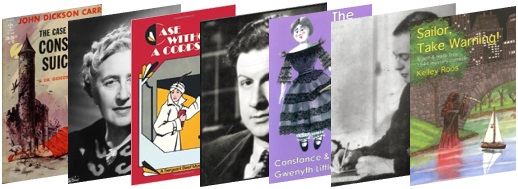
I will probably put this very poorly, so bear with me.
I am an Agatha Christie fan. I am also, you may have noticed, a fan of John Dickson Carr, and of Edmund Crispin, Leo Bruce, Rupert Penny, Kelley Roos, and Constance & Gwenyth Little. What these detective fiction writers have in common is two-fold: firstly they are all dead, so their output is now a fixed and known quantity, and secondly it is my express intention to read everything they ever published in the crime fiction sphere. In some cases this may not be achievable – though with the recent increase in GA reprints it’s to be hoped that these will be picked up before too long – but I intend to give it my best shot nonetheless.
Continue reading
#28: Dirty Little Reading Habits
I’ve picked this up from Cleopatra Loves Books who in turn cites the following motivation:
I saw this fun post on Finding Time To Write, a great blog full of Marina’s poems, fantastic places to read as well as considered reviews. In turn Marina found this tag on the blog 50 a Year. I couldn’t resist sharing my reading rituals, honed over decades, with you all.
It’s always fun to hear/read what other people get up to, so in the grand tradition of My Blog Name in Books I thought I’d give this a go before editing my next crime-centric post:

 The Invisible Event