Author: JJ
#46: The Black Shrouds (1941) by Constance and Gwenyth Little
 So, from one Australian author last week – the entertainingly bonkers world of Max Afford’s Owl of Darkness – to two this week – the entertainingly bonkers world of the Little Sisters. This is my first foray into the Monthly Challenge over at Past Offences, with the year for December being 1941 and so falling perfectly into my TBR pile, and it’s been a joy to reacquaint myself with these literary ladies after frankly too long away. Shades of my reviews from earlier this year – Pamela Branch’s The Wooden Overcoat and Torrey Chanslor’s Our First Murder – resurface here, with delightful overtones of everyone’s favourite crime-solving couple found in the echoes of Kelley Roos’ The Frightened Stiff, too, as a murder in a boarding house gives way to suspicion, fear, mistrust, confusion, doubt, terror and…laughter. Because as well as being a well-plotted and beautifully light mystery, this is also very, very witty indeed.
There are no tentpole comic set-pieces like in The Wooden Overcoat – seriously, the ‘picnic’ chapter in that book still makes me smile – and it’s not that the Littles are especially arch or sharp-tongued in their prose, but there is a gentle kind of amusement behind everything that really works. It helps typify characters such as Neville Ward who is “about as exciting as a boiled egg” and in failing to make himself heard during a drunken conversation involving a great many other people is described as having his soprano voice “cut off at birth”. It helps perfectly capture fellow resident Camille “an ex-actress in her sixties who…made no bones about admitting that she was nearly forty”. And, crucially, it helps soften the edges on, and emphasises the charm of, runaway heiress and narrator Diana Prescott who, in less graceful hands, would probably have irritated the living hell out of me. Continue reading
#45: The Kings of Crime – I: John Dickson Carr, the King of Hearts

Bookends: It Walks by Night (1930)/The Hungry Goblin (1971)
Books published 1920-59: 64
The Case for the Crown
Diversity: In a career spanning 41 years John Dickson Carr published seventy-six novels and collections of short stories, wrote a raft of mysteries for radio (many of which can be found here), penned the official biography of Arthur Conan Doyle and a non-fiction account of the mysterious murder of magistrate Edmund Godfrey, wrote a column for Ellery Queen’s Mystery Magazine, and was made a member of the Detection Club as well as a Grand-Master of the Mystery Writers Of America. He created two long-running and dearly-loved sleuths, and in his later career branched out into exquisitely-researched and detailed historical mysteries that weren’t afraid to veer into the nonsensical – the time travel element of Fire, Burn! (1957) – or the fantastical – invoking a deal with the Lucifer himself in The Devil in Velvet (1951) – if they served his purposes.
#44: Who are the Kings of Crime?

The Tuesday Night Bloggers – an opt-in blogging group initially started by ‘Passing Tramp’ Curtis Evans to commemorate Agatha Christie’s 125th birthday but since expanded to include a broader program of authors from the Golden Age – has produced a glorious range of diverse posts from a variety of contributors and perspectives. Mostly I feel incapable of contributing anything half as interesting as what these guys and girls come up with, but Brad Friedman’s recent Ngaio Marsh-themed post on his excellent AhSweetMysteryBlog has got me thinking laterally about something he said, and so I’m going to run in my own direction with an idea that I’m curious about.
Any conversation about Marsh, see, veers into the debate over the Queens of Crime which is rife with obviously-Christie, pro-Sayers (hmmm), anti-Mitchell (yay!), possibly-Allingham (wooo!) debate, but Brad says that his personal “Queens of Crime” included John Dickson Carr and Ellery Queen. And I thought: hang on a minute, male monarchs? There’s a word for that…
Because, who are the kings of crime fiction?
Continue reading
#43: Owl of Darkness, a.k.a. Fly by Night (1942) by Max Afford
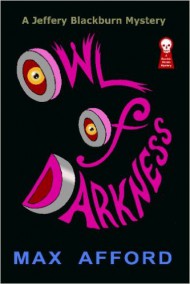 Regular readers of this blog – hello, Mum – will be aware of how much I appreciate die-hard devotees like Fender Tucker and Tom and Enid Schantz, whose (respectively) Ramble House and Rue Morgue Press imprints have for years been keeping the kind of classics everyone had long forgotten about in print just for the love of them. I won’t condescend to imply that everything they publish is of equal quality, but some of it is more equal than others and they have jointly brought some absolute delights to my attention. Unfortunately the latter’s Smallbone Deceased (1950) by Michael Gilbert proved not to be my kind of thing and so I couldn’t really review it having not read it, but it does give me a chance to talk about Max Afford’s Owl of Darkness which is published by the former and I read in those bleak and hazy dark days I now think of as ‘pre-blog’.
#42: Defining ‘Fair Play’ in detective fiction

Partly because I’m feeling brave, and partly because it’s something that has niggled at the back of my mind given some recent reading experiences, I wanted to have a bit of a discussion – or, well, monologue – about what constitutes a fair play detective novel. I shall attempt not to go the Full Knox, and I’m not imagining that anything I say will be remotely original, but it’s on my mind and it’s my understanding that this is how blogging works. So…
I think I’m relatively safe in saying that for many people the appeal of the detective story is the opportunity to have a go at fitting the puzzle together before the author explains all at the end (differentiating here from the crime novel or the thriller, which for brevity’s sake we’ll simply say have different intentions). It’s also quite secure ground to say that finding out you never had a chance of solving the mystery for whatever reason – insufficient clueing, frank lies on behalf of the author, etc – adversely affects one’s enjoyment of such books. Having all the information there for you to colligate and deduce is what motivates a lot of said reading, but the precise nature of what constitutes a ‘fair play’ novel is somewhat hard to rigorously define. I’ll suggest up front that my own conclusions probably won’t tally with your own, but that’s all part of the fun, what?
#41: Vintage Mystery Cover Scavenger Hunt 2016
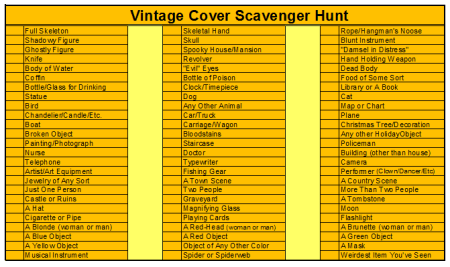
You’re doubtless aware of the Vintage Mystery Bingo challenges offered by Bev Hankins over at My Reader’s Block, and with a full twelve months of blogging ahead of me in 2016 I’m declaring my entry into the latest of these, Vintage Mystery Cover Bingo. I’ll allow Bev herself to explain:
Your mission, should you choose to accept it, will be to find as many objects on the scavenger hunt list as possible on the covers of the mystery books you read. As has been the case for Vintage Bingo you may play along in either the Golden or Silver Mystery Eras (or, for the more adventurous, both).
Being rather more of a Golden Age fan I’ll be doing the Golden Mystery era, though at my current rate of one review a week and a liberal helping of out-of-era locked room mysteries it remains to be seen how successful I shall be!
 John Pugmire’s continuing mission to bring us the best unheralded impossible crime stories from around the globe under the guise of Locked Room International now adds Sweden to Japan (Yukito Ayatsuji’s The Decagon House Murders), France (Noel Vindry’s The House That Kills,
 The Invisible Event