Author: JJ

#86: Where has all the classic detective fiction gone…?
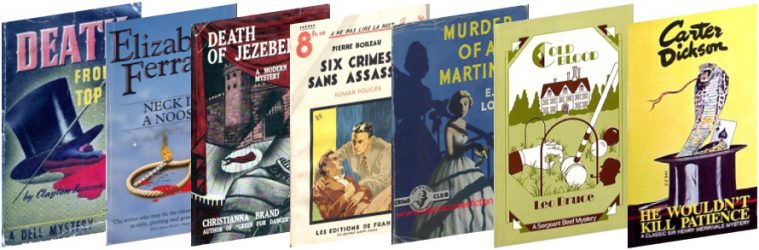
If you’re anything like me, well, firstly my condolences, but also you have a list of books not printed any time in the last few decades that you spend hours scouring secondhand bookshops, book fairs, online auction sites, and other people’s houses in the hope of finding. A lot of them – in my case, say, The Stingaree Murders by W. Shepard Pleasants – are rather obscure and so their lack of availability is understandable, but in other cases it just seems…baffling.
Continue reading
#85: Policeman’s Holiday (1937) by Rupert Penny
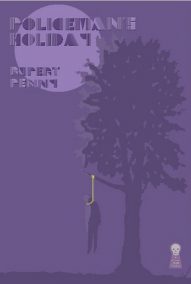 “If a man’s mind be wandering,” said Francis Bacon, “let him study the mathematics”. Well, the mathematics take up an unreasonably large amount of my time as it is, and for me nothing helps my wandering mind quite like classic detective fiction. So, with 2016 having been an underwhelming year in books so far, and coming back off a 2 month hiatus with my hand injury, I’m keen to get a bit of enthusiasm back into my reading. Hence I shall spend the next little while focussing on the sure-fire hits in my collection: expect much Max Afford, Leo Bruce, John Dickson Carr, Agatha Christie, Paul Halter and others, as well as some classic locked room nonplussing, in the weeks to come while I try to reorient myself within my chosen enthusiasm.
And there’s frankly no better place to start than with the wonderful Rupert Penny, pen name of Ernest Charles Basil Thornett and puzzle plotter extraordinnaire who has been brought back into print by the wonderful Ramble House. This is the second of Penny’s Chief-Inspector Edward Beale books, and concerns the death of a philanthropist and puzzle-writer found hanging by the neck from a tree in the Dorset woodland. Clearly it must be suicide, but the man was well-known locally and no motive for suicide can be unearthed. It seems an unlikley accident, however, so the only other option must be murder. Right? With the locals uncertain, Beale is asked to cancel the leave he has planned and head down to Dorset to investigate. And, of course, since his good friend Tony Purdon was due to go on holiday with him, he might as well tag along too…
Continue reading
#84: The Tuesday Night Bloggers – The Sherlockian Impossibilities of John Dickson Carr – II: ‘The Adventure of the Sealed Room’ (1953)
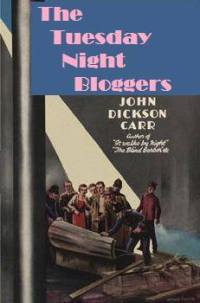
I’m guilty of sedition here: this isn’t technically part of the Tuesday Night Bloggers – they’re looking at travel in classic crime this month – but rather my own delayed TNB post on John Dickson Carr from March before I was sidelined. But, y’know how it is, it’s the second one looking at Carr’s Sherlock Holmes stories and so I feel I should probably post it on a Tuesday if only for internal consistency…my apologies for any confusion (though I suppose I cam writing about a Carr trip…). Just look upon this as my Never Say Never Again.
I talked about the origin of these stories in my first post on this topic, so let’s get straight on with it: this story is built on the reference to a case “of Colonel Warburton’s madness” made at the start of ‘The Engineer’s Thumb’ and so it’s appropriate that it begins in much the same way: someone in distress seeks out Watson (then for his doctoring, now seemingly because he knows Holmes) and is thus ushered into the Great Presence. It’s here that the story plays its most interesting card, as Holmes is rather short with the unfortunate Cora Murray who has just had a Colonel Warburton seemingly shoot himself and his wife while locked together in his study in the house where they all reside:
Continue reading
 Animals and their involvement in impossible crimes enjoy a long history, from the works of Edgar Allan Poe and Arthur Conan Doyle all the way up to the Jonathan Creek episode The House of Monkeys. Approximately halfway between these two we have Roman McDougald’s mandrill Geva, resident of your classical American Millionaire’s Household and on hand when said millionaire is found murdered in frankly baffling circumstances: in his office, stabbed in the back, with both doors into the room unlocked. Yes, unlocked. And yet he failed to leave the room while being attacked – the trail of blood he left leads from his desk to one door, then the other, and halfway back again – or raise the alarm in any way before the killer escaped.
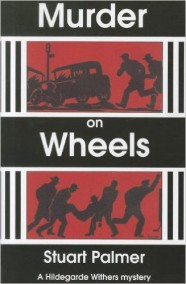 A little charm goes a long way – ask any bank teller or helpline operative, or indeed any fan of Golden Age crime fiction. Because, while a lot of absolutely wonderful books came out of this genre at that time, the fact is that a lot of what was published then and is popular now adhered to a particular school of writing and runs on very familiar rails. But the key thing is that so much of it is charming without having to innovate, and once you jettison any notions about every single book from the Golden Age being a complete game-changer you find a lot of joy there. Which astonishingly back-handed praise brings us to my first (but the chronological second) Hildegard Withers mystery by Stuart Palmer, possibly the first book I’ve really enjoyed for a long time in 2016 even though it does very little new or surprising.

 The Invisible Event