Author: JJ
 There are times when it’s possible to pinpoint the exact moment when a novel doesn’t fulfil its promise, and given the intricacy of many novels of detection these can sometimes be very keenly felt. Perhaps the detective is an absolute duffer (an accusation frequently levelled at Freeman Wills Croft’s Inspector French), or the guilty party comes disappointingly out of nowhere (as in John Dickson Carr’s The Blind Barber), or perhaps the solution offered up to a brilliant problem is a shade on the simplistic side (the disappearance from the locked bathroom in John Sladek’s otherwise-superb Black Aura springs to mind). For this second novel by husband and wife team Kelley Roos, I’d say the main problem is in the selection of the victim: the setup is excellent, the characters are a delight, and come the murder…the most obvious victim is selected and the book never quite recovers.
#96: The Tuesday Night Bloggers – Educatin’ the Pulps in Robert O. Saber’s The Black Dark Murders (1949)
This month the Tuesday Night Bloggers are looking at academic mysteries or those based around schools, schooling, university, etc., and – for the first few weeks, at least – I want to use this as a chance to put my longstanding love of Edmund Crispin’s Oxford don Gervase Fen to one side and try to, y’know, diversify a bit. See, I’ve been thinking a bit on the topic of transition in the genre as part of my rumination on the eternal Character v Plot debate (see part 1 and part 2), and it raised its head again when I read this university-set tale of your typical – albeit baby-faced – pulp P.I. hired to ensure the safety of a millionaire’s daughter following the murder of a female student on campus. Continue reading
#95: Character v Plot 2 – Atmosphere v Redundancy
As you’re no doubt aware, the internet is currently ablaze with my self-inflicted #9booksin9days challenge on Twitter in which, well, I’m reading 9 books over the nine days of my half term break. It’s been fun and slightly intense – I’ve read books in a single day before, even on consecutive days, but never nine in a row – and has caused me to reflect upon my post from last week on the topic of the character/plot threshold in detective fiction (which has already been reflected upon by Brad at AhSweetMysteryBlog). In light of this, I wanted to explore it a bit deeper. You are, of course, invited to come along with me.
Continue reading
#94: Death in Five Boxes (1938) by Carter Dickson
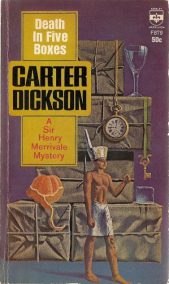 Four people are discovered sitting around a table as if at a dinner party, each with only a glass in front of them. Three of the four have been poisoned into a catatonic state and the fourth has been murdered by being run through with a narrow blade. Of the three who remain alive, one has two bottles of poison in their bag, one has the workings of an alarm clock in their pocket, and the third is carrying four pocket watches in various pockets about their person. At this point you are three chapters into the eighth Sir Henry Merrivale novel written by John Dickson Carr under his Carter Dickson byline and we haven’t even touched upon the revelation that greets you at the end of that chapter…suffice to say, boy are you in for a ride!
Continue reading
#93: The Tuesday Night Bloggers – America from the Outside: The Traveller’s Perspective in The Sharkskin Book (1941) by Harry Stephen Keeler
This week, for my actual final post for the Tuesday Night Bloggers on the subject of travel (I was, er, premature in predicting the number of days in May last week…), I was going to look at another book entirely. But in reading The Sharkskin Book by Harry Stephen Keeler – chief loon of the sanatorium that is Ramble House – I was struck by something rather more nebulous that I’m going to try to explore here: the sense of dislocation one can experience when separated from familiar trappings.
Continue reading
#92: Character v Plot
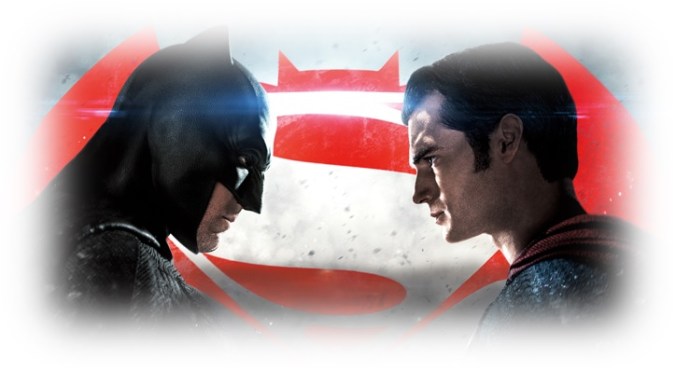 So here’s a starting point that doesn’t belong on a blog about crime fiction between 1920 and 1959 with frequent diversions into apparent impossibilities: I freakin’ love Batman. The whole Bruce Wayne/Batman duality in almost any form is an absolute joy to me – I’m not going to geek out here over the many, many years I’ve spent reading the comics nor the sundry disappointments of the various cinematic fusterclucks (I’m looking daggers at you, Schumacher…Burton, you’re borderline), and shall instead make the following observation: the second I heard Batman v Superman: Dawn of Justice was announced, I’d practically bought my ticket on the fact of it being a new Batman incarnation.
Continue reading
#91: The Moai Island Puzzle (1989) by Alice Arisugawa [trans. Ho-Ling Wong 2016]
Disclosure: I proof-read this book for Locked Room International in March 2016
 Children, incarnations of The Doctor, phases of the moon…generally I try not to play favourites. But if I had to pick one crime fiction conceit above all others it would undoubtedly be a group of people on an island getting killed off one by one. Sure, isolate them in some ancestral mansion via thunderstorm or on a train via unexpected snow and the effect is arguably the same, but there’s something about the island in itself that renders the idea all the more thrilling to my senses. And so this Japanese island-set puzzle, the second collaboration between Locked Room International’s John Pugmire and translator and crime fiction blogger Ho-Ling Wong after last year’s excellent The Decagon House Murders, would be just what the doctor ordered if the medical profession ever thought of prescribing books for those of us with the thrill of fictional murder in our hearts.
Continue reading
#90: The Tuesday Night Bloggers – Running Around with the Circus in Leo Bruce’s Case with Four Clowns (1939)


 The Invisible Event