Author: JJ
 My
#278: Six Were Present – A Collaboration of Titans in ‘The Scoop’ (1931)

Most fans of Golden Age detective fiction (GAD) will be aware of the portmanteau novel The Floating Admiral (1931) in which many luminaries of the form each contributed a chapter in turn to a murder mystery plot (pity poor Anthony Berkeley, who had to unravel all the clues and events to provide a coherent solution in the final chapter). I’m imagining that slightly — but only slightly — fewer of you will be aware of the precursors to this novel written in the preceding year, where the same sort of approach was taken for two mysteries to be broadcast on radio.
Continue reading
#277: The Temple of the Great Jupiter – The Three Investigators March in The Secret of Terror Castle (1964) by Robert Arthur
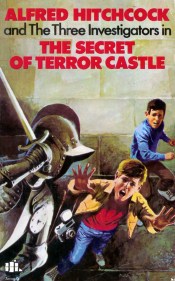
My inability to walk past a secondhand bookshop without at least having a “quick glance inside” recently resulted in me purchasing a stack of the Alfred Hitchcock and the Three Investigators titles, books I was aware of but have not previously read. So buying 22 of them in no way counts as a spontaneous over-commitment, oh no. Anyway, The Secret of Terror Castle is the first of the series and here are some thoughts on it.
Continue reading
#276: The D.A. Calls it Murder (1937) by Erle Stanley Gardner
 Erle Stanley Gardner, in my view one of the four most important male authors of classic crime fiction, is of course best known for the savvy machinations of Perry Mason, a man who never met a legal loophole he didn’t like. Yet between 1937 and 1949 he wrote nine books that just might comprise some of his most interesting writing, those featuring D.A. Doug Selby. Selby is a more naive presence than Mason — equally ready to fight his corner, yet strangely trusting in a way that at times proves his undoing — and in order to bring these books a little more attention I’m going to work through them in order over the next few months (yes, yes, we’ve heard this before… well I need a break from that, and this is the perfect antidote).
Continue reading
#275: A Little Help for My Friends – Finding a Modern Locked Room Mystery for TomCat Attempt #3: The Secrets of Gaslight Lane (2016) by M.R.C. Kasasian

A late-Victorian private detective living in London who exhibits such traits as brilliant deductive skills (highlighted especially in his observations about strangers), a brusque and pompous manner, the application of reason and logic in all his encounters with crime, and a singular lack of personal relationships with anyone beyond his household, the members of the police he encounters, and his chronicler. Sound familiar?
And, of course, he has that glass eye, too. Wait, what?
Continue reading
#274: Spoiler Warning – Coming in October: And Be a Villain (1948) by Rex Stout

You’ve just had time to recover from the spoiler-filled look at Rim of the Pit (1944) by Hake Talbot…well here’s fair warning of the subject of the next spoiler-filled discussion that will be going ahead here on The invisible Event this October: And be a Villain (1948), the 13th book by Rex Stout to feature fiction’s most famous orchid fancier, Nero Wolfe.
Continue reading
#273: Think of a Number (2010) by John Verdon
 This isn’t a review, it’s an obituary. My copy of Think of a Number by John Verdon opens with twenty-six glowing review excerpts from a range of authors, publications, and blogs, but it genuinely might be the single worst book I have read in a very, very long time, and without being in the least splenetic about it I’m going to explain why. I will avoid spoiling it in full thoughtless fashion but, honestly, I’m being mindful of your time, your money, your families, and your health in writing the following. I take no pleasure in this, it’s purely to save you the experience of this fustercluck of a novel posing and sold to you as something intelligent and worthwhile. It is neither. That this is on the market at all is a slap in the face to all concerned.
Continue reading
#272: John Sladek’s Criminal Year – 1968 and the Fruits Thereof…
Following on from last week’s post about John Sladek’s Thackeray Phin short stories, we turn our attention to the remaining crime stories collected in Maps, all of which were published in 1968. Is that significant? Let’s find out…
Continue reading
#271: Adventures in Self-Publishing – Impossible Bliss (2001) by Lee Sheldon

 Reader, brace yourself for a shock: I — the man who curated

