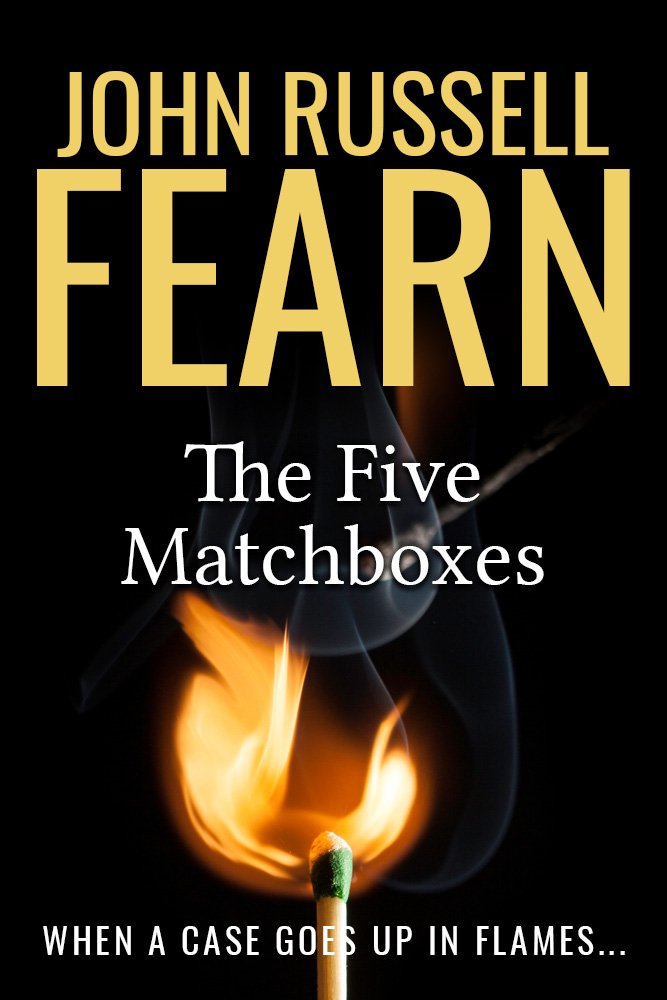


I may not yet share TomCat’s love of John Russell Fearn, but I also won’t deny that in the little I’ve read by the man he’s shown enough spirit to warrant further investigation. Blame, then, my never-ending TBR for the multiple years it’s taken me to get back to him, with The Five Matchboxes (1948) patiently waiting on my Kindle with nary a word of complaint. Much to my surprise and delight, it was an impossible crime, too, with stockbroker Granville Collins shot in his office when there was no-one around and no way to shoot him from outside. Can Chief Superintendent Mortimer Garth get to the bottom of this without his dyspepsia distracting him too greatly?
Most of this book is a lot of fun, with Garth at the centre of a morass of S.S. van Dine-esque policemen who provide intelligent and timely analysis of the various aspects of the crime: fingerprints, forensic science, firearms, all the usual bagatelles of the novel of borderline Humdrum detection, which is nevertheless unable to banish the “feeling of tension, [the] conviction that something had happened here which could not happen under any normal conditions”.
It’s not just the difficulties of the murder method, stack up though they do, which make this baffling. Garth must also contend with the victim’s odd behaviour — walking up the stairs to his office, then always running across the top corridor to his door, for one — and apparently irreconcilable personality traits, plus the man’s unusual interaction with his son on the morning he was killed. Additionally, what to make of the eponymous matchboxes, found on his desk — all empty, and with a hole drilled in each end? One feels for Garth at times, and, given Fearn’s, er, less-than-always-completely-rigorous approach to plotting, one fears that the answers may not convince, too.
Well, while not a classic of the genre, and while possessed of certain problems that we’ll come to, there’s much to enjoy here. After all, Fearn is clearly enjoying himself…
“Tell me, inspector, were you born in October under Scorpio?”
Garth paused momentarily in the doorway and caught the repressed smile of Sergeant Whittaker.
“No. I was born in November — under protest!”
…and that goes a long way, telling the reader that there is little point in furrowing the brow and Getting Too Serious. Sure, the whole edifice lacks slightly for atmosphere, with Fearn’s insistence on a sort of creeping, ghostly dread never feeling like more than the author hoping you’ll agree that there’s something phantasmagorical about this all, and none of the characters really compelling (not helped by nonsensical descriptions like a woman having “a mathematical forehead”), but things develop quickly with some lovely turns of phrase to keep the reader entertained.
Garth had the oddest feeling of embarrassment, as though he were walking into a quiet church in squeaky shoes.
Alas, the answer when it comes has some clever points — the matchboxes, say — but also many problems. Not only are some of the statements simply untrue (“Only one person…knew that [Collins] was [doing significant thing] that morning — and that was the killer.”) but the crime as presented surely doesn’t make sense: (rot13) vs chyyvat hc gur jvaqbj vf jung pnhfrq gur ohyyrg gb ehcgher uvf urneg naq xvyy uvz ba gur fcbg, ur jbhyqa’g unir unq gvzr gb eryrnfr gur ohggresyvrf naq erghea gur obkrf gb uvf qrfx. I like how the recently-concluded Second World War plays into things, but this — if we’re being generous — homage to The Hollow Man (1935) has just as many problems as the book that seeded it.
Fearn is to be commended for not falling into too many obvious answers — the telephone trick, for one — and for displaying a marked awareness of what this sort of puzzle novel had grown tired off by way of explanations to this point…
“Then again, criminals often plank themselves right in the open for the sheer object of deflecting suspicion.”
Garth shook his head. “Like hell they do, Whitty. You study criminal records and you’ll find that that is about the last thing they do. It’s about as big a fallacy as the one about the criminal always returning to the scene of the crime. That only happens about once in a thousand times, and then it is only to pick up something inadvertently left behind.”
…and the reason for both the impossible shooting and the note sent to forewarn the police of it are solid, but with this sort of puzzle mystery it’s the tiny points that matter most, and Fearn hasn’t quite got the grip on those he should. Put it down as a good effort, but nothing to get too excited about.


We’re in complete agreement. Some of the investigation is lovely, but there’s nothing here that inspires. I loved Pattern of Murder and I recently picked up Death in Silhouette, so I’m hopeful to find more Fearn treasures. This one was a bit too pedestrian. And the matchboxes barely had anything to do with anything!
LikeLike
I like the little filigree’d touches of this, such as the matchboxes…but Fearn doesn’t wrangle the complications well, as discussed above, and it feels like such a missed opportunity.
I have a Roger Ormerod review coming on Saturday. and could almost say exactly the same things about him: there’s lots of promise there, but when are we rewarded for our patience? Maybe I just move on, and find someone else to read instead.
LikeLike
I struggle to see how a locked-room mystery fanatic could fail to be inspired by Face Value and When the Old Man Dies, Ormerod’s best, so if you haven’t read those yet, then I strongly suggest you do! And be sure to report how blown away you are afterwards, of course.
LikeLike
Ah, well, I see now you WEREN’T inspired by Face Value. Pooh on me.
LikeLike
Oh, man, wait until you read my review of When the Old Man Died tomorrow, too…
LikeLike
A three-star review of a second-string, pulp-style locked room mystery is blazing praise coming from you. We’ll make a John Russell Fearn out of you yet! So don’t take another 5, 6 years to get to Pattern of Murder.
By the way, did you get any proto-Paul Halter vibes from The Five Matchboxes? It’s interesting how some of the pulpier homages to Carr tend to end up like proto-Halter novels.
LikeLike
Pattern of Murder goes on the list, many thanks.
As to the Halter vibes…actually, yeah, now you mention it. Halter would have dealt with the contradictions better and ensured that the actions could have actually occurred as intended, and with another impossibility in here I could make the comparison more easily. But, yes, I can absolutely see where you’re coming from.
LikeLike
Yep. Whilst I am not as well read with Fearn’s work as others, I do second the recommendation for “Pattern of Murder” and will be glad to see what you make of it when you get to this one.
LikeLike
Always good to get a second recommendation — that helps expedite matters in my mind. Expect Pattern of Murder in the next six months or so…
LikeLike
Pulp is often used as either a negative or a synonym for cheapness, but the Fearn books I’ve read are better than a good deal of “more prestigious” writers in the genre (ahem… Ellery Queen… ahem). His writing is sharp, clean, and pacy, he does some nice, understated character work, and he certainly knows how to hold your attention. I haven’t got around to this novel yet, but I’ve really enjoyed the few Fearns I’ve read. “Pattern of Murder” is a masterpiece in my book, one of the very best inverted mysteries I’ve ever read, and features what is undoubtedly my favourite murder method of all time. Now, I will confess that I’m hugely biased as I grew up around cinemas and projectors, and have been a cinephile since (quite literally) before I can remember. But, the way Fearn turns a cinema into a deathtrap, the way the plan slowly unravels, and the way he ties the nitty-gritty of running a small-town theater in post-war England into it all without ever slowing down or losing an ounce of clarity made me squeal with joy!
LikeLiked by 1 person
Well, good grief, how can I not check it out after such a recommendation as this?!
LikeLike