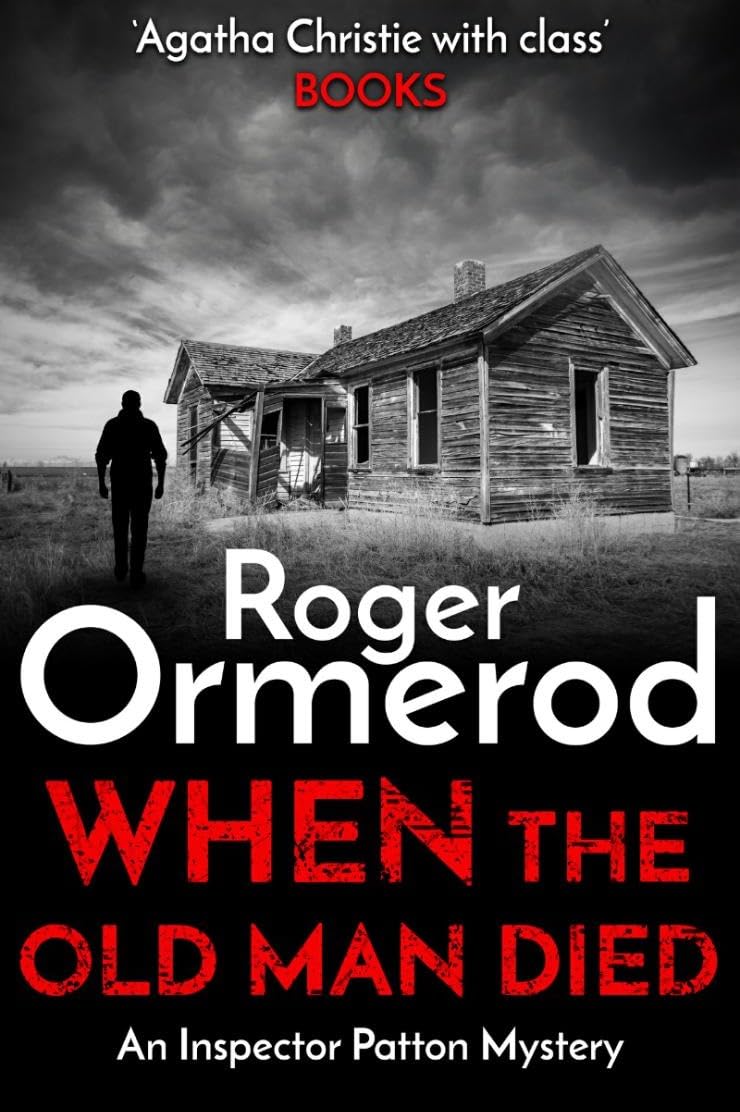
It’s been a while since I read anything by Roger Ormerod, and that’s in part because I can’t quite decide how I feel about his work. Yes, he puts forwards some intriguing ideas and has resolved a few impossibilities very neatly, but at the same time there’s no real detection and the books always seem to sag heavily in the middle…so can the much-recommended When the Old Man Died (1991) reverse those impressions?
Visited in his retirement by Chief Superintendent Wainwright, ex-D.I. Richard Patton is told that a senior officer, having been mortally wounded while driving a car that seems to have been rigged to kill him, confessed to a minor infraction while investigating a case early in his career. And it’s an infraction that could have major implications for the conviction to police achieved in the case, and as such has been playing on the man’s mind. And the officer in charge of the case ten years ago was…D.I. Richard Patton.
Approached several months later by the man originally convicted of the murder, Patton is semi-guilted into re-investigating so that Julian Caine can start living his life again.
“My conviction’s been quashed. I’ve been released. Big deal, as they say inside. I was due for parole, anyway.”
“It’s the same as a not-guilty verdict,” I assured him, not really believing that myself.
“No it’s not. Nobody believes I didn’t do it. I’ve got off on a technicality, that’s all it is. Got off. Tcha! It’s as bad as that Scottish thing: not proven.”
And so the process of re-examining everything, re-interviewing witnesses, and “find[ing] yourself facing a complete destruction of your self-esteem” as he has to call all his previous conclusions into doubt begins…with the net result that Caine ends up looking more guilty than he ever did before.

The first third of this is excellent, with Patton demonstrating why he was such a canny policeman to begin with — why the bullet fired into the clock at the crime scene had to be the second shot fired, say — and various tensions building around him as he undertakes to second guess everything that came before. The dead officer’s wife, for instance, has no interest in Caine being found not guilty, worried it will tarnish her husband’s reputation posthumously, and Ormerod is at his best when setting up the crime and building pictures of the various people who now surround the situation as it is newly evolving.
He smiled. It wasn’t a splendid thing to observe.
Various elements all seem to orbit the crime possibly intersecting it and possibly merely building no more than smoke to hinder the view: an antiques dealer from London, a car crash that killed the victim’s wife a year prior, Julian Caine’s wife being terrified of the antique guns he kept locked away in their home, the fact that the victim of the shooting was well-known for writing “what they used to call poison pen [letters]”, or the bizarre instance of all the clocks in the house where the murder occurred stopping at exactly the same time…something which had been undone when the other residents of the house returned to it.
I was not prepared, despite the title, for the role that clocks would play in this plot, and Ormerod writes about them very well indeed, such as the way a roomful of antique clocks brings to mind the “fluttering [of] tiny urgent hands, thrusting elements of time into the past”. Indeed, it’s perhaps apt that the notion of time, and especially the reinterpretation of things from the past, crops up again and again: see those antique guns, whose “makers had, in all cases, applied loving skill to them, as though their beauty might mask their deadly intent”. A grandfather clock…
“Long-case,” he said.
“Pardon?”
“Long-case clocks, they’re called. Not grandfather. That name was given to them because of an old song.”
“Thank you. I’ll treasure that.”
…plays a key role in all of this, and as the dodgy dealing of various antique sellers comes to light, so does the importance of the time passed and the sins that are lurking ready to spring out and cause havoc in the present.
The middle third is, however, predictably awful. A lot of time is spent trying to convince Patton that he has no right to be re-investigating this crime — as if he’s going to give it up, FFS, Roger — and lots of conversation is had and, wow, Ormerod really cannot write extended dialogue. He runs out of plot here, as typically happens, and so we slowly cover old ground and slowly get nowhere very quickly, and dear St. Christopher I just want to read a book by Roger Ormerod which doesn’t sink into these doldrums. I got to the two-thirds point wondering if I’d even finish.
And the final third…? Well, what do you think? Patton ends up pulled into events where someone else explains to him how the crime was done, and then he has a moment of staggering insight in which he dismisses two perfectly reasonable suggestions and then realises that actually that method is correct but the person implicated is wrong…and then the killer is just sort of there and starts shooting people and Wainwright seems to show up out of nowhere and then we get an explanation which is 90% of what we’ve already been told by someone else and then an extra dumping of motive which relies on the character of someone who we do not know and could not possibly have divined.
In other words: it’s a Roger Ormerod novel.
Don’t get me wrong, this means that some clever ideas definitely present themselves — the way that Julian Caine is proved comprehensively innocent of the murder is clever — but it also means that a lot of stuff is simply realised and must be correct because the main character knows that there are only six pages remaining in the book. That motive, for one, is in no way prepared for, and everyone just nods along like it’s the most obvious thing in existence and then we’re done. And so despite some touches of genius — the explanation for those stopped clocks is infuriating, and then absolutely brilliant — the main impression here is again someone knocking on the door of warranting further investigation but seeming more likely to disappoint.
Also, he writes some of the oddest sentences in the history of fiction. Did no-one edit these?
[While driving] I met not one other driver. Overtook a couple, but met none coming the other way.
So, what of me and Roger Ormerod in the future? I don’t bloody know. He was a talented ideas man who could conjure up and explain away some superbly confounding crimes at a time when the puzzle mystery was not held in the highest of esteems. And yet, perhaps because of his ability to do this — he wrote nearly 50 books in the last quarter of the 20th century, an astonishing output — he always fudges crucial elements of plotting and detection, and leaves the true puzzle hound baying in frustration at the slapdashery that is used to finish off his excellent concoctions.
And so…is it worth these constant, repetitious disappointments to enjoy the sparkles of brilliance Ormerod brought to the genre? I can buy all 15 Richard Patton books on Kindle for a pittance, and slowly work my way through them and probably get some enjoyment out the man’s rich imagination…or, well, that time could be put into other authors where I’ll maybe find something excellent as a result. I dunno, I really don’t. Any perspectives on this quandary will be greatly appreciated.


Having read all the Ormerods, my favourites, in no particular order:
Landscape with Corpse
Death of an Innocent
The Silence of the Night
Sealed with a Loving Kill
The Seven Razors of Ockam
The Key to the Case
Seeing Red
One Deathless Hour
Farewell Gesture
The Weight of Evidence
A Spoonful of Luger
A Dip into Murder
Mask of Innocence
Face Value
No Sign of Life
Too Late For The Funeral
Guilt on the Lilly
A Shot at Nothing
LikeLike
This is superbly helpful, thank-you. I take it the bold titles are the ones you rate more highly, and I have A Shot at Nothing already, so that’s where I shall head next in my explorations.
And, good work on reading all the Ormerods! It’s not a small corpus, and shows real dedication to the cause.
LikeLike
I’m fascinated by that “Agatha Christie with class” pull quote. What on earth does that mean? Last I checked, Christie wasn’t a common lout…
LikeLike
I believe the full quote is “Agatha Christie with class-consciousness removed, as well as most of the clues, characterisation, and detection. In fact, not like Agatha Christie at all, so forget we said anything and certainly don’t quote us on the above”. But publishers being wat they are ignored this plea, and the rest is confusing history.
LikeLiked by 2 people
Sad you didn’t like this one. I think the way this one fuses tropes of alibis and locked-room mysteries is brilliant, especially since the set-up effectively involves the idea of “the detective is confident X alibi trick was used, but the alibi trick itself is a locked-room mystery”. The explanation is equally brilliant.
I agree with you he could use more rigor, though… But I also find his fusion of genres more readable than you do. I find it charming and his writing often has lots of witty and quotable lines. The prose is also unfussy, which I think leaves a lot of real estate for the genre fusions to work better than it would if he were more verbose.
Ormerod always works for me on the level of someone with a super fertile mind for set-ups and trickery, who consistently belted out brilliant takes on breaking alibis and opening locked-rooms, such that when I’m reading the denouement of an Ormerod I often forget any quibbles I had with the book because good lord, the cleverness and inventiveness on display at his best rivals even the best of the Golden Age. There are few, I think, who could claim to have better ideas for impossible crimes and alibis than Ormerod, at least… But I do agree his rigor and detection and investigation and cluing could certainly have used more work.
LikeLike
It’s that richness of imagination that makes me want to come back, but all the titles I’ve read, which have all been recommended in high terms by someone, suffer from the same structuring problems, so it’s clearly a recurrent thing in Ormerod.
I guess I could just skip the middle third of each book, where the threads get bogged down and usually someone ends up running around to no effect just to pad the page count. Maybe that would make them pass more favourably.
My own tastes aside, I don’t think I’m completely done with Ormerod yet, however. I’ve cooled on him, but, like you, the fertility of those ideas compels me and will definitely draw me back. Just with lower expectations.
LikeLike
I’m the same with Ormerod. I often forget/overlook about the shortcomings or flaws in an Ormerod novel after finishing it. The best and imaginative parts stick better than the bad or underdeveloped parts.
If it’s that richness of imagination you want from Ormerod, the one you should read next is More Deaths Than Alive. It has Ormerod as an ideas man in overdrive with very little else. I believe Tom Mead even picked it as one of his favorite locked room mysteries.
LikeLike
Many thanks for the recommendation, it all goes on the big pile. It would be good to see Ormerod at full tilt, without the tedious lull that seems to mar the midpoints for me.
LikeLike