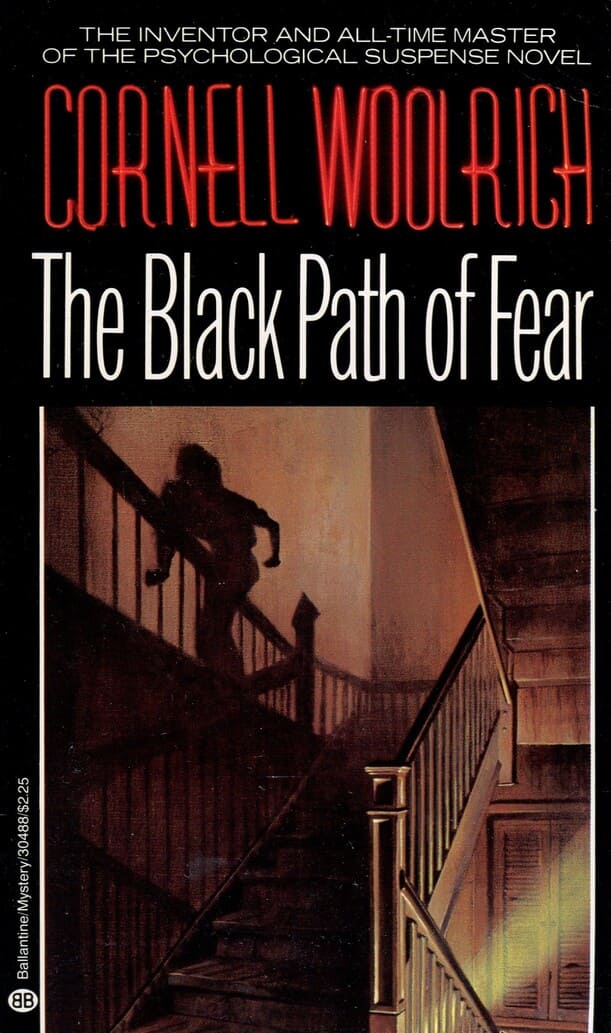


Clearly on the run, Bill ‘Scotty’ Scott and Eve Roman find themselves in Havana, and are set about living as full a life as they can when the past catches up with them and Scotty finds himself accused of murder. With the police apparently willing to believe his protestations of innocence — at first, at least — Scotty soon finds himself in a nightmarescape where his memory of events and the evidence he has to back it up diverge, and so only one course becomes available to him: go on the run again. And so, in an unfamiliar city and with no knowledge of the language, just how does this hunted protagonist go about proving his innocence? And what of the threat that surrounds him, the ‘someone’ he’s fleeing, who is keen that Scotty get some just deserts?
Where Cornell Woolrich’s best works leave much to the imagination, or have plot developments that genuinely surprise and shock you as you chase along, his weaker novels such as The Black Alibi (1942) and today’s read The Black Path of Fear (1944) are short in developments and looooong on suspense…but ‘suspense’ requires that the reader be in some doubt as to what’s going to happen. Alas, once Scotty’s plight is settled, it’s pretty clear what he’ll do, and how it will turn out, and so most of the pages of this, while undeniably excellently written at times…
My pain was in English. Their fright was in Spanish. There are no different languages for things like that.
…are just slowly working towards the inevitable. Sometimes it can be a real joy to stew in the press of Woolrich’s fear and paranoia, but this time around it didn’t work for me at all. Yes, I know he’s tense; yes, I know he’s nervous about what’s in the shadows; yes, I know he’s going to move slowly and be cautious and looking around himself and shying at every sound and creak and twitch; but could he just walk through the door without it taking two pages? Every once in a while, this slow burn approach to small activities is magnificent at building tension and dread; when applied to everything, it gets rather boring. I can read Umberto Eco for that sort of thing.
The best ideas are stray moments, like Scotty and Midnight, the cop-hating woman he serendiptouses into, discussing how, even if he manages to avoid the police in the city, he’s still trapped on an island with nowhere to go. It feels like there are enough ingredients here for Woolrich to cook something up, but most man-on-the-run thrillers are by necessity somewhat simplistic, and the by-the-numbers progression of this (it’s essentially a fetch quest, and a protracted one at that) leaves him with little to do except find a multitude of ways to describe the ominous feeling conjured up by dark corners. And, yes, that’s what Woolrich excels at, but he’s also a magnificent plotter when he wants to be — c.f. The Bride Wore Black (1940), Phantom Lady (1942) — and that’s lacking here.
Some nice character notes fill out the backstory provided in chapter V, such as Scotty reflecting on the eyes of gangster thug Mr. Jordan…
His reminded me of shoe buttons. Or of coffee beans. Smooth, hard-surfaced; just objects.
…and no-one can touch Woolrich for the fatalism he is able to casually inject into even the most harmless of moments, where others might reach for beauty:
[T]wilight’s a sad hour; the day is dying, and your hopes are dying, and your youth is dying, and the dream you’ve had will never come true now.
…but for all the richness here, it’s too little plot is stretched out over too many pages. And when an author has come close to perfection at this sort of thing in the past, it’s difficult to want to look upon their flawed creations, however much scarred beauty they may contain.
~
See also
Laura @ Dead Yesterday: The Black Path of Fear, with its uneven tone and dull male lead, is not one of [Woolrich’s] best, but that’s a very high bar to clear. There’s still a whole list of things Woolrich does better than almost anyone else (obsessed hero/heroine, tight deadlines, doom-laden atmosphere), and these strengths are showcased well here.
~
Cornell Woolrich on The Invisible Event
Novels:
The Bride Wore Black (1940)
The Black Curtain (1941)
Phantom Lady (1942)
The Black Angel (1943)
The Black Path of Fear (1944)
Deadline at Dawn (1944)
Waltz into Darkness (1947)
Rendezvous in Black (1948)
Short story collections:
Nightwebs (1971)
Darkness at Dawn (1988)
Individual stories/novellas:

