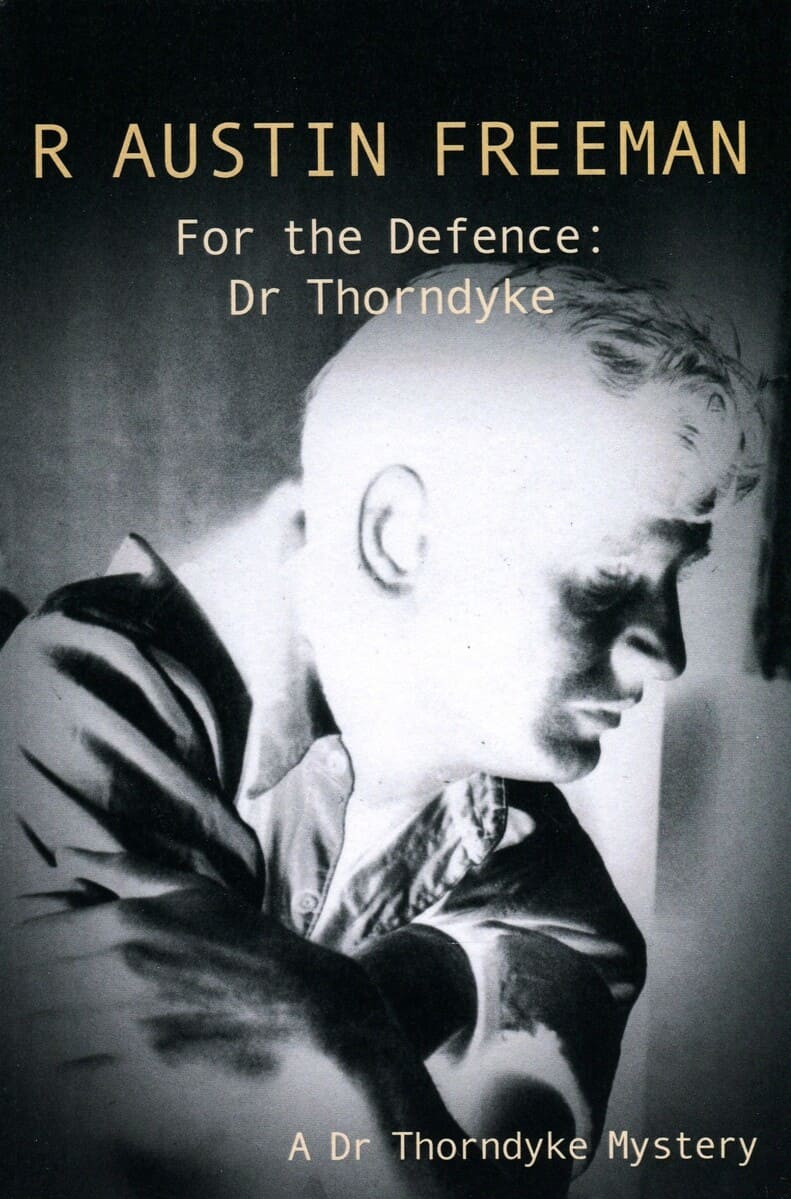


Prior to reading For the Defence: Dr. Thorndyke (1934), the sixteenth novel featuring R. Austin Freeman’s eponymous esteemed medical jurist, the honour of Most Ridiculous Opening to a Book I’ve Read belonged to thriller The Day After Tomorrow (1994) by Allan Folsom. To Folsom’s credit, that book is pretty insane the whole way through, and he drops the opening few lines on you quickly and then moves on at a superb pace. Freeman’s novel, by comparison, takes Folsom’s cake and bakes it several times over, using its first five chapters to patiently build in classic Freeman style towards the pitch of its true insanity, and doing it all with a straight face.
As a result of happenstance, coincidence, unfortunate timing, some frankly unlikely plotting, and the sort of ill-informed decision-making reminiscent of a certain 2016 referendum, Andrew Barton finds himself mistaken for his dead cousin Ronald. Deciding, for reason that are best left to the reader to learn for themselves, that this personation should be allowed to stand, he takes on Ronald’s life and — like something out of a gentler Cornell Woolrich narrative — learns that Ronald’s life comes with complications of its own, as he soon discovers that “[a]head of him the rapids were roaring; but he could do no more than drift passively towards his destruction”.
To Freeman’s own defence, I would say that the eventual thrust of these problems — (rot13 for moderate spoilers) n zna raqvat hc npphfrq bs uvf bja zheqre — probably just about justifies the contortions that the plot must go through. Freeman is such a stolid and sensible performer, however, that he doesn’t quite have the panache to pull off the various contortions with the tongue-in-cheek air that they deserve. However, the book is delightfully written as always (“[H]e had finished work, and certain internal sensations associated themselves pleasantly with the lamb cutlets which he happened to know would be awaiting him at his lodgings.”) and there’s an air of gentle humour that helps things along…
After tea she produced the two hats — the principal spoils of the [shopping trip] — and exhibited them to Andrew; who looked at them as Lord Dundreary looked at the chimpanzee, with surprise and incomprehension. (The feminine hat is usually outside the scope of the masculine intellect, and the hats of that period were beyond belief as things intentionally created.)
…and if you’re a fan already you’ll settle into the gentle rhythm of this, happy to accept that there’s something coming which makes this slightly shifty plot mechanics worth the wait.
It’s true that Andrew Barton is not the most sympathetic of protagonists, failing to consider, say, the impact his disappearance might have on his wife Molly — Molly, it must be said, is given something of a short shrift by her apparently loving husband — and you’ll probably lose patience with him on at least one occasion as the “amazing complications” pile up around him. Some historical interest makes up for this (cosmetic surgeons were, in 1928, somehow even more disgustingly manipulative and morally repugnant than those we have a century later), but some of the assertions — “It often happens that a similarity of handwriting runs in families” — will test the patience of a soul from our more enlightened age.
The arrival of Thorndyke is a delight, as usual, and while the problems he must unpick are by no means as insoluble as Barton seems to think, it’s still pleasing to see the measured intelligence he brings to the skein. I especially like the summary of him when the prison doctor recommends him to Barton, and Barton seeks reassurance that, no matter how insane his story seems, Thorndyke will believe it:
“He wouldn’t. But neither would he disbelieve it. He would just treat it as material for investigation. He would pick out the alleged facts which were capable of being verified or disproved and he would proceed to verify or disprove them. If he found your statements to be true, he would go on with the case. If he found them untrue, he would decline the brief and pass you on to a counsel who would conduct the defence without prejudice as to his personal convictions.”
It’s a shame, then, that the closing chapters require so much restatement of what has gone before, and this reader couldn’t help but wonder if the story itself might have stood some restructuring to make some of the material discussed therein a little newer to the observer. However, watching Thorndyke work is always a distinct pleasure, and the lifting wave of joyous rationality that closes things out is wonderful to experience. New readers should start elsewhere — The D’Arblay Mystery (1926), As a Thief in the Night (1928), Mr. Pottermack’s Oversight (1930) — or be prepared to strike a star from the above, but as an example of the good doctor’s fine arts this is a rewarding if slightly old-fashioned time.
~
R. Austin Freeman on The Invisible Event:
The Red Thumb Mark (1907)
John Thorndyke’s Cases, a.k.a. Dr. Thorndyke’s Cases [ss] (1909)
The Eye of Osiris, a.k.a. The Vanishing Man (1911)
The Mystery of 31 New Inn (1912)
The Singing Bone, a.k.a. The Adventures of Dr. Thorndyke [ss] (1912)
A Silent Witness (1914)
The Great Portrait Mystery [ss] (1918)
Helen Vardon’s Confession (1922)
The Cat’s Eye (1923)
Dr. Thorndyke’s Casebook, a.k.a. The Blue Scarab [ss] (1923)
The Mystery of Angelina Frood (1924)
The Shadow of the Wolf (1925)
The Puzzle Lock [ss] (1925)
The D’Arblay Mystery (1926)
The Magic Casket [ss] (1927)
A Certain Dr. Thorndyke (1927)
As a Thief in the Night (1928)
Mr. Pottermack’s Oversight (1930)
Pontifex, Son and Thorndyke (1931)
When Rogues Fall Out, a.k.a. Dr. Thorndyke’s Discovery (1932)
Dr. Thorndyke Intervenes (1933)
For the Defence: Dr. Thorndyke (1934)
The Penrose Mystery (1936)
 The Invisible Event
Yeah, but. The thing about looking in the mirror and admiring himself after his nose job. That stuck with me. I didn’t see my own face until I was nearly 30.
LikeLike
There are undoubtedly bits of this that are very well written — Freeman had his talents, no doubt. And, yes, if an experience like that resonates with you then it would most certainly hit harder than for the rest of us.
LikeLike