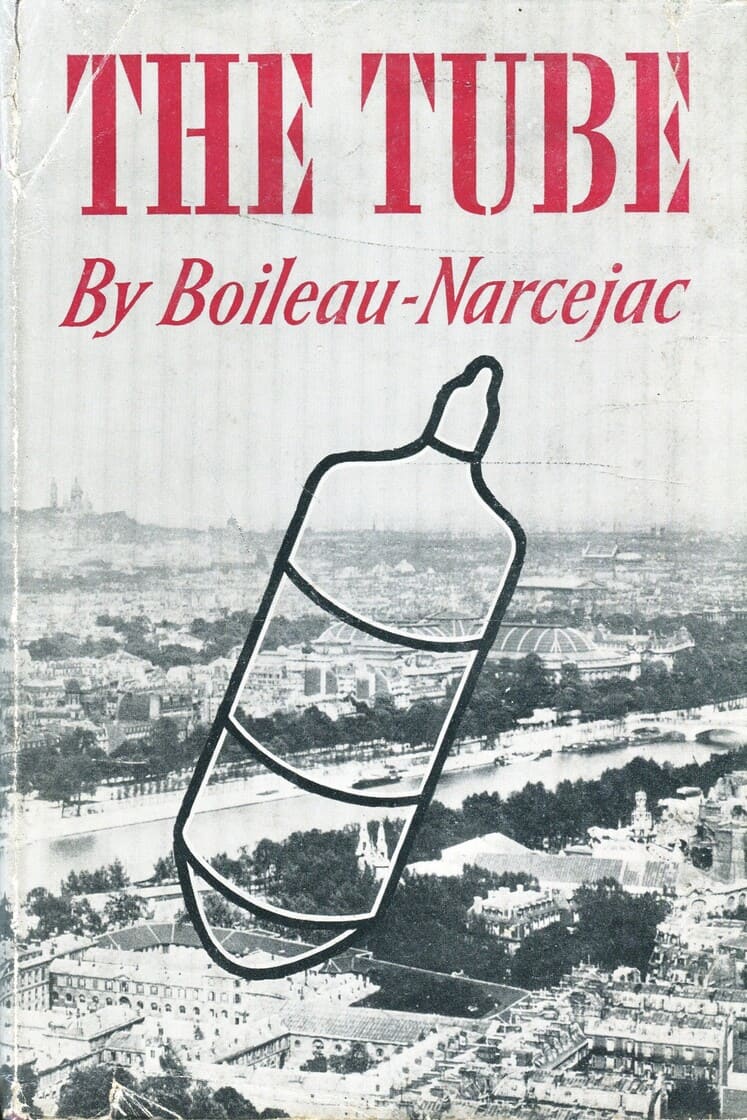
2026 is becoming the year in which I finally capture some white whales, having read the astonishingly elusive Into Thin Air (1928) by Horatio Winslow and Leslie Quirk and now the equally scarce The Tube (1958) by French maestros Pierre Boileau and Thomas Narcejac.
Returning from their lunch break to the largely-deserted scientific research centre where they work, two engineers are chatting with the security guard when a cry for help rings out from a nearby window, followed by the sound of a gunshot. Leaving the guard outside — he has a wooden leg, one of a handful of odd little touches that scatter the book — the two men race into the building and kick in the locked door to the room where the cry came from…only to find a colleague shot on the floor and the safe in the room standing open. But, since there wasn’t either the time or the place for the assailant to escape without being seen, and since the guard is able to assure them that no-one exited via the window, where’s the shooter?
“The murderer can’t be hiding in this building; one the other hand, he can’t have got either through the door or through one of the windows…[W]hat you’re saying doesn’t make sense.”
This impossible vanishing which opens the book is already a tidy little problem, and it is then added to with the realisation that from the empty safe must have been taken the tube of the title: a nuclear Macguffin which raises the stakes somewhat: “It [c]ould destroy the whole district, and half Paris would become radioactive for at least ten years… That’s just a rough indication of what it would be like”.

Written today, one feels that the Nuclear Threat storyline would predominate, with lots of military units deployed and men on high-protein diets chasing down slim leads while getting increasingly sweaty. Interestingly, Boileau and Narcejac treat this element almost as colourful background, giving us instead a much smaller focus on the people involved and the various impossible problems — for there will be more — which confront Chief Superintendent Mareuil, the poor man tasked with finding the killer and the nuclear device.
If this all sounds rather high stakes, it doesn’t come across with the urgency one might anticipate. The friend who leant this to me likened it to something by Georges Simenon, and I have to say that the comparison is not a million miles off.
[D]eath at any moment could turn thus corner of the world into a desert. And it was he, Mareuil, who had been chosen to avert the cataclysm. And he hadn’t the smallest clue, the faintest idea where to begin.
There is, given the amount of time spent cogitating over impossible shootings and incomprehensible vanishings, a surprising amount of character in here, with the wife of that murdered colleague “puzzling over a problem which kept her sorrow in check” when told of her husband’s shooting, or Mareuil and his colleague taking a moment in the midst of the madness to lean on the memories of the tough times (the French experience in the two world wars is lightly in the background throughout) which have forged their friendship:
“You remember…” Belliard had said. Yes, Mareuil remembered all right; every particle of Mareuil’s body remembered.
One feels for Mareuil, who must endure a certain amount of scepticism from his superiors while fighting against rising fears of the populace and a series of crimes that seem to defy explanation. If anything, it’s these sections which hit hardest, with Mareuil desperate for “a sudden dash, a little violent action which would at least get them somewhere,” and the Director of Police Headquarters, Lhuillier, parading in front of him a variety of more and more influential civil servants who complacently demand answers without contributing anything to the methods:
Luhuillier looked at Mareuil.
“Yes,” he said. “What’s you explanation?”
“I haven’t got an explanation,” said Mareuil. “I’m just stating the facts.”
“Anyone can do that,” observed Rouveyre from the depths of his armchair.
This title is included in Adey with two crimes against it: one shooting, and one vanishing. As it happens, there are four separate crimes, all of them some combination of shooting and vanishing — and all with distinct, though overlapping, solutions. And full credit to B-N, who present the situations with none of the hand-wavery of a less confident writer — what you’re told here, in deceptively simple prose, is what happens (or, well, what Mareuil observes happening), and it’s left to you to try and pick the bones out at the sense of unreality builds. “If the problem can’t be solved when it’s put like that,” Mareuil observes early on, “then it can’t have been put the right way,” and rest assured that what you’re told is accurate, you’re just caught in the maw of two masters.
That said, I did solve about 50% of it, and I feel pretty smug for doing so.
Mareuil is — and so your authors are, too — wise to the possibilities of misdirection, and some of these ideas are discussed as the gyre widens to take in even more impossibility, but you do also feel the sense of increased discombobulation “when a human being made of flesh and blood vanished like a puff of smoke, between four ordinary walls” causing reason to “totter”. This, too, along with the calm pace of it all, is there the Simenon comparison really feels strongest, with the awareness that “a criminal with exceptional resources at his disposal was pursuing his terrible ends” kept front and centre, and the investigation struggling whether pursuing the specific as Mareuil does or chasing down the general, as a colleague brought in to do an Inspector French-like job discovers.
Astonishment surged up inside him, and joy, a joy so fierce that it almost hurt, took him by the throat.
If you’re wondering: yes, this does share a certain amount of DNA with Boileau’s earlier, solo effort Six Crimes sans Assassin (1939) — an official English translation of which is coming this winter from Pushkin Vertigo — in the density of crimes, the steady growing of the pressure on the central sleuth, and some of the tricks deployed to explain the apparently miraculous events within. For me, Six Crimes is probably slightly the stronger book, but the final chapter revelations here were satisfying and superbly imbricated into the plot and character notes that had come before (indeed, the motive here is much stronger). In fairness to the French school in which this is written, you don’t get any clues mainly because none of them would help, and it’s sort of funny to me that Mareuil only sees the light because of an accident…but, obviously, I’ll say no more.
The Tube is, then, a superb little puzzle, and excellent character piece, a magnificent entry into the pantheon of baffling impossible crime plots, and a wonderful example of how European crime writers applied themselves to some beautifully inventive conceits. This translation by Robert Eglesfield is, to my knowledge, the only English version currently available, but if Six Crimes sells well when released and Pushkin are looking for more to follow it up with, they could certainly do much, much worse than to turn their eye this way. And, hey, I’d love a copy of my own to pick over in the years ahead, so get out there when Six Crimes comes out and buy, buy, buy!


Oh thanks, I need to get back to Boileau-Narcejac. I enjoyed a lot Sueurs froides (Vertigo).
Your book in French has actually an intriguing title: The Engineer who loved numbers too much!
LikeLike
This is one of those cases where the English title is, I feel, much better. The French one makes sense, but…I dunno, it’s not the focus I would pick for the book were I to write it. I’d frankly love to know why they picked it in the first place…
LikeLike
I’m curious, so I need to read the book!
LikeLike
Firstly you must find a copy, in which endeavour I wish you good luck 🙂 Maybe Pushkin might republish it if Six Crimes wells well, and I’d love to know others’ thoughts should this wonderful occasion come about.
LikeLike
I’m French so of course I’ll read it in French. I found a copy online very quickly
LikeLike
Oh, well, that’s cheating 🙂
LikeLike
“…so get out there when Six Crimes comes out and buy, buy, buy!“
You don’t have to tell me to buy Six Crimes Without a Murderer more than once, Jim, but it’s not coming this winter. They pushed the release date to spring next year. Same for Yukito Ayatsuji’s The Black Cat House Murders, now coming in February.
LikeLike
Presumably they were scared it would sell too many copies in the run-up to Christmas…
LikeLike
That or someone is trying to stage an intervention.
LikeLike