Not such a little Little Fiction this week, as I revisit the novella Six Were to Die (1932), which I’ve read before in edited form.
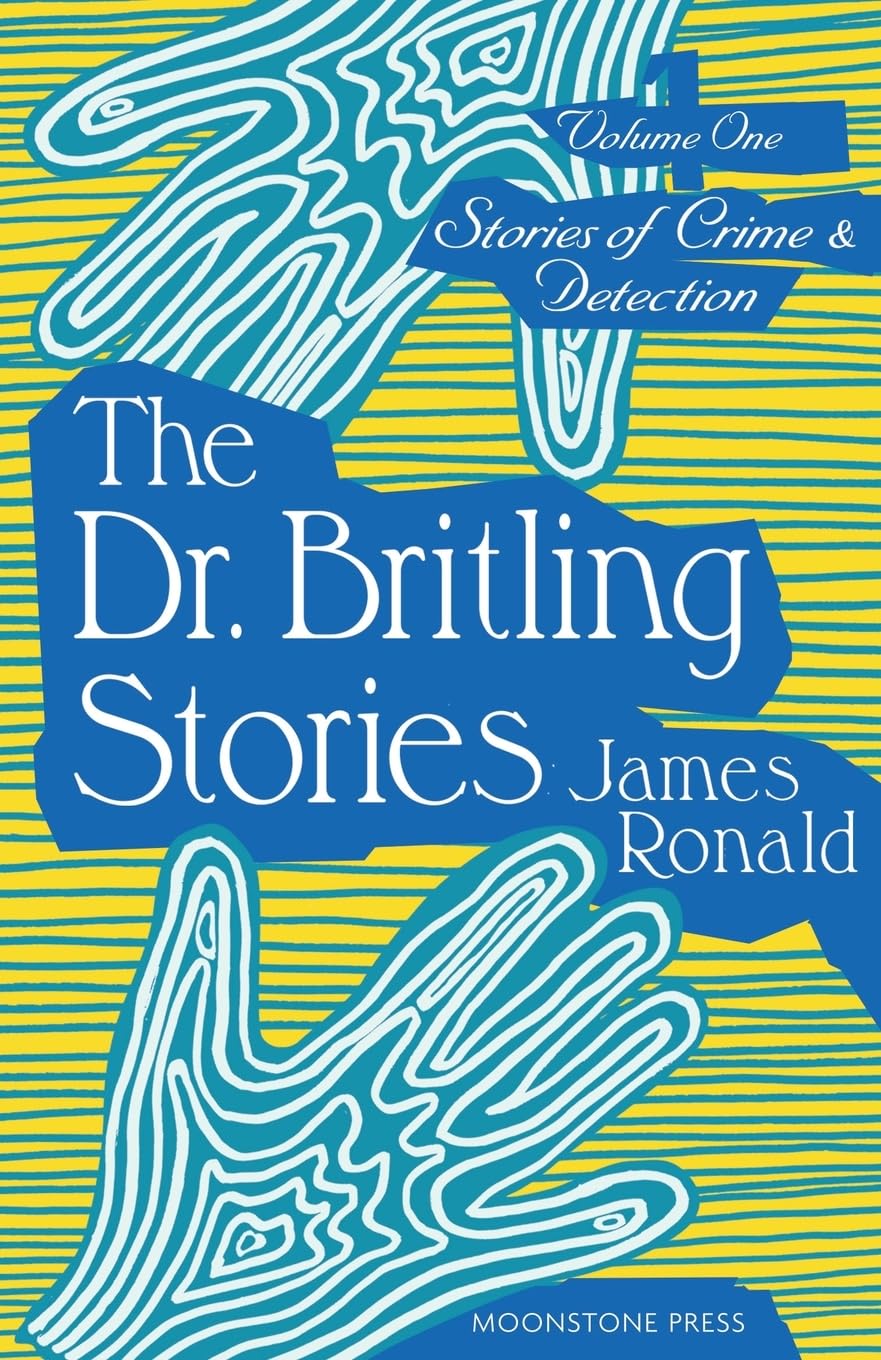
Remember, I’m working through the first volume of James Ronald’s criminous writings, in the process of being reissued by Moonstone Press; the titles in this volume are:
- ‘The Green Ghost Murder’ (1931)
- ‘Too Many Motives’ (1930)
- ‘Find the Lady’ (1930)
- Six Were to Die [n] (1932)
- ‘Blind Man’s Bluff’ (1929)
Full disclosure: I remembered bits of this, but many of the details are lost to history and the 700-odd books I’ve read since that first encounter. So I didn’t revisit my initial review before rereading this, and will just write up my thoughts of this unbowdlerised text without referring to my first impressions.
Enjoying a late breakfast, police surgeon Dr. Daniel Britling — this was to be his final appearance — receives first a letter forewarning him that he is about to receive an entreaty for help, and threatening that he should reject the advance or pay with his life, and then a visit from financier Jubal Straust, who comes proffering the aforementioned entreaty. Daniel, not one to take kindly to threats, listens to Straust’s story — that he and five associates have been threatened with death, with Straust himself told he will die at 5pm that very day — and agrees to help…only for Straust to die as foretold.
With Britling very much in the mix now, he continues on to the estate where Straust’s co-threatened have holed up, learns that they wronged an ex-colleague and he — now free from prison — is seeking his revenge, and decides to throw his lot in with this crooked bunch since, well, it’s not really right to go around murdering people, is it?

That’s really it as plots go: attempts are made, often successfully, on the lives of the core group, and Daniel must figure out from what quarter they come. What elevates this — and I really did enjoy this all over again, almost a new story since I could remember very few details — is how Ronald writes in the little details, like Mark Annerley “dressed in a close-fitting grey checked suit and socks, with a shirt and tie that were costly poems in coloured silks”, or the fact that he never tries to hide what utter bastards his accursed group are:
“Besides, what is friendship? Its commercial value is nil. Will a banker accept it as security? Will a pawnbroker take it in pledge? We followed the rule of the wolf pack. When the leader of the wolf pack stumbles, he is torn to pieces by his followers before he can rise.”
Additionally, where it would be easy to demonise these men and this woman as merely selfish fools getting what was due to them, Ronald introduces something somewhat admirable into the comportment of Gideon Levison, a man who keeps his head while those around him wait with increasing agitation for their wronged confrère to “exact payment in a coin of his own minting”. And Ronald even had time for his minor characters to enjoy a little life, such as chief goon Albert Moody caught delighting in the wonders of nature just as our villain is unmasked and a hot-foot chase is about to develop, or a nameless newspaperman desperate to get his dispatch to headquarters despite narrowly escaping the fiery denouement with his life.
A few semi-Thorndykian touches imbue this with a little more intelligence than the average pulp shocker employing this type of plot might see, such as Daniel’s diagnosis of one of the threatened men shoring himself up with cocaine, or a brief diversion into the actions of subcutaneous poisons. There’s no rigour as such — the impossible murders are explained away with a ready scarcity of detail (“I must decline to divulge the method whereby it was contrived” says our killer in his confession and, yup, that pretty much sums it up), but you’re somehow in no doubt as to how these things were done, and, perhaps most crucially, too much explanation would slow things down and spoil the fun — and we don’t want that, do we?
Because the truth is that I really, really enjoyed this, being swept along on Ronald’s light prose and wonderful descriptions (c.f. thunder echoing in the sky “like cannonballs rolling down the golden stairs of Heaven”) and his structuring that poses a problem and sees Daniel unpick it with astuteness fairly soon thereafter, just in time for the next event, rather than making us wait until the end for an ego-swelling monologue. They’re not among the finest examples of impossible crimes, and it’s far from the tightest detection you’ll ever encounter, but for sheer, giddy merriment this takes some beating: I read these 180 pages very quickly indeed, and thoroughly enjoyed them all. Hell, the death of one of the eponymous six is actually rather moving…and to achieve that at this pace with those archetypes is no mean feat!
And so the second life of James Ronald’s criminous career gets off to a great start, with much to enjoy and much that hints at the strength of what is to come. My thanks once again to series editor Chris Verner for all the effort he has put in, and to Moonstone Press for both providing me with this volume and, more generally, for taking up the mantle of republishing Ronald in the first place. A wonderful undertaking all round, and I urge you in the strongest possible terms to support both this opening volley and all the volumes to come.
~
The James Ronald Stories of Crime and Detection, published by Moonstone Press:
- The Dr. Britling Stories (1929-31)
- Murder in the Family (1936)
- This Way Out (1939)
- They Can’t Hang Me (1938)
- The Dark Angel (1930)
- Cross Marks the Spot (1933)
- Death Croons the Blues (1934)
- Hard-Boiled (1937)
- Murder for Cash (1938)
- Counsel for the Defence (1932)
- The Sealed Room Murder (1934)
- She Got What She Asked For (1941)
 The Invisible Event
It’s interesting – the setup kind of sounds like a reverse take on They Can’t Hang Me, which Ronald published later in his career.
LikeLike
I can well believe that Ronald thought of how to improve this as his writing prowess improved, as They Can’t Hang Me is definitely an improvement on this theme. Both are a lot of fun, but this is a pulp author’s take where TCHM is a proper novel of suspense.
LikeLike