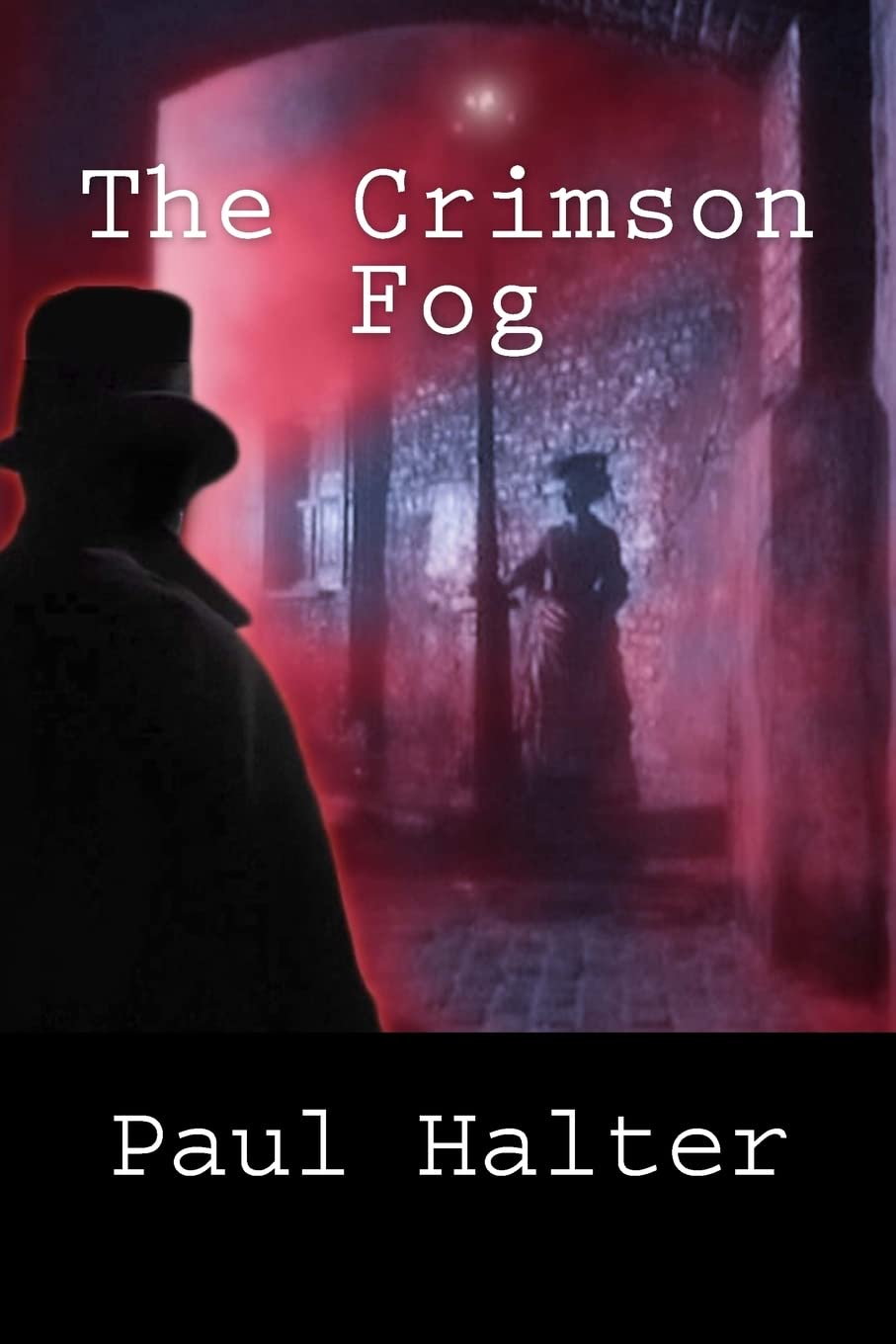
With a new Paul Halter short story recently appearing in Ellery Queen Mystery Magazine, not to mention novel The Siren’s Call (1998, tr. 2023) being newly translated, the time seemed ripe to jump into the sole remaining Paul Halter novel that I first read pre-blog. The Crimson Fog (1988, tr. 2013) represents something of a tricky proposition to review, so let’s see how we do.
It is May 1887, and our narrator Sidney Miles gets off the train in the village of Blackfield where, some nine years ago, squire Richard Morstan was murdered in apparently impossible circumstances: stabbed in the back while his daughter and her friends sat on the other side of a drawn curtain awaiting a magic show. Marston had already demonstrated that his half of the room was untenanted by any other physical being, so how could someone have entered, stabbed him, and — crucially — left unnoticed? The only door to that side of the room had planks nailed over it, the open window had witnesses outside of it the whole time…and Sidney Miles wants to figure out how murder was done.
Except, there are already a few complications. From the off, we know that Sidney Miles is not our narrator’s true name and that this is not his first visit to Blackfield: he spent his youth there, and is hopeful that, now a grown man, none of the denizens who remain will recognise him. So what is his interest in the murder of Richard Morstan? He tells others that he’s a journalist writing a novel that will include the method used in Morstan’s murder, but the reader has reason enough to be doubtful of this given the efforts gone to in obscuring his identity…and as the mystery unfolds, this question gets only deeper.

In the nine years since I first read this, my memories of it have become a little muddled. I distinctly remembered that the first section of the story, set in Blackfield, then gave way to a second half set in London which seemed at first to bear no relevance to what had gone before…and this turned out to be false on both counts: the London-set scenes arguably follow very logically from those in the provinces, and the murder mystery in Blackfield in fact takes up the first two-thirds of the book. I also remembered that final developments of this being closely linked to the three words always thrown around when talking about the book to the extent that those three words constituted a massive spoiler…and that’s also not the case. So, well, in many ways I was reading a new book here.
I’d argue on this revisit that the murder mystery set in Blackfield is the most successful section, and it’s almost a shame — though completely understandable — that the action has to move to London at all. The murder of Richard Morstan is a clever little puzzle, and the use of various people in the village to unpick the mystery is very neatly done. With a little more substance, or an additional thread, this could easily be fleshed out into a full novel of its own, since the reversals, clever misdirection, and eventual answers are well-handled and will take even the most seasoned reader by surprise. Hell, even the romance between Miles and innkeeper’s daughter Cora is well-written, and that sort of thing is usually a tertiary consideration at best in novels of this type.
I hadn’t appreciated quite how much of a mood piece this was, either, with translator John Pugmire finding in Halter’s original prose some superbly affecting descriptions:
But for her almost inhuman coldness, the severity of her coiffure which held her opulent hair in check, and the sombre dress which deprived her of all femininity, she could have been beautiful.
And when we move onto the capital, there’s much to be enjoyed in Halter’s atmospheric rendering of the various slums and corners we encounter:
London is often described as a juxtaposition of towns, such is the startling contrast between its different quarters. The West End, a mixture of parks and palaces, opulent mansions and green gardens, immense squares, green carpets framed by trees and fenced by iron grills. Then, in the East End, the greatest and cruellest of miseries, an open wound typified by Spitalfields and Whitechapel. Overpopulated and squalid neighbourhoods, narrow, winding streets lined with large, leprous houses sweating with dampness, where all of life’s human debris seem to have congregated; a teeming, haggard population suffering the scourge of poverty and vice in all its forms, including the most abject.
The purpose of those first two-thirds in setting up this final chase is much clearer to me second time around — or, well, I’ll remember it better, certainly — as murders terrify the East End and various historical figures (some real, some fictional) come into proceedings. Again, Halter’s writing is excellent (“The bloody series was going to continue and London was going to walk in terror.”) and the various twists and surprises are well-handled, even if my faulty memory tells me that I was wise to them first time around…because, see, some of this stuff is hidden very well — and, disappointingly, this is at least in part because Halter cheats at a key moment which stuck out to me this time around since I already knew his eventual solution.
That aside, the final third of this is again a delight, the only caveat perhaps being that something of an underwhelming air pervades in some of the answers where impossible disappearances are concerned (I’ve reconciled myself to the sheer lack of detection in halter’s novels now, understanding as a result of other excellent translations from Pugmire that detection was never really a part of the French school of mystery writing). You have to love Halter telling you at a couple of stages ‘Look! I told you this thing!’ as if reassuring you that he has played fair…but, in all honesty, I’d advise that the best approach is to not expect too much rigour and to let the sheer chutzpah of it all just roll over you.
So, yes, a tricky proposition to review — I feel like I’ve been picking my way between eggshells this whole time — but a fun time to revisit and see, that one cheat aside, how much the sheer enjoyability of The Crimson Fog had stood up in my mind. It won’t make a fan of anyone not convinced by Halter’s brand of mystery, but if you’re already a fan and have someone missed this one, you’re missing out.
~
Paul Halter reviews on The Invisible Event; all translations by John Pugmire unless stated
Featuring Dr. Alan Twist and Archibald Hurst:
The Fourth Door (1987) [trans. 1999]
Death Invites You (1988) [trans. 2015]
The Madman’s Room (1990) [trans. 2017]
The Seventh Hypothesis (1991) [trans. 2012]
The Tiger’s Head (1991) [trans. 2013]
The Demon of Dartmoor (1993) [trans. 2012]
The Picture from the Past (1995) [trans. 2014]
The Vampire Tree (1996) [trans. 2016]
The Siren’s Call (1998) [trans. 2023]
The Man Who Loved Clouds (1999) [trans. 2018]
Penelope’s Web (2001) [trans. 2021]
Featuring Owen Burns and Achilles Stock:
The Lord of Misrule (1994) [trans. 2006]
The Seven Wonders of Crime (1997) [trans. 2005]
The Phantom Passage (2005) [trans. 2015]
The Mask of the Vampire (2014) [trans. 2022]
The Gold Watch (2019) [trans. 2019]
Standalones:
The Crimson Fog (1988) [trans. 2013]
The Invisible Circle (1996) [trans. 2014]
Collected short stories:
The Night of the Wolf (2000) [trans. 2004 w’ Adey]
Individual short stories [* = collected in the anthology The Helm of Hades (2019)]:
‘Nausicaa’s Ball’ (2004) [trans. 2008 w’ Adey]*
‘The Robber’s Grave’ (2007) [trans. 2007 w’ Adey]*
‘The Gong of Doom’ (2010) [trans. 2010]*
‘The Man with the Face of Clay’ (2011) [trans. 2012]*
‘Jacob’s Ladder’ (2014) [trans. 2014]*
‘The Wolf of Fenrir’ (2014) [trans. 2015]*
‘The Scarecrow’s Revenge’ (2015) [trans. 2016]*
‘The Fires of Hell’ (2016) [trans. 2016]*
‘The Yellow Book’ (2017) [trans. 2017]*
‘The Helm of Hades’ (2019) [trans. 2019]*
‘The Celestial Thief’ (2021) [trans. 2021]
‘The Wendigo’s Spell’ (2023) [trans. 2023]
 The Invisible Event
I wasn’t aware that The Siren’s Call was coming so look forward to reading it. I see that it’s available in the US from the usual online places. You mention that a Halter short story was recently in EQMM, do you know the title of that one?
LikeLiked by 1 person
The Wendigo’s Spell, I believe.
LikeLiked by 1 person
Thank you – I am off to track down that story. Indeed it is in the May-June 2023 issue of EQMM.
LikeLike
I’m looking forward to reading this, having only recently run a copy to earth myself. I’m told it’s a good ‘un…
LikeLike
Indeed.
LikeLike
This novel seems to have a reputation based solely on its final third, and yet, as you capture, that is the slump of it. The first two thirds though, capture Halter at what may be his closest moment to Carr in the late 30s. This received great press, and maybe – in spite of the headline summaries – was for the first portion.
LikeLiked by 1 person
I seem to remember reading — though, citation needed, as this was a long time ago — that the focus of the final third was a particular fascination of Halter’s, and so in that regard setting up the first section to explain the last makes sense. But, man, there’s a wonderful historical mystery here that got a little pushed aside — not without moments of interest, I grant you — so that personal fascination could be explored. There’s enough material here for two books, really; a shame he only wrote the one…!
LikeLike
I remember being underwhelmed by this one, in part the change that occurs two thirds of the way in – I wonder, if you know it’s coming, does that make it make more sense? I’ve reread a couple of Halters that I was less impressed by and, knowing the basic shape of the solution, found them better than I expected. But that does perhaps reveal a flaw somewhere in his writing style if you have to read it twice to “get” it.
LikeLike
I remember reading this the first time one Friday evening after work — I just sat on my couch glued to my Kindle and tore through the whole thing in one sitting. In that regard, I might not have been in the best place to appreciate its subtleties 🙂 Taking more time for this second read, the second section does follow more naturally from the opening two-thirds than I remembered, so maybe it’s just a case of having gone in with the wrong expectations on my part. Certainly it did feel as jarring, and anyone going in prepared for this to be a little…experimental should be fine, I’d reckon.
But it’s not going to make a fan of anyone who’s already on the fence about Halter. And that makes it all the more brave considering it was, I believe, his second published novel.
LikeLiked by 1 person
This (Le brouillard rouge) was the first Halter I read, and I detested it. I remember it being graphic in its gore.
LikeLike
Yes, the violence here is on a different level to the rest of his works, eh? Almost like something Michael Slade would write.
And yet, I suppose, the real life murders he’s including would be pretty well understood…so I wonder if it’s possible to write about them in this way without being so gory. Certainly he’s not repeated it in anything else I’ve read in English, so it feels like a distinct — if hard to bear — stylistic choice for this particular novel.
LikeLiked by 1 person
Just like you, my memory of The Crimson Fog has become blurry, but remember being disappointed Halter didn’t obscure the time period of the Blackfield portion of the story. I think it would have made the part about those three closely-linked words even better. But, yes, definitely a good Halter.
Surely, enough short stories have accumulated by now to compile a sequel to The Realm of the Impossible. But what to title it? A World of Wonders? Frontiers of the Possible?
LikeLike