Disclosure: I proof-read this book for Locked Room International in October 2015.
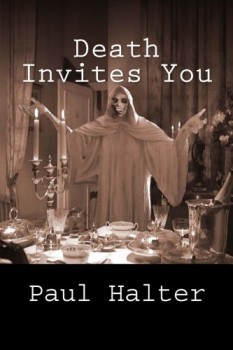 Death Invites You, the third novel published by Paul Halter – who is swiftly gaining a deserved reputation as a deviser of baffling locked room puzzles – is based around the murder of man found dead in his study with the door bolted from the inside, seated at a table set for a meal. The victim, Harold Vickers, is an author who has gained a deserved reputation as a deviser of baffling locked room puzzles and whose next novel – Death Invites You – was due to feature a victim found dead in his study with the door bolted from the inside, seated at a table set for a meal. It is unfortunately never revealed whether Vickers’ victim was an author of some repute working in the field of locked rooms and whose next novel was due to feature such a crime, but, given the hall of mirrors that you enter at the beginning of any Halter narrative, it frankly wouldn’t surprise me…
Vickers’ novel was, alas, incomplete, and so with the method remaining a mystery Inspector Archibald Hurst and criminologist and amateur genius Alan Twist are called in (this was the first Halter novel to pair them on page) to untangle a mess involving suspicious neighbours, suspicious house staff, suspicious family members and generally suspicious everyone. If it sounds like I’m being dismissive, I’m really not – this book is a joy, and rockets along through a combination of Halter’s deft plotting, wonderful eye for the obscure (the bowl of water under the window, for instance) and John Pugmire’s fabulous translation. You get the impression that Pugmire is now immensely comfortable and confident doing this – not just the translating, but capturing Halter’s voice and atmosphere – and has really relaxed into the role over the last few Halters he has put out. The last time a John and Paul worked this well together for your delectation, they produced Let It Be.
I could cite many other acknowledged locked room classics, but I prefer to enjoy Halter for being Halter. This lacks the complexity of, say, The Tiger’s Head or the monstrous thrust-and-parry of The Seventh Hypothesis, but it’s more believable than The Seven Wonders of Crime – the plot-within-a-plot structure recalls Halter’s debut, The Fourth Door, and he even ties in his second novel, The Crimson Fog, into this universe (giving away – in chapter one – the direction that book takes, though naturally without spoiling anything specific). There are some lovely flourishes that complicate the commission of the crime, too, as if he isn’t content to simply give you a murder behind a bolted door, instead filling out what could otherwise be a fairly routine setup with something much more arresting. If anyone does this kind of elaboration even half as joyfully as Halter, please let me know in the comments as I dearly love seeing it done so well.
From Vickers’ magician brother-in-law to the aforementioned suspicious neighbour, and the young policeman – fiancé to one of Vickers’ two very different daughters – desperate to settle the matter for the sake of his wife-to-be, the characters feel slightly more rounded than criticism of Halter would otherwise have you believe him capable of. I mean, sure, you’re not getting a nuanced portrait of grief in the face of the unknown, but you didn’t sign up for that (I’m hoping); eschewing the easy option of falling back on archetypes, Halter has at least given his characters some personality beyond a mere function in the plot. Hurst is good value here, too, clearly more than just a Rent-A-Watson but never veering into easy parody or buffoonish slapstick, and gets some of the best lines (I’m itching to give one as an example, but would hate to spoil some of the laughs you’ll get). Only Twist is an enigma, perhaps deliberately, held back to reveal the startling truths everyone else misses, but a slightly pale presence even in his finest hour.
This doesn’t get five stars because, as the eleventh Halter novel that Locked Room International have published, I’ve already seen how fantastic he is elsewhere and this falls perhaps a tiny bit short of the originality of The Phantom Passage or freshness of The Invisible Circle. That’s perhaps being a trifle unfair, but at his best he really is in the top-rank: the solution to the locked room here is a little derivative in light of how versatile his solutions would become, and there’s one key aspect elsewhere (a feature of this type of fiction, let’s say) that’s possibly a trifle underdeveloped. Nevertheless, for a third novel it’s a bold statement of intent, significantly ahead of what practically all his contemporaries are offering, and even more exciting for having seen this promise already fulfilled.
However, if you are looking for somewhere to start with Paul Halter’s books, or with locked room mysteries in general, this is practically perfect – lacking the contortions of his more complex novels that might dissuade the unfamiliar or unwary, and positively overflowing with excellence in virtually every other department. Another superb job from John Pugmire and Locked Room International; encore, encore!


Paul Halter reviews on The Invisible Event; all translations by John Pugmire unless stated
Featuring Dr. Alan Twist and Archibald Hurst:
The Fourth Door (1987) [trans. 1999]
Death Invites You (1988) [trans. 2015]
The Madman’s Room (1990) [trans. 2017]
The Seventh Hypothesis (1991) [trans. 2012]
The Tiger’s Head (1991) [trans. 2013]
The Demon of Dartmoor (1993) [trans. 2012]
The Picture from the Past (1995) [trans. 2014]
The Vampire Tree (1996) [trans. 2016]
The Siren’s Call (1998) [trans. 2023]
The Man Who Loved Clouds (1999) [trans. 2018]
Penelope’s Web (2001) [trans. 2021]
Featuring Owen Burns and Achilles Stock:
The Lord of Misrule (1994) [trans. 2006]
The Seven Wonders of Crime (1997) [trans. 2005]
The Phantom Passage (2005) [trans. 2015]
The Mask of the Vampire (2014) [trans. 2022]
The Gold Watch (2019) [trans. 2019]
Standalones:
The Crimson Fog (1988) [trans. 2013]
The Invisible Circle (1996) [trans. 2014]
Collected short stories:
The Night of the Wolf (2000) [trans. 2004 w’ Adey]
Individual short stories [* = collected in the anthology The Helm of Hades (2019)]:
‘Nausicaa’s Ball’ (2004) [trans. 2008 w’ Adey]*
‘The Robber’s Grave’ (2007) [trans. 2007 w’ Adey]*
‘The Gong of Doom’ (2010) [trans. 2010]*
‘The Man with the Face of Clay’ (2011) [trans. 2012]*
‘Jacob’s Ladder’ (2014) [trans. 2014]*
‘The Wolf of Fenrir’ (2014) [trans. 2015]*
‘The Scarecrow’s Revenge’ (2015) [trans. 2016]*
‘The Fires of Hell’ (2016) [trans. 2016]*
‘The Yellow Book’ (2017) [trans. 2017]*
‘The Helm of Hades’ (2019) [trans. 2019]*
‘The Celestial Thief’ (2021) [trans. 2021]
‘The Wendigo’s Spell’ (2023) [trans. 2023]
 The Invisible Event
Thanks for the review – I should have known that only a very special occasion, such as the release of another novel by Paul Halter, would result in a break in your weekly routine. 🙂
Given your earlier ranking of ‘Death Invites You’ as the third-best Halter title,together with ‘Invisible Circle’/ ‘Crimson Fog’/ ‘Demon of Dartmoor’/ ‘Seventh Hypothesis’, superseded only by ‘Phantom Passage’ and ‘Tiger’s Head’ – I would have expected a rating closer to 5 rather than 4 stars… Nevertheless, I’m glad to hear that it’s better than ‘Seven Wonders’, which struck me to be good rather than great.
I think ‘Tiger’s Head’ will be my next Halter novel to be lifted from the TBR pile – unless you think ‘Invisible Circle’ or ‘Death Invites You’ should come first…?
LikeLike
It’s a tricky one to call, as I personally abolutely loved it but I recognise that elements of the solution hold it back from five-stardom It’s not -gasp! – completely original). The translation really is top-drawer, and it’s the perfect place to start with Halter or impossible crimes as I say, but the solution just pulls it back a touch and my mathematical background makes partial starts a slippery slope!
Tiger’s Head is wonderful, it’s a perfectly good place to go next. I mean, you should read them all and I will be badgering and bothering you until you do (same with Rupert Penny!), so really the order doesn’t make much difference now you’ve done Seven Wonders. That’s by no means a bad book, but it is the weakest in my opinion. Nothing to fear after that, read ’em in whatever order you like.
LikeLike
Ah, surely ‘Lord of Misrule’ would qualify as a weaker novel than ‘Seven Wonders of Crime’? 😛 I think I had a great start with Halter, having begun with ‘Sevenh Hypothesis’, but two relatively weaker novels in a row after that – ‘Seven Wonders’ and ‘Crimson Fog’ – dampened my enthusiasm slightly. Thankfully things picked up after that with ‘Fourth Door’. I think I shall read ‘Death Invites You’ next; I tend to leave the best for the last, which means that ‘Demon of Dartmoor’ and ‘Phantom Passage’ will be collecting dust on the TBR shelf for some time…
P.S. Is originality even possible after John Dickson Carr? Ok, ok, I’m being tongue-in-cheek…
LikeLiked by 1 person
Personal tastes, but I really enjoyed LoM. I was planning on reviewing in on here at some point as it was the very first halter novel LRI put out, so hopefully we’ll get a chance to discuss it before too long.
And my experience of Crimson Fog was coming home from work absolutely worn out one Friday evening, sitting down to start it about 7pm and then putting it down finished at about 10pm, so suffice to say I hugely enjoyed that, too – though it does seem to be a less popular book of his, which mystifies me a bit.
As for post-JDC originality..well, well…you may be joking, sir, but..well…well…humph…harrumph…well…
LikeLike
I purchased ‘Death Invites You’ on my Kindle earlier this evening, and managed to complete the novel in (largely) one sitting. 🙂 I enjoyed the novel, and I concur with your assessment of it. Thanks for the review! 🙂
The solution to the locked-room scenario is clever, and gains points for simplicity – but yes, one key aspect of the trick is familiar, given that I’ve been gorging on a certain crime/ detective television series cast in the mould of Golden Age mysteries. I was wondering if we have been watching the same television series? Or if you encountered the trick in another novel?
In terms of ranking, I would certainly put this above ‘Seven Wonders of Crime’ and ‘Crimson Fog’, but below ‘Seventh Hypothesis’. I’m ambivalent as to whether it supersedes ‘Fourth Door’ – but I would say that the events in ‘Death Invites You’ were more plausible than one or two central elements in ‘Fourth Door’.
*Potential Spoiler*
Given what I’ve read from Halter so far, the choice of culprit(s) seems slightly predictable; towards the end, I started wondering if Halter would pull a familiar rabbit out of the hat. But at least in ‘Death Invites You’, I didn’t think it was as obvious as it was in the other novel, where I started smelling a rat two-thirds way through. The relative brevity of ‘Death Invites You’, among other things, helped…
LikeLike
Wow, procrastination is not in your lexicon, is it?! I’m very impressed! And of course delighted that you found it such a quick and enjoyable read. Isn’t the translation marvellous? I honestly think that John Pugmire has got better and better as he’s gone, and it really shows here.
The element of the solution you refer to is something I’ve encountered in both TV and books, though obviously I’ll neglect to mention specific titles. As for the culprit, I liked the reveal and I particularly liked the justification Twist used for highlighting that person – it was a nice touch, and definitely improved the solution given that it’s not among Halter’s most original.
I’ll be extremely interested in your views on Halter as I chart his books both past and future…it sounds like you may be a kindred spirit; I’m thinking I need to read Pugmire’s translation of Noel Vindry’s The House That Kills soon, as I’ve had it for ages and it keeps drifting down the TBR – have you read that?
LikeLike
I have finished the book and cannot rate it higher than 3.
Yes, the locked room trick is clever but it is not original. The trick was used in a novel published in 1942 and also in a novel published in 1985.
The identity of the culprit becomes obvious much before the end.
SPOILER ALERT (what follows contains spoilers)
The plan of the culprit is so complicated that I am unable to understand his strategy. For example, what is the reason for burning the face and hands ? If the intention is to create confusion regarding the identity of the victim, it makes no sense since as long there is confusion, the inheritance would be blocked. Moreover, the plan of the culprit is to reveal both the bodies so that he can claim both inheritances. Then why this attempt to create confusion.? Also if he wants to implicate Diane then it is essential that the first victim be identified as Harold.
What happens on the night between Sunday and Monday is absurd. The culprit goes to the first floor and murders a woman (luckily she does not scream !) Then, instead of escaping quickly, he calmly goes to Diane’s room, cuts off a few locks of her hair and hides the locksmith’s kit under her mattress. He then goes outside to place a piece of his bloody sheet on the path leading to the cemetery. He then goes back to the house, climbs to the first floor to Valerie’s room and frightens her. Valerie’s screams waken other people in the house and would have woken the neighbours in the still night. Still he manages to escape undetected !
LikeLiked by 1 person
Hahaha, well when you put it like that…! I’m not sure if it’s a credit to how much I enjoyed the book or to the detriment of my critical eye that most of this didn’t occur to me when reading it, but I’m going to take it as the former.
And it’s not like Halter hasn’t employed shaky schemes before: I think we’re agreed that The Phantom Passage is among the best currently translated, but as a set of actions go it’s hilariously unlikely. I just get swept up in the fun he’s obviously having!
LikeLike
Completely agree, JJ. But surely some of the actions at the first crime scene were just to replicate the fictional crime scene?
LikeLike
Pingback: #70: Five to Try – Starting Paul Halter | The Invisible Event
Pingback: #102: Paul Halter Day – II: The Impossibility of More Impossibilities | The Invisible Event
Pingback: #162: The Tuesday Night Bloggers – Meta-Fictional Historical Deconstruction in Magpie Murders (2016) by Anthony Horowtiz | The Invisible Event
Pingback: #200: Celebrating 100 Impossible Crimes with Paul Halter’s The Vampire Tree (1996) [trans. John Pugmire 2016] | The Invisible Event
Pingback: Death Invites You by Paul Halter – Mysteries Ahoy!
Pingback: #434: Locked Room International is 30 – My Favourite 15 Books | The Invisible Event
I decided to try a Paul Halter book and this was the only one my local library system had without needing to call in an interlibrary loan, so I just tried it out- and help me out, but is this meant to be an inverted mystery? As someone who has read more than five mystery novels before it was IMMEDIATELY obvious who did it (like, I guessed correctly before the murder was committed) and honestly much of my suspense was hoping that it would turn out to be someone else… I think the thing that captured my attention most was all the fun detailing of the actual murder itself; the solution was fine (though I think the solution as to the similarity with the past case was more fun/interesting) but the identity of the killer wasn’t a surprise at all.
So I keep wondering- was this on purpose, with Halter dropping a zillion circumstantial clues to a really obvious person who did in fact do it so we’d just be wondering how they could have done it? Or was he so zeroed in on making the locked room bit intricate and tricky that he lost perspective on how much other cluing was too much? Or am I the only one who saw the book that way? (I’d make a comp to another book with the same shtick that I got earlyish on though not nearly as early as here, but on searching your blog I’m not sure it’s one you read yet so I won’t risk spoiling as it’s great and takes the shtick in a different direction.)
LikeLike
Firstly, I’m impressed Halter was in your library system at all.
Secondly, I’m afraid I’m no good when it comes to critical appraisal of Halter’s work; a bit like Walter S. Materman, something in his writing just brings me so much joy that I often struggle to remember to have a critical eye on what’s actually happening.
That said — it’s to be wondered if you might not have a point. At times in his career (The Fourth Door, Seventh Hypothesis, etc) he points the finger so squarely at someone in a way that you find yourself suspectng whether he thinks he’s being subtle…and, well, how each of those plays out depends on how suspicious you are. So…maybe that’s what he did here? As a double-bluff? Although before he’d written either of those books…so, as a pre-bluff…?
I mean, probably not, but, also, why not?
I’m also very intrigued about which other book you’re thinking of — please tell. I’m honestly not sure what you’re referring to, and I’ve got about 15 years of GAD reading not on this blog, so there’s a good chance you’re not spoiling anything.
LikeLike
Completely fair to love something enough that it becomes against nature to separate oneself enough from it for critical analysis- I have so many things where I’m the same!
And yeah, the NYPL has some very strange blind spots while also having some incredibly random finds so I was really excited to find this one! Without reading others it’s impossible for me to compare in terms of how he writes about other people who turn out to be the killer, but it was just so odd to me how clearly they were signposted throughout.
And in terms of the comp I allude to, a particular book did come to mind (ROT13: Qrngu Jnyxf va Rnfgerccf) but while there is one key similarity (gur xvyyre orvat n pbc jub xvyyf- vs abg arprffnevyl va guvf cnegvphyne vafgnapr- va beqre gb vzcebir uvf pnerre), and the personalities of the two killers are aligned as well, the motives in the primary cases aren’t quite the same and once you’re at that point you’re in the much broader general pool of the xvyyre cbyvprzna which goes back at least as far as GK Chesterton.
LikeLike
Whoops this was meant to be a reply to the other thing!
LikeLike
See, now you’ve got me wondering what the earliest example of this style of story — at least the person being criminous, if not outright murderous — might be.
Not read DWiE, but I did know that was the solution, so no harm done 🙂
LikeLike
Interesting question! So we have that Father Brown story in 1910- that’s early enough that it’s not impossible it’s the first but late enough that it PROBABLY isn’t.
LikeLike
There’s doubtless something in my Victorian crime story reading, especially given the behaviour of early police force. But I’m dashed if anything comes to mind (which happens more and more lately…I think).
LikeLike