Ramble House
 Over the summer, I read certain sections of Masters of the Humdrum Mystery by the
 #187: Policeman in Armour (1937) by Rupert Penny
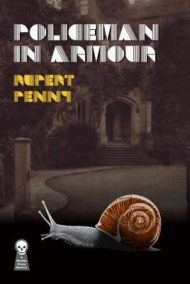 I am swiftly approaching the point where I will be reluctant to read any more Rupert Penny; he published a mere nine books, of which Policeman in Armour is the fifth I’ve read, and I don’t want to find myself in a situation where there’s no new Rupert Penny to pick up and lose myself in. I still have plenty to be getting on with — half of Carr, 10 Christies, 17 Berrows, countless undiscovered gems — but Penny holds a special significance for me because he is such a superb classicist and produced detective plots that walk the fine line between several stools without tripping and getting trapped between any of them (I apologise for any pain that mixed metaphor may have caused you).
Continue reading
#181: The Tuesday Night Bloggers – Strangers in Strange Lands: When East Comes West…
Alongside classic detective fiction and locked room/impossible crime mysteries of every date, stripe, and hue, I read a moderate amount of both classic and modern SF. And as much as I rejoice in the closedness of the ‘rules’ of detective fiction, I take equal delight in the free-form craziness that can open up in front of you in excellent SF.
Continue reading
#167: Case in the Clinic (1941) by E.C.R. Lorac
 Given the number of people who applied themselves to the challenge of writing a novel of detection during the Golden Age (precise dates pending…), it is to be expected that a fair number of wonderful novels, plots, ideas, and authors will have been lost in the tidal wave of creativity. Through the continued efforts of publishers like Ramble House — who were reprinting this stuff before it was cool again — we’ve been able to rediscover Max Afford, Norman Berrow, Rupert Penny, Hake Talbot, and others, and it’s this path of frank fabulousness that has brought me now to E.C.R. Lorac, author of some 70-odd novels under a couple of pseudonyms. Does she belong in the realm of How In The Hell Is This Stuff Overlooked? Well, on this evidence…maybe.
Continue reading
#163: The Spaniard’s Thumb (1949) by Norman Berrow
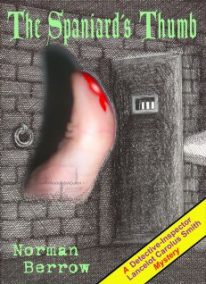 We should be thankful that Norman Berrow left behind him such wonderful novels as these that make it almost possible to get a glimpse into the workings of his mind. I mean, who else would predicate a novel on the grounds of a giant disembodied thumb vengefully crushing to death anyone who ventures into its lair? It’s a setup too barmy for John Dickson Carr’s fertile impossibilities, too outré for the straight-laced world of Agatha Christie, Miles Burton, Christianna Brand, and their ilk, and doesn’t have enough train journeys for Freeman Wills Crofts. It’s too comedic and explicit for the standard horror get-up of M.R. James or those who followed him…honestly, had Berrow not written this there’s really no-one else who could have.
Continue reading
#148: So, Like, What Is an Impossible Crime or a Locked Room Mystery?
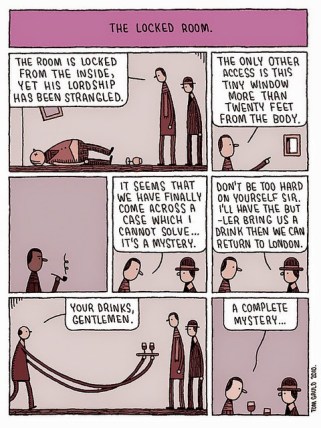
Recent experiences of reading Darkness at Pemberley by T.H. White and What a Body! by Alan Green — oh my days, I’ve only just noticed that they’re both named after colours… — have made me wonder on the above question. See, both are listed here, on a compendium of the best ever locked room mysteries voted on by an international collection of people who know about this stuff, and both are listed here, on a rundown of the favourite locked room mysteries by resident blogosphere expert TomCat…yet personally, in the face of public opinion from such well-informed and respected sources, I’m reluctant to consider either of them as locked room mysteries. Even taking my famously contrary nature out of the equation…what the hell?
Continue reading
#110: The Dead Are Blind (1937) by Max Afford
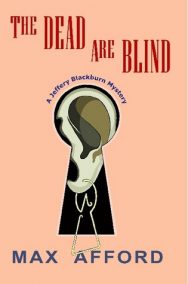 I believe the philosopher John Francis Bongiovi, Jr. said it best: “Keep the faith”. The Dead Are Blind is the third novel by Max Afford I’ve read and, having hugely enjoyed the other two, I found myself struggling to maintain interest through the opening chapters. Certainly from a historical perspective they have plenty to offer – our lead characters are invited to tour a radio studio on its opening night, something of a gala event at the time, and so this is chock-full of fascinating tidbits from Afford’s own experience of working in radio. But the mix of dense description and fixation on minute details that are hugely unlikely to become relevant later puzzled even my will and left me a bit apathetic by the end of chapter two.
Continue reading
#109: The Tuesday Night Bloggers – The Problem with Poison via ‘Poison Can be Puzzling’ (1944) by Max Afford
It’s Max Afford Week on The Invisible Event…not through any design, but purely because I selected his novel The Dead Are Blind (1937) as my review this coming Thursday and the Tuesday Night Bloggers’ chosen topic of ‘Poison’ gives me the chance to look at one of the three short stories in the Ramble House collection Two Locked-Room Mysteries and a Ripping Yarn. But, hey, that’s no bad thing, as Afford is one of my discoveries of the last year or so and it’s always nice to shine a little light his way.
Continue reading
#96: The Tuesday Night Bloggers – Educatin’ the Pulps in Robert O. Saber’s The Black Dark Murders (1949)

 The Invisible Event