
OOP
#171: JDC OOP – WTF?
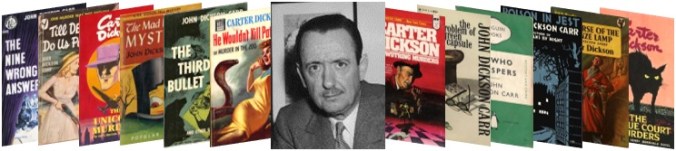
In his lifetime, John Dickson Carr published 76 novels and short story collections, plus a biography of Arthur Conan Doyle and a ‘true crime’ novel predating Truman Capote’s In Cold Blood, The Murder of Sir Edmund Godfrey. Following the closure of the Rue Morgue Press, who had five Carr novels in their books, and the coming disappearance of Orion’s ebook undertaking The Murder Room, who have around 14 or so Carr novels in their ranks, we’re not too far from a point in time where only two Car novels will be available to buy: Orion’s perpetually in-print version of The Hollow Man and the Mysterious Press publication of The Devil in Velvet. So, to return to the question in the title of this post: John Dickson Carr’s out of print — where’s the fuss?
Continue reading
#164: On Failing to Engage with “the Swedish John Dickson Carr” – Deadly Reunion (1975) by Jan Ekström [trans. Joan Tate 1983]
Given that John Dickson Carr — who would have been 110 at the end of the month, folks — published seventy-eight books over a 41 year career that encompassed such joys as Till Death Do Us Part and such nadirs as Papa La-Bas, there’s probably no-one who couldn’t be compared to him at some point in his career. So when Swedish writer Jan Ekström’s 1975 novel Ättestupan is translated into English and the synopsis opens with the tantalising promise ‘Often called the Swedish John Dickson Carr…’ well, you’re going to get a lot of peoples’ attentions even though it doesn’t at first glance really tell you anything.
Continue reading
#157: The Tuesday Night Bloggers — A Background of History in The Red Widow Murders (1935) by Carter Dickson

“The story of the Widow’s Room…begins in the month of August, and in the city of Paris, and in the year 1792. It begins with the Terror, but it has not ended yet.”
Upon reflection, it’s fairly astounding that John Dickson Carr published novels for 20 years before finally writing his first ‘true’ historical tale with The Bride of Newgate in 1950. Throughout so much of his early work there is a miasma of the past pushing through, and a revelling in the detail of such times that threatens to overload the present story as Carr seems far more interested in dumping as much detail as possible from, say, the French Revolution upon you so that the Weight of History can be added to the press of his peculiarly heady tales of mystery and imagination.
Continue reading
#155: Ye Olde Book of Locked Room Conundrums – Publication Day!
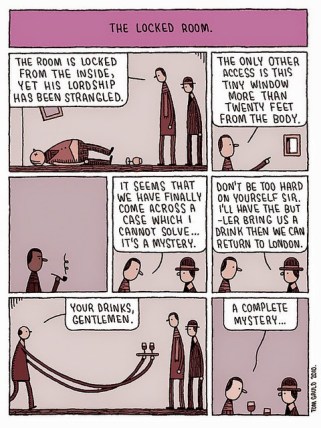
 I dunno, I’m starting to think it’s me. For the second time in just over a month — the first being with
 Apologies for my recent blogging absence; a combination of what I understand are referred to as ‘IRL’ circumstances and the fact that everything I picked up and tried to read was absolute dreck put something of a kibosh on things. The sensible thing seemed to be just to write off September and move on. So now I’m back with the oft-cited classic — and so inevitably hard-to-find outside of the USA, where the lovely Mysterious Press have published it — locked room mystery Death of Jezebel by Christianna Brand. Why this one? Well, it’s supposed to be awesome and I’m trying to get into Brand, having been thoroughly meh’d by
  The Invisible Event