#147: What a Body! (1949) by Alan Green

what-a-bodyI dunno, I’m starting to think it’s me.  For the second time in just over a month — the first being with T.H. White’s Darkness at Pemberley — I’ve read a novel famed for its impossible murder plot and come away going “Well, yeah, but that’s not really an impossible crime, though, is it.”  The shooting of millionaire health guru Merlin Broadstone on the fourth floor of his hotel on his exclusive island health farm  presents a couple of interesting points, but the fact that he was shot through an open window and that an obvious deduction is ignored for pretty much the entire duration of the case precludes any impossibility in my mind.  One perplexing occurrence and the characters failing to consider a particular set of circumstances doesn’t make it an impossible crime.  Maybe I’m too narrow-minded, but this doesn’t fly for me.

Continue reading

#140: Death of Jezebel (1948) by Christianna Brand

death-of-jezebelApologies for my recent blogging absence; a combination of what I understand are referred to as ‘IRL’ circumstances and the fact that everything I picked up and tried to read was absolute dreck put something of a kibosh on things.  The sensible thing seemed to be just to write off September and move on.  So now I’m back with the oft-cited classic — and so inevitably hard-to-find outside of the USA, where the lovely Mysterious Press have published it — locked room mystery Death of Jezebel by Christianna Brand.  Why this one?  Well, it’s supposed to be awesome and I’m trying to get into Brand, having been thoroughly meh’d by Green for Danger (1944) and slightly more taken with Suddenly at His Residence (a.k.a. The Crooked Wreath) (1946).  So, how did I fare?
Continue reading

#138: The Second Shot (1930) by Anthony Berkeley

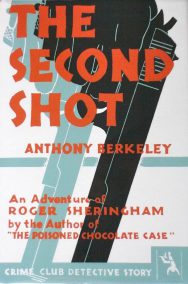
Second ShotBefore Anthony Berkeley’s recurring sleuth Roger Sheringham appears at just past the halfway point of The Second Shot, we are told by narrator Cyril ‘Pinkie’ Pinkerton that we possess all the necessary information to work out who shot bounder and all-round bad apple Eric Scott-Davis.  I have two problems with this: firstly it is not true, as there is sundry information revealed in the epilogue that we had no possible way of knowing, and secondly it renders the entirety of Sheringham’s investigation invalid for you, the reader, as you know there’s nothing new to be uncovered.  It’s an odd decision for an author who strove hard to redefine the limits of the ‘mere’ puzzle novel, but then Berkeley has always been rather erratic in his output to my tastes.

Continue reading

#134: A Puzzle for Fools (1936) by Patrick Quentin

Puzzle for FoolsYou’re writing a detective novel during the most productive and creative period that the genre has ever gone through, so pay attention — the tropes aren’t tropes yet, they’re still ingredients, and the standard mix requires the following: a murder or two, an amateur detective, a closed circle of suspects, an imminent sense of threat for our hero to fret over and be dismissed by the professional police, a love interest who must fall under suspicion before our hero realises she just might be his soul-mate…any questions?  Okay, off you go.  Keep the dunnage to a minimum, avoid long-winded and namby-pamby descriptions — this is entertainment, remember — and for pity’s sake keep it light.

Continue reading

#129: Some Reflections on Editing A. Demain Grange’s ‘The Round Room Horror’ (1911)

Ye Olde Book

As Ye Olde Book of Locked Room Conundrums edges ever closer — 11 of the 15 stories are now typed and ready, and TomCat is beavering away editing a twelfth — I thought I’d share my thoughts on certain aspects from the preparation, because it’s been an interesting insight into some things I’ve previously had no experience with.  My apologies in advance if this seems self-aggrandising, I just think some of this will be of legitimate interest to you and have no desire to make it all “hey look how much work I’m doing”.  No-one is making me do this, after all, and it’s honestly a huge amount of fun.  Yes, my notion of fun is not like that of other people.

Continue reading

#127: ‘The Third Bullet’ and Other Stories [ss] (1954) by John Dickson Carr

Third BulletI haven’t reviewed (or read, come to that) a short story collection for a while, and it’s 1954 this month for Crimes of the Century at Past Offences meaning the time is ripe for a long-overdue (har-har) return to John Dickson Carr.  I had read a couple of the stories contained herein before, but the majority were new to me, and as ever it’s a delight to see Carr’s imagination wrangle with the shorter form.  Given how frequently stories of this ilk fail to conceal their workings and/or killer, it’s also great to see him do both over and over again with consummate ease, as if saying to his contemporaries “C’mon, guys, it’s simple –just do this“.  We’ll take them one at a time as is my usual approach with collections — and, yes, most of these were originally published before 1954 and so might be inadmissible.  Let’s just get on with it and an independent official enquiry can determine the eligibility of this at a later point.

Continue reading

#124: Invisible Green (1977) by John Sladek

Invisible GreenJohn Sladek is better known these days as a furiously inventive author of decidedly loopy SF — and I mean that as a compliment — but he did publish two detectives novels in the 1970s that each contained several impossibilities.  The first, Black Aura (1974), has two disappearances and a man flying outside a third-storey window (without anything so amateur as wires holding him up, you cynic), and two-thirds of these are explained away superbly — the second disappearance in particular.  It is a very good book, if perhaps a little slow in places, and boded well for the next time Sladek opted to dip his toe in our waters.  Invisible Green, then, is very much the realisation of this potential, being superior in every single respect, and therefore something of a bittersweet read as we know now that nothing else followed it in the realm of the unachievable provably done.

Continue reading

#119: An Undertaking – Ye Olde Book of Locked Room Conundrums

Ye Olde Book

So, earlier this week I put up this post lamenting the poor selection of stories for a ‘new’ locked room anthology edited by David Stuart Davies.  In response, the internet’s resident doyen of all things locked room, TomCat over at Beneath the Stains of Time, put up this post suggesting an alternative list of equally out-of-copyright stories suggested by a look through Robert Adey’s Locked Room Murders.  To wit:

I arranged an alternative line-up of fifteen titles for Classic Locked Room Mysteries or a hypothetical, non-existent anthology, called Ye Olde Book of Locked Room Conundrums…

Continue reading

#100: The Dead Room (1987) by Herbert Resnicow

Dead Room HBWhen the unpopular patriarch of a family is found stabbed to death in his locked study, it’s clear that one of the six family members gathered at the ancestral pile must be the murderer (the servants, of course, are excluded immediately).  It’s up to our plucky amateur detective team to work out how he was killed and beat the police to the killer before it’s too late while also beginning to realise how they really feel about each other…  So far, so Golden Age.  Now substitute the following nouns: patriarch/inventor, family/hi-fi company, study/anechoic chamber (sound-testing room, if you will), family members/company executives, ancestral pile/company studio, and servants/technicians.  What you have now is the plot of Herbert Resnicow’s The Dead Room.  It’s that simple a switch – but for the trappings of its location, this could not be more of a Golden Age detective story, and the entire enterprise is undertaken in the same spirit as those classics. Continue reading