
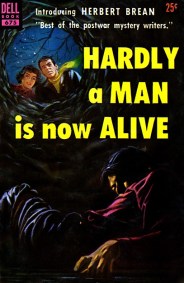
OOP
#678: Minor Felonies – Alfred Hitchcock’s Solve-Them-Yourself Mysteries [ss] (1963): ‘The Mystery of the Five Sinister Thefts’ by Robert Arthur and Morris Hershman
Five short mysteries from the pen of Robert Arthur in the year before he launched The Three Investigators on the world? What’s not to love? And this first story even comes with a supplementary mystery all of its own.
Continue reading
#664: The D.A. Breaks an Egg (1949) by Erle Stanley Gardner


Well, it’s taken me about twice as long as I thought it would, but we’re finally at the end of Doug Selby. This is the ninth and final novel to feature Erle Stanley Gardner’s District Attorney of Madison County — a place where “they roll up the sidewalks and put them in mothballs at nine or ten o’clock at night” and that in the words of P.L. Paden, new owner of the Blade newspaper, “has been small time [and is] about to grow up”. Certainly one change is in evidence here: events of the preceding novel carry over in a way that spoils one of the best surprises of that book, so make sure you’ve read The D.A. Takes a Chance (1948) before picking this up.
Continue reading
#657: Minor Felonies – Death Knell (1990) by Nicholas Wilde
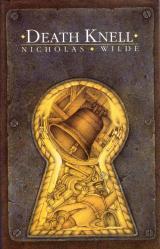
Okay, so how wide of the mark was TomCat when pouring praise upon this one a few weeks ago? Let’s find out…
Continue reading
#651: Minor Felonies – The Secret of Hangman’s Inn (1956) by Bruce Campbell
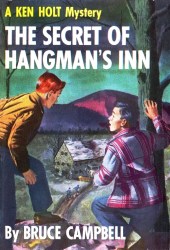
I, doubtless in common with anyone who has persevered through the stronger and weaker works of any prolific author’s career, have been moved at times to reflect at what point a long-running series becomes good before it starts to tail off in quality through the challenges of sustaining such an output.
Continue reading
#650: Puzzles for Players – The Baffle Book (1930) by Lassiter Wren and Randle McKay [ed. F. Tennyson Jesse] Problems 8 to 14

As in life, this blog has a few untrimmed threads hanging — one of these days I really must return to The Knox Decalogue and The Criminous Alphabet — but for today it’s back to The Baffle Book (1930). The first seven problems in F. Tennyson Jesse’s edit of Lassiter Wren and Randle McKay’s famous puzzle series failed to excite my reason or my enthusiasm, so how does this second quarter of puzzles stand up?
Continue reading
#649: The Curse of the Bronze Lamp, a.k.a. Lord of the Sorcerers (1945) by Carter Dickson
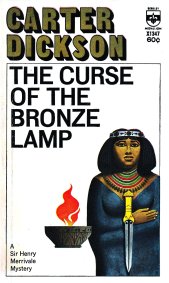
You may view the above rating of this book as too harsh, and you may be right. Honestly, I’ve struggled with how good The Curse of the Bronze Lamp, a.k.a. Lord of the Sorcerers (1945) may or may not be, and it certainly has its fans — at one point John Dickson Carr apparently considered it among the four of his own books that he enjoyed the most. But the key thing I keep coming back to is how this novel, rooted as it is in Egyptian curses and an apparent vanishing in a ghostly old family pile, written by a man who could stir up sulfur and brimstone with a well-place adjective and could summon the most wonderful patterns from the most perplexing of mysteries, is so very forgettable.
Continue reading
#646: The D.A. Takes a Chance (1948) by Erle Stanley Gardner
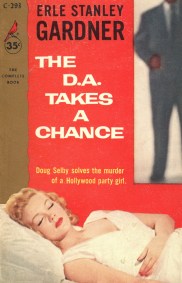
I’ve always thought of 1950 as a watermark year in the career of Erle Stanley Gardner. It’s arguably the point at which prevailing literary trends started to diverge meaningfully from the style of writing Gardner had staked out for himself. Post-1950 his Perry Mason series is a catalogue of steadily-diminishing returns, being somewhat preserved in aspic in its early-1930s incarnation, and the escapades of Donald Lam and Bertha Cool are saved only by Gardner’s many talents in not allowing that series to ever be easily pigeonholed. But for me the most compelling evidence that 1950 was meaningful for ESG is how Doug Selby never saw the light of day again after 1949.
Continue reading
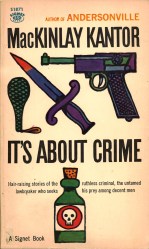
#636: Justice It Was That Moved My Great Creator – It’s About Crime [ss] (1960) by MacKinlay Kantor
 The Invisible Event