-
Subscribe
Subscribed
Already have a WordPress.com account? Log in now.

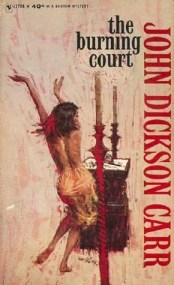 In a career that does not exactly lack for belauded titles, The Burning Court might just be the most belauded of John Dickson Carr’s oeuvre. Opinions diverge sharply on what I would consider all-time classics like The Plague Court Murders (1934) or The Hollow Man (1935), but arguably only this and perhaps She Died a Lady (1943) seem to enjoy universal adoration. So for the Carr acolyte like myself, approaching every book fully intent on getting the most possible out of it, there’s now the extra twinge of almost needing to love this so as to be taken seriously when discussing the man and his work. Five years from now, you don’t want “Yeah, but you didn’t enjoy The Burning Court” being thrown in your face like the castigation it is.
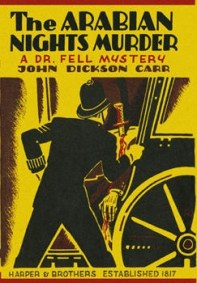 In the orchestra of John Dickson Carr’s detective fiction, his early years from It Walks by Night (1930) up to arguably The Arabian Nights Murder (1936) are very much the accordion section. Events occur in concentrated bursts, with clues and characters squeezed together to make the notes of the plot emerge, only to then be drawn apart before inexorably squeezing together again for another dense exposit you must pore over in order to follow the necessary developments. From The Punch and Judy Murders (1936) until the 1940s he wrote in the fine, clean, overlapping lines of the harp, and then the violins took over… but enough of this analogy, back to this book and the wheeze of a bellows working overtime.
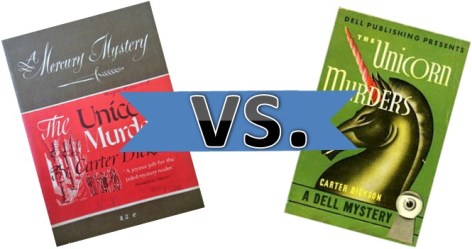
 When a man is found dead, stabbed between the eyes by a unicorn (of indeterminate nationality) — a, yes, fictional animal that can nevertheless apparently turn invisible at will — you don’t expect to find yourself in the GADU. And when a second victim is then killed in the same way but in full view of witnesses, if one can witness an invisible animal, you better hope you’re in the GADU or else things are about to get silly. Well, it’s your lucky day, because you are in a classic impossible crime mystery and things are about to get silly — this book is probably the final time John Dickson Carr had all the ingredients for a classic and didn’t actually write it, instead leaving a few edges untouched so that the overriding impression is slightly more “Er…what?” than “Hell, yeah!”.
 The Invisible Event