
Impossible Crimes
#94: Death in Five Boxes (1938) by Carter Dickson
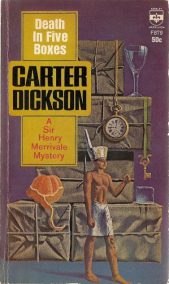 Four people are discovered sitting around a table as if at a dinner party, each with only a glass in front of them. Three of the four have been poisoned into a catatonic state and the fourth has been murdered by being run through with a narrow blade. Of the three who remain alive, one has two bottles of poison in their bag, one has the workings of an alarm clock in their pocket, and the third is carrying four pocket watches in various pockets about their person. At this point you are three chapters into the eighth Sir Henry Merrivale novel written by John Dickson Carr under his Carter Dickson byline and we haven’t even touched upon the revelation that greets you at the end of that chapter…suffice to say, boy are you in for a ride!
Continue reading
#91: The Moai Island Puzzle (1989) by Alice Arisugawa [trans. Ho-Ling Wong 2016]
Disclosure: I proof-read this book for Locked Room International in March 2016
 Children, incarnations of The Doctor, phases of the moon…generally I try not to play favourites. But if I had to pick one crime fiction conceit above all others it would undoubtedly be a group of people on an island getting killed off one by one. Sure, isolate them in some ancestral mansion via thunderstorm or on a train via unexpected snow and the effect is arguably the same, but there’s something about the island in itself that renders the idea all the more thrilling to my senses. And so this Japanese island-set puzzle, the second collaboration between Locked Room International’s John Pugmire and translator and crime fiction blogger Ho-Ling Wong after last year’s excellent The Decagon House Murders, would be just what the doctor ordered if the medical profession ever thought of prescribing books for those of us with the thrill of fictional murder in our hearts.
Continue reading
#88: The Lord of Misrule (1994) by Paul Halter [trans. John Pugmire 2006]
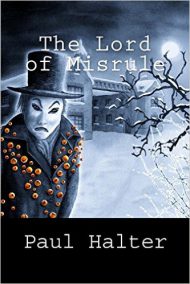 One dark and snowy night, a mysterious figure who is observed entering the home of an upright citizen commits a murder in an inaccessible room and vanishes without leaving so much as a footprint to tell of their presence, only for a second murder to then be committed outside in the snow but leaving only the victim’s footprints in evidence…you can’t tell me the similarities between Paul Halter’s The Lord of Misrule and John Dickson Carr’s The Hollow Man (a.k.a. The Three Coffins) are anything less than an absolute fanboying homage to the master. And Halter would know the risk he was running, but having established himself as an artisan of the impossible crime by this stage in his career (this was, by my estimation, his tenth published novel – though the first to be translated into English by John Pugmire) it was clearly a task he was happy to take on.
It may seem like a facile basis for such comparison but, upon re-reading The Lord of Misrule for this post, I was struck by the sheer number of similarities – enough, in fact, to possibly warrant a future post dedicated to solely that topic – the most obvious of which is the use of enumerated maps to highlight the finer points of the murder scenes, disarranged furniture, slashed painting and all; click below to see for yourself. Continue reading
#87: The Tuesday Night Bloggers – All-But-One Aboard for John Dickson Carr’s ‘Cabin B-13’

While Cabin B-13 became the name of the series of radio plays written by John Dickson Carr, I’m using the Tuesday Night Bloggers’ chosen topic of travel to look at the original play of that title which was broadcast on 9th November 1943 for the radio series Suspense (if you’ve 25 minutes to spare, you can check it out for yourself here) and from which that later series was inspired. If it also gives me a chance to cast some light in the direction of Carr’s oft-overlooked radio work, well, more’s the better.
It’s described in its own broadcast as a tale looking at “strange – very strange – happenings aboard an ocean liner” and set in “happier peace-time days” as newlyweds Ricky and Anne prepare to go on honeymoon in Europe. They deposit their bags in the titular cabin, Anne goes onto the deck to watch as ship leaves New York…and returns to find not only that her bags are in a different room – one booked in her maiden name, no less – but also that the room she originally used doesn’t exist, and with witnesses swearing that she was never in the presence of her husband to begin with.
Continue reading
#84: The Tuesday Night Bloggers – The Sherlockian Impossibilities of John Dickson Carr – II: ‘The Adventure of the Sealed Room’ (1953)
I’m guilty of sedition here: this isn’t technically part of the Tuesday Night Bloggers – they’re looking at travel in classic crime this month – but rather my own delayed TNB post on John Dickson Carr from March before I was sidelined. But, y’know how it is, it’s the second one looking at Carr’s Sherlock Holmes stories and so I feel I should probably post it on a Tuesday if only for internal consistency…my apologies for any confusion (though I suppose I cam writing about a Carr trip…). Just look upon this as my Never Say Never Again.
I talked about the origin of these stories in my first post on this topic, so let’s get straight on with it: this story is built on the reference to a case “of Colonel Warburton’s madness” made at the start of ‘The Engineer’s Thumb’ and so it’s appropriate that it begins in much the same way: someone in distress seeks out Watson (then for his doctoring, now seemingly because he knows Holmes) and is thus ushered into the Great Presence. It’s here that the story plays its most interesting card, as Holmes is rather short with the unfortunate Cora Murray who has just had a Colonel Warburton seemingly shoot himself and his wife while locked together in his study in the house where they all reside:
Continue reading
 Animals and their involvement in impossible crimes enjoy a long history, from the works of Edgar Allan Poe and Arthur Conan Doyle all the way up to the Jonathan Creek episode The House of Monkeys. Approximately halfway between these two we have Roman McDougald’s mandrill Geva, resident of your classical American Millionaire’s Household and on hand when said millionaire is found murdered in frankly baffling circumstances: in his office, stabbed in the back, with both doors into the room unlocked. Yes, unlocked. And yet he failed to leave the room while being attacked – the trail of blood he left leads from his desk to one door, then the other, and halfway back again – or raise the alarm in any way before the killer escaped.


 The Invisible Event