Impossible Crimes


#631: Adventures in Self-Publishing – Murder Brewed at Home (2015) by Belle Knudson

It is a truth universally acknowledged that the most unpleasant character in any murder mystery typically ends up dead. The cozier the mystery, the truer this adage becomes. And the more hobby-based the mystery is, the cozier it tends to be…so welcome to Murder Brewed at Home (2015).
Continue reading
#628: Adventures in Self-Publishing – Murder Most Scottish (2018) by Blake Banner

Well, well, well, 200π posts — or 100τ if you’re a weirdo. Let’s celebrate with two locked room murders…
Continue reading
#627: A Little Help for My Friends – Finding a Modern Locked Room Mystery for TomCat Attempt #14: The Darker Arts (2019) by Oscar de Muriel

A certain amount of debate continues to rage — “rage” might be too strong a word — over whether the impossible alibi qualifies as a true impossible crime. I suggest that, should it eventually be inducted into future Locked Room Murders supplements, we do so on a ‘one out, one in’ policy and retire the “death by unknown means” to make space.
Continue reading
#625: Adventures in Self-Publishing – The Matter of the Duct Tape Tuxedo [ss] (2019) by Steve Levi

A lot of impossible crime novels published these days have, let’s face it, about enough impossible crime content for a short story. So a short story collection seems like a sensible thing to try, right? Even one that does put ‘short stories’ on its cover and then call itself “a novel” on the back. Right?
Continue reading
#624: Bob’s Yer Uncle – Locked Room Murders Supplement (2019) ed. Brian Skupin
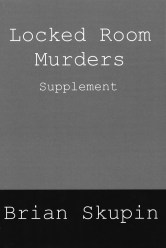
The reprinting of Robert Adey’s Locked Room Murders (2nd ed., 1991) at the end of 2018 was a delightful turn-up for those of us who had been dreaming of owning that reference bible. And once the excitement settled, I’m sure more than a few people started thinking “Hey, they should really do another one of these…”.
Continue reading
#622: Adventures in Self-Publishing – The Phantom Ragdoll (2019) by DWaM

The joy of self-publishing must be the freedom to live or die solely on your own efforts. There’s most likely no-one looking over your shoulder to advise you, and while that may be the key factor that ruins a lot of SP fiction, if you can get it right on your own I imagine it’s rather thrilling.
Continue reading
#619: Adventures in Self-Publishing – The Royal Baths Murder (2019) by J.R. Ellis

It had been my intention to read one of J.R. Ellis’ earlier Yorkshire-set impossible crime novels after reading his third, The Murder at Redmire Hall (2018), last year. But then he released a fourth and, well, the best laid plans…
Continue reading
#616: Adventures in Self-Publishing – Touch (2018) by Robert Innes

 The Invisible Event