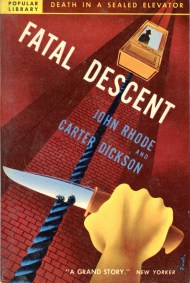
In the style of Sesame Street, today’s review is brought to you by In Search of the Classic Mystery Novel‘s Puzzle Doctor, who kindly leant me this book following years of me failing to find an affordable copy. And, boy, what an exciting prospect it is: no mere “one chapter each” in the style of ‘Behind the Screen’ (1930), ‘The Scoop’ (1931), or The Floating Admiral (1932), this is a proper collaboration between two of the Golden Age’s titans: Carter Dickson, a.k.a. John Dickson Carr, and John Rhode, a.k.a. Miles Burton — two gentlemen who individually devised a greater library of brilliant means of criminal dispatch than almost any other pair you’d care to name.
It’s that time again: Dan who blogs at The Reader is Warned and I are here once more with another episode of our podcast The Men Who Explain Miracles, and things are about to get personal…
I will admit the chance that I am overrating this book slightly, but, dude, I loved it. The central premise — that Herman Pennik can both read the minds of others and kill people just by thinking about them, using a hitherto-unexplored scientific principle he calls Teleforce — has the absurdity of overwroughtness that distinguishes the Henry Merrivale books under John Dickson Carr’s Carter Dickson nom de plume (see: The Unicorn Murders (1935), The Punch and Judy Murders (1936), etc). But Carr plays it remarkably straight, keeping his phantasmagorical flourishes to a minimum and concentrating on plot and glorious atmosphere.
Here we are, the third and final week of Dan and I using our podcast The Men Who Explain Miracles to look at the list of the 15 best impossible crime novels as curated by Ed Hoch in 1981.
Continuing our examination of the 15 best impossible crime novels of all time as compèred by Edward D. Hoch in 1981, here is the second of three episodes looking at the titles in question from Dan and myself in our occasional podcast The Men Who Explain Miracles.
Let the tucket sound! Dan and I are back with our occasional podcast The Men Who Explain Miracles, and we’re taking on something rather special this month.
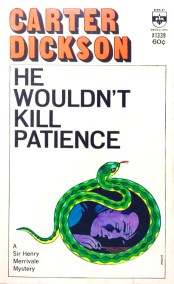
The result of a challenge between John Dickson Carr and magician-turned-author Clayton Rawson to write a murder in a room whose inaccessibility is assured by paper taped across the inner door jamb, He Wouldn’t Kill Patience (1944) also has GAD brethren in Freeman Wills Crofts’ zoo-set, poisonous-snake-centric Antidote to Venom (1938). Carr and Rawson take more puzzle-oriented routes, of course, and both happen to feature magicians, but the Reptile House subgenre is off to a good start with these two novels in it. And since you’re going to ask, in the head-to-head of this and Rawson’s ‘From Another World’ (1948), Carr wins. Boy, does Carr ever win.
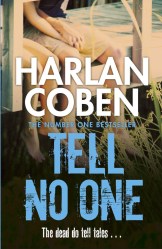
I’ll warn you now: even for me, this is niche. Following a reorganisation of books at Invisible Event Towers I stumbled across my copy Harlan Coben’s Tell No One (2001), which I read while at university, and got thinking about it in light of my more recent adoption of GAD an impossible crimes. And the above question struck me, but discussing it will require you, dear reader, to have done some rather specific reading…