British Library Crime Classics
#349: Family Matters (1933) by Anthony Rolls

Detective fiction’s Golden Age produced many very witty books — Case for Three Detectives (1936), etc — but Family Matters (1933) by Anthony Rolls is to my mind the first time that the process of killing someone is genuinely funny. As a deployment of the detached third-person narrator it might represent the pinnacle of the genre. In many ways, this stands apart from the remainder of GAD in the way The Ladykillers (1955) stands apart from other Ealing comedies: it is savage and unsparing, and not afraid to show you the darkness beneath…but done with such a surety of touch that you don’t know whether a sentence is a joke or a profound truth until you finish it.
Continue reading
#337: Foreign Bodies [ss] (2017) ed. Martin Edwards

Had you asserted back in 2014 that the republication of two forgotten crime novels would lay the foundation for one of the most celebrated series of GAD reissues in modern times, well, people would have laughed. And yet the British Library Crime Classics collection, under the stewardship of Martin Edwards and Rob Davies, is now over 50 books deep and gathering momentum for another exciting year. And it’s a sure sign of the hale condition of the series that, far from simply reissuing books, they’re now branching out into original translations with this collection of overseas tales. In the words of Ira Gershwin, who’s got the last laugh now?
Continue reading
#297: Murder in the Museum (1938) by John Rowland
 It is understandable that we, as readers, hope for everything we read to be good. However, it is also unlikely that this will be the case, and so sometimes we have to make do with what a book actually offers us. It may not be good, so is it interesting? Does it tell us something new about the era in which it is set or was written? Failing that, is it at least enjoyable? Murder in the Museum (1938), the first of two John Rowland books published as part of the British Library Crime Classics series, is not especially good, but it is a lot of fun. And I’ll take fun. Fun is underrated. I could broadside this for its many flaws and failings, but the truth is I ripped through it, didn’t take it too seriously, and had a great time.
Continue reading
#293: On Narrowness in Impossible Crimes, via ‘Locked In’ (1939) by E. Charles Vivian

 While we can be thankful for real-life developments in forensic science that enable the speedier detection of criminals, there can be little argument that it was the death-knell of good detective fiction. Dull Inspector Arnold and his genius amateur sidekick Desmond Merrion spend so much time combing through the minutiae of the physical and mental aspect of the crime in Death in the Tunnel, and come up with such entertaining possibilities while doing so, that a crime scene tech in one of those all-over white body suits could never be a fifth as much fun. It makes me all the more appreciative of this kind of classic approach, knowing that this sort of book has seen its heyday pass.
 I was pretty much goaded into this, you should know. Ben at The Green Capsule is diversifying his blogging to extend beyond the works of John Dickson Carr, and the first book he chose was
  An experienced pilot crashes his plane and dies, and at the inquest the jury returns a verdict of ‘death by misadventure’. They’re correct, and there’s nothing else to investigate. Nah, I’m kidding, of course — we’re deep in the Golden Age here, so it has to be more complicated than that, and before you know it there are amateur sleuths, mistaken identities, re-examination of bodies, codes, intrigue, and the threat of more murder zipping around like so many flies at a picnic. As an exemplar of what the Golden Age did so well, Death of an Airman joins
 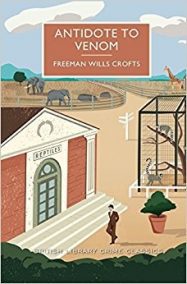 The reputation for being something of an interminable bore that still dogs Freeman Wills Crofts some 60 years after his death wants for evidence in Antidote to Venom. We’re about halfway through when the murder occurs, by which point you’ve had not only a highly sympathetic portrait of the central man in the affair, but also the convincing use of minor characters to create the situation in a way that relies on coincidence without feeling forced, an allusion to the Sherlock Holmes canon, and two — count ’em — legitimate jokes. It is spry, focussed, beautifully rich in intrigue and heartbreak, and balances its inverted and traditional elements perfectly. And when the investigation starts…oh, boy, are you in for a treat.
 If you’ve never read a classic-era novel of crime and detection, what are you waiting for? There’s that Agatha Christine lady who wrote those David Suchet books, and the British Library has been putting out affordable classics for a little while now — go ahead and dig in. Sure, some of them are better than others, but if you want a good introduction to this type of thing then Alan Melville’s circus-set Death of Anton might just be the perfect place to start: it’s very witty, written with the lightest of touches, and wastes no time in maundering on in a wannabe hard-boiled fashion while dealing with the seeming imprecations of a circus where death keeps raising its head…
 The Invisible Event