-
Subscribe
Subscribed
Already have a WordPress.com account? Log in now.
 When a man is found dead, stabbed between the eyes by a unicorn (of indeterminate nationality) — a, yes, fictional animal that can nevertheless apparently turn invisible at will — you don’t expect to find yourself in the GADU. And when a second victim is then killed in the same way but in full view of witnesses, if one can witness an invisible animal, you better hope you’re in the GADU or else things are about to get silly. Well, it’s your lucky day, because you are in a classic impossible crime mystery and things are about to get silly — this book is probably the final time John Dickson Carr had all the ingredients for a classic and didn’t actually write it, instead leaving a few edges untouched so that the overriding impression is slightly more “Er…what?” than “Hell, yeah!”.
 While we can be thankful for real-life developments in forensic science that enable the speedier detection of criminals, there can be little argument that it was the death-knell of good detective fiction. Dull Inspector Arnold and his genius amateur sidekick Desmond Merrion spend so much time combing through the minutiae of the physical and mental aspect of the crime in Death in the Tunnel, and come up with such entertaining possibilities while doing so, that a crime scene tech in one of those all-over white body suits could never be a fifth as much fun. It makes me all the more appreciative of this kind of classic approach, knowing that this sort of book has seen its heyday pass.
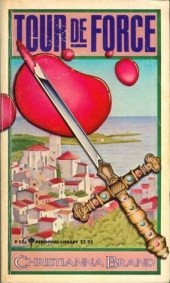 I was pretty much goaded into this, you should know. Ben at The Green Capsule is diversifying his blogging to extend beyond the works of John Dickson Carr, and the first book he chose was Christianna Brand’s Green for Danger. In the comments, conversation turned to other Brand titles and Brad had the temerity to doubt my fortitude: I don’t think JJ should read Tour de Force either. I couldn’t bear to think what he would make of it! Well, challenge accepted. Now, true, Brand and I didn’t get off to the best of starts — Green for Danger made her very much the new stepmother trying too hard to replace Agatha Christie in my affections — but we’ve had some great times since then, and so I came to this with an open mind.
 An experienced pilot crashes his plane and dies, and at the inquest the jury returns a verdict of ‘death by misadventure’. They’re correct, and there’s nothing else to investigate. Nah, I’m kidding, of course — we’re deep in the Golden Age here, so it has to be more complicated than that, and before you know it there are amateur sleuths, mistaken identities, re-examination of bodies, codes, intrigue, and the threat of more murder zipping around like so many flies at a picnic. As an exemplar of what the Golden Age did so well, Death of an Airman joins Death of Anton as a virtual textbook for the beginner, and as such marks another superb entry in the British Library Crime Classics series.
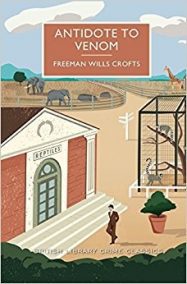 The reputation for being something of an interminable bore that still dogs Freeman Wills Crofts some 60 years after his death wants for evidence in Antidote to Venom. We’re about halfway through when the murder occurs, by which point you’ve had not only a highly sympathetic portrait of the central man in the affair, but also the convincing use of minor characters to create the situation in a way that relies on coincidence without feeling forced, an allusion to the Sherlock Holmes canon, and two — count ’em — legitimate jokes. It is spry, focussed, beautifully rich in intrigue and heartbreak, and balances its inverted and traditional elements perfectly. And when the investigation starts…oh, boy, are you in for a treat.
 If you’ve never read a classic-era novel of crime and detection, what are you waiting for? There’s that Agatha Christine lady who wrote those David Suchet books, and the British Library has been putting out affordable classics for a little while now — go ahead and dig in. Sure, some of them are better than others, but if you want a good introduction to this type of thing then Alan Melville’s circus-set Death of Anton might just be the perfect place to start: it’s very witty, written with the lightest of touches, and wastes no time in maundering on in a wannabe hard-boiled fashion while dealing with the seeming imprecations of a circus where death keeps raising its head…
 The setup of The Poisoned Chocolates Case is rightly very famous: a lady is killed when a box of chocolates given to her husband by another member of his gentlemen’s club — who himself received them unsolicited through the mail — turns out to have been laced with poison. The police, with no culprit in sight, allow six amateurs with a fascination for real life crimes to theorise and present their own solutions, each one appearing watertight until someone finds a flaw that brings the edifice down. For this conceit alone, and the genius way Berkeley uses his different sleuths to unpick the sparse and simple known facts, this book has passed into near-legend in detective fiction circles.
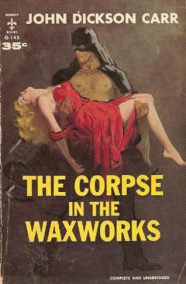 The penultimate case for John Dickson Carr’s first sleuth, Henri Bencolin, opens with a wonderful demonstration of the reputation which that juggernaut of justice enjoys among the less salubrious sections of French society: ‘Bencolin was not wearing his evening clothes, and so they knew that nobody was in danger.’ The palpable sense of relief this engenders in all who see him as he travels from tavern to tavern captures the character with a clarity that shows how much Carr grew as an author over his opening five books, and augurs well for the Fellian delights that would follow soon upon the heels of this as Carr hared his way up the detective fiction firmament and into history. And it sets the scene nicely for a deceptively complex little book that almost feels like a short story in its setup, but is wrought into something more by the expert pacing Carr has honed in the couple of short years since It Walks By Night (1930), showing here his emerging talent for taking a situation that many others would struggle to fill 20 pages with and making every nuance and moment of its 188 pages count.
 Apologies for my recent blogging absence; a combination of what I understand are referred to as ‘IRL’ circumstances and the fact that everything I picked up and tried to read was absolute dreck put something of a kibosh on things. The sensible thing seemed to be just to write off September and move on. So now I’m back with the oft-cited classic — and so inevitably hard-to-find outside of the USA, where the lovely Mysterious Press have published it — locked room mystery Death of Jezebel by Christianna Brand. Why this one? Well, it’s supposed to be awesome and I’m trying to get into Brand, having been thoroughly meh’d by Green for Danger (1944) and slightly more taken with Suddenly at His Residence (a.k.a. The Crooked Wreath) (1946). So, how did I fare?
 People hold weird beliefs: that the moon landings have all been faked, for instance, or that the moon is hollow, or that the phases of the moon have anything at all to do with your love life or finances. Some people might even hold weird beliefs not about the moon. Here’s one: I firmly believe that for the remainder of human history there will never again be anyone who writes the detective novel as well as did John Dickson Carr at his peak. When I eventually narrow my ten favourite detective novels of all time down to a list that is actually ten books long, there’s a real chance all ten of them will be by Carr. And, I’ll tell you now, it will definitely feature The Problem of the Green Capsule, which in my current mood I consider to be the pinnacle of the form.
 The Invisible Event