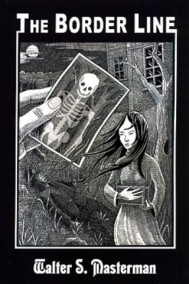
 I am from a televisual generation and so struggle to comprehend the power radio held in its pomp – people actually believing that Orson Welles’ radio broadcast of The War of the Worlds was genuinely detailing an alien invasion of Earth, for instance. So, to me, the idea of presenting the haunting of a Spooky Old House as a radio show seems a bit…pointless. Nevertheless, Jack Hartley and his BBC radio chums descend upon Cold Stairs, the ancestral home of Sir John Harman (5 bed, 2 bath., stunning aspect in own woodland), to record ghostly goings on and bumps in the night with the intention of making a broadcast of it. Or that should really be ‘bumping offs in the night’ as some poor soul is murdered by the evil spirit that resides in the vicinity – the same spirit that shocked his housekeeper’s son so badly he fell down the stairs and crippled himself – and then it turns out that Harman’s introverted, reserved niece has been communing with something calling itself the King of the Forest, and that’s really the beginning of everyone’s problems.
#74: “Old people know how valuable life is, and how interesting…”, portrayals of age in Agatha Christie’s A Caribbean Mystery (1964)
Agatha Christie was 74 years old when she published her ninth Miss Marple novel, A Caribbean Mystery, by which time – as I said in my review of The Mirror Crack’d from Side to Side – she would have known a lot about the procedures of ageing. There were still 13 books to come from her pen (well, 11 really, since the final Marple and Poirot books had famously been written some years previously) and this belief in her own abilities is echoed in the treatment of her beloved elderly spinster as, in spite of the infirmities she suffers and the attitude others take towards her, she continues to outfox murders left, right, and centre.
Christie, of course, had less to prove by now than she would have done in her younger days and so this isn’t a “We’ve Still Got It” Oldies v. Whippersnappers cage match – the Clint Eastwood movie Space Cowboys comes to mind, and can thankfully be dismissed – but is instead a moderately elegiac reflection on old age, youth, and the folly of both (contrast it with the far earlier Partners in Crime, where Bright Young Things Tommy and Tuppence prove their worth at a range of investigative styles). And since I’ve been in a bit of a reading funk for a few weeks now (which I promise I’ll not mention again) I thought I’d try a bit of a textual analysis on this theme to see if it got me anything interesting.
Continue reading
#73: The Murder Room is dead, long live The Murder Room!
Mark Twain-esque, it seems that I may have extrapolated incorrectly from reports that Orion’s e-book initiative The Murder Room was ceasing operations and that the books will in fact be available for a little while yet. Former Murder Room publisher Julia Silk – or someone purporting to be Julia Silk, but it seems an unlikely deception to perpetrate as she hasn’t even requested my bank details – has dropped by to let us know that not only a) will the books be available for a while yet (whew!) but also b) there’s new stuff coming as well.
Happy days!
#72: X v. Rex (1933), a.k.a. The Mystery of the Dead Police by Philip MacDonald
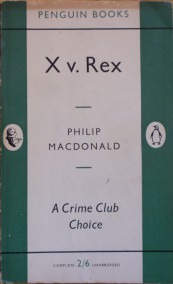 Philip MacDonald first came to my attention for having written a handful of impossible crime novels but this is not one of them, and nor does it feature his series sleuth Anthony Gethryn. I stumbled across my copy of X v. Rex in a second-hand bookshop a good while ago and, as he was out of print at the time (one Gethryn novel, The Rasp, has since been republished by Collins) I picked it up for future perusal. And so, with the Crimes of the Century at Past Offences dipping into 1933, here we are – with policemen in and around London being targeted by a killer, and a government sliding into disarray as the previously unimpeachable bastion of order is attacked seemingly at will.
This is decidedly more of a thriller than a crime novel – no small cast of suspects, no scattered clues, no sudden moment of retrospective reanalysis, no clever misdirection – you just sit and wait for the suspect to be apprehended three pages from the end and then that’s over and done with. There is one piece of sort-of misdirection, but it’s revealed fairly quickly and by that point I wasn’t really all that bothered. It certainly wasn’t clever enough to warrant a closer reading. Honestly, where’s the appeal?
Continue reading
#71: The Case of the Borrowed Brunette (1946) by Erle Stanley Gardner
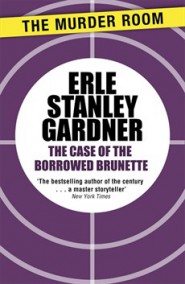 There’s an appealing irony in the assertion that you know an author has hit the big time when everyone remembers the name of their characters over that of the creator themself: Lisbeth Salander, Jack Reacher, Tarzan, Jason Bourne, we erudite types remember them, of course, but the world at large – fuelled no doubt by TV and films – associates more with their representations than their origins. Erle Stanley Gardner – a King of Crime, lest we forget – is not just less well-known than his character, but also the piece of music that character is himself overshadowed by; all together now… Frankly, he must be like the biggest-selling author in the world on those terms. Well, uh, yeah, he kinda is, actually. And yet, despite my avowed love of the man and his writing, it’s taken me 70 posts to get round to reviewing him here; what gives?
Well, two things. Firstly, I’d read a lot of Gardner before starting this blog and had sort of lost track of exactly what I had and hadn’t already encountered, and secondly a lot of it was written at high speed and with, er, some quality control issues and so some of what I’ve read since hasn’t exactly covered him in glory. However, The Case of the Borrowed Brunette is about as classic a Perry Mason – oh, yeah, that’s the famous character, but the way – novel as you’ll get, and showcases a lot of what Gardner did extremely well and also a lot of the flaws in his process.
Continue reading
#70: Five to Try – Starting Paul Halter
After the fun of jointly analysing Paul Halter’s The Seven Wonders of Crime with Kate at CrossExaminingCrime, there’s now collateral damage to tidy up. Namely, that the inevitable question for anyone eager to take the plunge with the French maestro des impossibilités (and, frankly, how can you not be?) will be: Where do I start? Well, start wherever you like, of course, but if I had to pick my first five of the eleven currently available they’d look something like this:
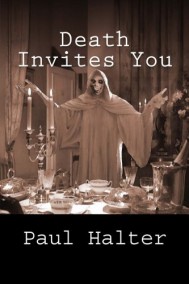
Death Invites You (1998) [trans. 2015]
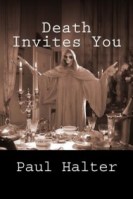 As I said in my review the other week, if you’re starting completely new with Paul Halter and/or impossible crimes then this is the perfect place to do it. The balance of plot and character is just right, the contortions for the murder of a man over a table set for a meal in his locked study – matching exactly the novel he was writing – are not too outré for the novice and, while the locked room element isn’t completely original, there’s no excess of foliage to obscure your view of what’s going on. This was the first book to feature Archibald Hurst and his harried genius amateur Alan Twist together, and it’s a relationship that feels natural from the very first page of them discussing impossible crimes while drinking in a pub. If Hurst ends up rather abject following his expressed desire for some “really meaty” case to get involved with, the reader is treated to the beginnings of a rather special relationship that will bring a great many hours of reading pleasure.
Continue reading
#69: Death’s Mannikins, a.k.a. The Dolls of Death (1937) by Max Afford
 An isolated ancestral home ruled over by an eccentric patriarch with a keen interest in esoterica and a private museum of medieval weapons, into which an eager young man is brought by an acquaintance only for murder to insinuate its way among the denizens…yup, John Dickson Carr’s The Bowstring Murders (1933) certainly is a classic of the genre. What’s that you say? Death’s Mannikins? Oh, wow, uh, this is awkward. Okay, let’s start again: an isolated ancestral home ruled over by an eccentric patriarch with a keen interest in esoterica and a private museum of medieval weapons, into which an eager young man is brought by an acquaintance only for murder to insinuate its way among the denizens…yeah, no, there’s no getting away from those similarities. And, y’know what? I only bring it up because there’s more than a touch of Carr about this, Afford’s second Jeffery Blackburn novel, and that’s really not a bad thing.

I mean, take the following:
It was as though the second tragedy acted as sudden leaping flames under a simmering pot. The scalding, seething flux exploded and boiled over, galvanizing each person under that roof into an insane panic that throbbed and hummed and zoomed from cellar to tower with the horrible impotence of a monstrous and unclean bluebottle trapped against a window.
Continue reading
#68: On Racism, Sexism, Xenophobia, and Other Necessary Aspects of the Golden Age

So the other week Kate at CrossExaminingCrime published this interview with one of the editors at Dean Street Press in which it was mentioned that a potentially-offensive racial term had been edited out of one of the DSP books, with said editor saying that doing so was “the right decision”. Being unhelpful as I am, I picked up on this as a sentiment I completely disagree with – I don’t think it was the right decision at all – and a few of us kicked around the points in the comments for a while (I’m sorry to say that it was a very adult and mature set of comments, in case anyone was hoping to encounter a flame war). I’ve been thinking about it ever since, and thought I’d try and get my thoughts into some sort of order over here so that I’m not filling up Kate’s blog with yet more comments on this stuff.
I feel I should make it clear up front that my issue is in no way with Dean Street Press – they’re far from the only publisher doing this, and all are well within their rights to put out whatever material they see fit, I just think it’s a point that needs addressing, that there is a platform in favour of these books being retained in their original form which is too easy to overlook when under the impression that only one course of action is acceptable.
Continue reading
#67: The Murder Room is closing its doors
Orion’s digital crime arm The Murder Room will apparently be ceasing operations in the near future, meaning to those of us in the UK the loss of high-quality e-books from classic Golden Age authors like Anthony Boucher, Pamela Branch, John Dickson Carr, J.J. Connington, Stanley Ellin, Erle Stanley Gardner, Geoffrey Household, Ronald Knox, John D. Macdonald, Helen McCloy, and E. L. White, and more contemporary fare such as Charles Willeford and many others.
They have excelled in the high standards of their output, the range of authors they promoted, the fact that they made these books available to the widest possible market, and their commitment to the Golden Age long before it was fashionable again. Goddammit, this has really spoiled my day.


