-
Subscribe
Subscribed
Have a WordPress.com account? Log in now.
 People hold weird beliefs: that the moon landings have all been faked, for instance, or that the moon is hollow, or that the phases of the moon have anything at all to do with your love life or finances. Some people might even hold weird beliefs not about the moon. Here’s one: I firmly believe that for the remainder of human history there will never again be anyone who writes the detective novel as well as did John Dickson Carr at his peak. When I eventually narrow my ten favourite detective novels of all time down to a list that is actually ten books long, there’s a real chance all ten of them will be by Carr. And, I’ll tell you now, it will definitely feature The Problem of the Green Capsule, which in my current mood I consider to be the pinnacle of the form.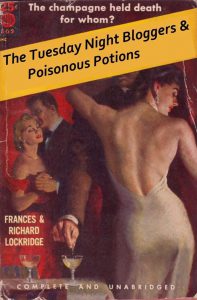
 After many years reading, talking about, reviewing, and now blogging on the subject of detective fiction I am presented with a real difficulty here: I honestly don’t know quite what to write about Noel Vindry’s classic The Howling Beast for fear of giving anything away. It is a balancing act of a book that, while probably not completely successful by today’s standards, is hugely enjoyable and absolutely something that those who count themselves as puzzle fans or lay claim to an interest in the emergence and development of detective fiction really should read. And I’m not just being vague here because I don’t want to criticise it — I really enjoyed it, and there’s one key thing it does absolutely brilliantly, and I’m especially keen to preserve that for those of you who should experience this pure. So, with that out of the way, here goes.
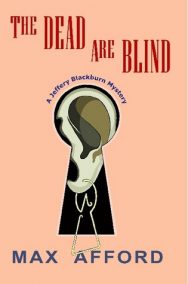 I believe the philosopher John Francis Bongiovi, Jr. said it best: “Keep the faith”. The Dead Are Blind is the third novel by Max Afford I’ve read and, having hugely enjoyed the other two, I found myself struggling to maintain interest through the opening chapters. Certainly from a historical perspective they have plenty to offer – our lead characters are invited to tour a radio studio on its opening night, something of a gala event at the time, and so this is chock-full of fascinating tidbits from Afford’s own experience of working in radio. But the mix of dense description and fixation on minute details that are hugely unlikely to become relevant later puzzled even my will and left me a bit apathetic by the end of chapter two.
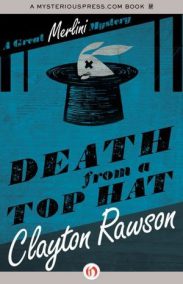 Well, where to start? Locked room murders (plural!), magicians, a hefty dose of self-reference, an extended John Dickson Carr homage-cum-lecture, a sprinkling of magical and mystical esoterica, and some really quite awesomely clever solutions…to be honest this — Rawson’s first novel to feature magician detective The Great Merlini and his Watson, journalist Ross Harte — should be a shoo-in for my favourite book of all time. Something about the conflation of conjuring and seemingly-impossible crimes just gets me all a-giggle with excitement, and Rawson wrote one of my favourite impossible crime short stories of all time (‘Off the Face of the Earth’, since you asked) so has previous with me, but this just comes up a little short to call it the masterpiece it probably should be.
