#104: The Tuesday Night Bloggers – The Light and Shade of Gervase Fen
Okay, so I’m going to do my best to stay on-task today; none of these wild flights of fancy. A discussion of Golden Age academic mystery and nothing more. And since I already have my post sorted for next Tuesday, and that’s the final week in June, it has to be now that I engage in some discussion about Edmund Crispin and the irrepressible Gervase Fen. Continue reading
#103: Paul Halter Day – III: The Round-Up

Well, as 60th birthdays go, I hope mine is this much fun. And so as Paul Halter Day comes to an end – and given that you’ve already checked out my two posts on the beginning of the Locked Room International enterprise and then some unapologetic fanboying on Halter’s impossible crime mantle-bearing – here’s the round-up of what others who were generous enough to get involved had to say.
~
First up, and with thanks for his not taking legal action over me stealing his Crimes of the Century round-up idea for this post, Rich at Past Offences tackled The Demon of Dartmoor, his first toe into the Halter Pool (see what I did there?), and liked what he found:
Continue reading
#102: Paul Halter Day – II: The Impossibility of More Impossibilities

Declaring that the detective novel was the only form of literature that put the reader to work, [S.S. van Dine] argued that “a deduction game emphasising fair play within a limited setting” would be the story structure with the best potential to result in masterpiece mystery stories […] But when the elements of the game are too severely limited and the building materials are all the same, only the first few builders will get all the glory and there will be an over-abundance of similar novels…
—Soji Shimada, in his introduction to The Moai Island Puzzle
Continue reading
#101: Paul Halter Day – I: An Epistle of Paul the Impossible

If I ran one of those clickbait-style websites, I would have been teasing this for at least a week now as the tautology of a ‘world exclusive never-before-seen Paul Halter translation’. I mean, it is exactly that, but that’s not the point.
In order to help with the acknowledgement of Paul Halter’s 60th birthday, John Pugmire — perhaps better known under his stage name of Locked Room International — has, with M. Halter’s blessing, sent me a copy of the letter he received from Halter when mutual friend Roland Lacourbe first showed Halter the English translation John had done of his debut novel, The Fourth Door. Lacourbe is, of course, the acknowledged overlord of the French impossible crime scene and compiler of the encyclopaedic reference 1001 Chambres Closes, the French equivalent of Robert Adey’s English language rundown of all things fictional and impossible, Locked Room Murders.
Continue reading
#100: The Dead Room (1987) by Herbert Resnicow
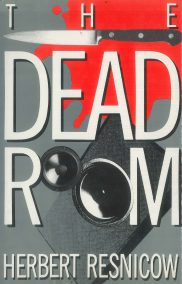 When the unpopular patriarch of a family is found stabbed to death in his locked study, it’s clear that one of the six family members gathered at the ancestral pile must be the murderer (the servants, of course, are excluded immediately). It’s up to our plucky amateur detective team to work out how he was killed and beat the police to the killer before it’s too late while also beginning to realise how they really feel about each other… So far, so Golden Age. Now substitute the following nouns: patriarch/inventor, family/hi-fi company, study/anechoic chamber (sound-testing room, if you will), family members/company executives, ancestral pile/company studio, and servants/technicians. What you have now is the plot of Herbert Resnicow’s The Dead Room. It’s that simple a switch – but for the trappings of its location, this could not be more of a Golden Age detective story, and the entire enterprise is undertaken in the same spirit as those classics. Continue reading
#99: The Tuesday Night Bloggers – Life Imitating Art in ‘The Day the Children Vanished’ (1958) by Hugh Pentecost
It’s possibly a bit of an ask to cram this into the ‘academic mystery’ box as required by this month’s Tuesday Night Bloggers, but there’s too much of interest here not to look at. And the story does concern the seemingly-impossible disappearance of a group of children on their way home from school and so is probably just about allowable.
Nine young children in a station-wagon-acting-as-school-bus are being driven from their school to the nearby town where they live, a route which includes the ‘dugway’ road cut into the rock face between the two towns. The car is seen entering the dugway, the father of two of the children on board drives past it in the opposite direction and so is able to vouch for its presence…but it never emerges at the other side. A close inspection of the road reveals no evidence of the car having crashed through any barriers, the ice-covered lake below shows no breakages or disturbance to its surface, and the steepness of the rockface and density of the forestry thereon precludes any off-road antics even if the car was able to somehow pass through a safety barrier without leaving a mark.
Continue reading
#98: One week until Paul Halter Day!

I have absolutely no doubt that Kate, Rich, Puzzle Doctor, and many others will do jobs far superior to anything I ever could in summarising yesterday’s hugely enjoyable Bodies from the Library and so I’ll leave that to them.
Instead, I’d like to remind anyone still considering it that next Sunday will be Paul Halter’s 60th birthday and so Paul Halter Day will come into effect. If you’re posting anything Paul Halter-related on that day, put the link in the comments of this post and I’ll do a wrap-up later in the evening.
My thanks in advance to anyone getting involved, really looking forward to what people come up with…!
#97: If the Shroud Fits (1941) by Kelley Roos
 There are times when it’s possible to pinpoint the exact moment when a novel doesn’t fulfil its promise, and given the intricacy of many novels of detection these can sometimes be very keenly felt. Perhaps the detective is an absolute duffer (an accusation frequently levelled at Freeman Wills Croft’s Inspector French), or the guilty party comes disappointingly out of nowhere (as in John Dickson Carr’s The Blind Barber), or perhaps the solution offered up to a brilliant problem is a shade on the simplistic side (the disappearance from the locked bathroom in John Sladek’s otherwise-superb Black Aura springs to mind). For this second novel by husband and wife team Kelley Roos, I’d say the main problem is in the selection of the victim: the setup is excellent, the characters are a delight, and come the murder…the most obvious victim is selected and the book never quite recovers.
Continue reading
#96: The Tuesday Night Bloggers – Educatin’ the Pulps in Robert O. Saber’s The Black Dark Murders (1949)

