#174: Adventures in Self-Publishing – The Mysteries of Reverend Dean [ss] (2008) by Hal White
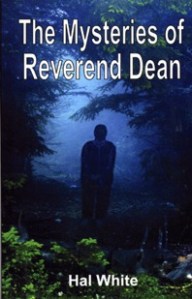
Continuing the grand old tradition of crime-solving clergy — I refer, of course, to The Father Dowling Mysteries — Hal White’s collection of impossible crime stories featuring the retired octogenarian Reverend Thaddeus Dean gives us six takes on vanishing murderers, no footprints in the snow, impossible alibis, and more classic staples of my most-beloved of sub-genres. And, no small praise, it bears the stamp of approval from Bob Adey…so, are the stories any good? Well, as part of my continued trek to find something in the realms of self-published detective fiction that’s actually worth your time, let’s have a look…
Continue reading
#173: Murder Gone Mad (1931) by Philip MacDonald
 Well, this seems an odd choice of book to review the day after John Dickson Carr’s 110th birthday, right? The sensible thing would be to pick one of his novels, in keeping with the occasional Carr-related theme of my posts of late, right? Aha! Well, good job, then, because this is Carr-related: in 1946 Carr selected what he felt to be the 10 best detective novels published to date (writing an essay entitled ‘The Grandest Game in the World’ that, I believe, was intended to be published as an introduction to a run of reprints of the books…which never materialised due to copyright issues) and this was one of them. I really did not like the first MacDonald book I read (X v. Rex) and was warned in advance by both TomCat and Noah that this isn’t a particularly good book…so that all boded well, hey?
Continue reading
#172: The Round-Up of #Carr110

And so, with John Dickson Carr’s 110th birthday coming to an end on this side of the Atlantic, let’s have a look at what those people who got involved had to say of the man and his work…
Continue reading
#171: JDC OOP – WTF?
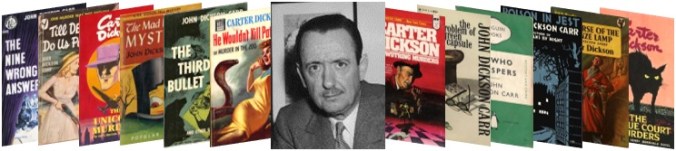
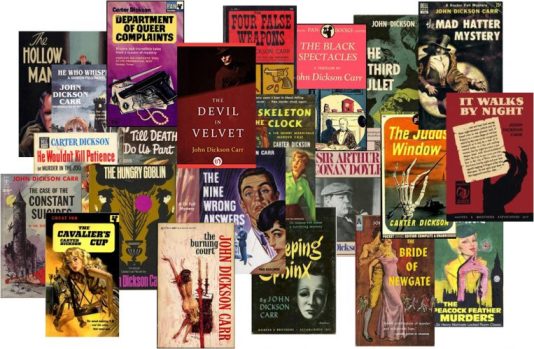
In his lifetime, John Dickson Carr published 76 novels and short story collections, plus a biography of Arthur Conan Doyle and a ‘true crime’ novel predating Truman Capote’s In Cold Blood, The Murder of Sir Edmund Godfrey. Following the closure of the Rue Morgue Press, who had five Carr novels in their books, and the coming disappearance of Orion’s ebook undertaking The Murder Room, who have around 14 or so Carr novels in their ranks, we’re not too far from a point in time where only two Car novels will be available to buy: Orion’s perpetually in-print version of The Hollow Man and the Mysterious Press publication of The Devil in Velvet. So, to return to the question in the title of this post: John Dickson Carr’s out of print — where’s the fuss?
Continue reading
#170: Dark of the Mood – Atmosphere in the Work of John Dickson Carr

Half a lifetime ago, I put up this post looking at the consistency of language across the Sherlock Holmes canon, and for my first post today in celebration of John Dickson Carr’s 110th birthday — a second post will be going up later today, then a round-up of the posts I’m kinda just trusting that other people are doing will go up this evening — I thought I’d utilise a similar approach to analyse an aspect of Carr’s writing that is often much-discussed: his use of atmosphere.
Continue reading
#169: The Tuesday Night Bloggers – Man and Superman: Refining the Protagonist in John Dickson Carr’s Historical Mysteries

With the great man’s 110th birthday looming tomorrow — I hope everyone has got their suits dry-cleaned (I’m not the only one who blogs while in full formal dress, right?) — I thought I’d look at an aspect of John Dickson Carr’s writing that came to my attention recently upon reading The Devil in Velvet, namely his use of a modern-day protagonist thrown back into the past.
Continue reading
#168: Death on the Radio – John Dickson Carr and ‘Murder by Experts’
Since reading Max Afford’s radio-set mystery The Dead Are Blind, I’ve had a new-found appreciation for the art of creating radio drama, especially during the age when radio held such a huge sway in the homes of most people. My interest in detective fiction from this era inevitably lead to some passing awareness of the serials produced at this time, but Afford’s novel really brought home the level of technical expertise required to produce something so much more complex than simply four people sitting at a microphone with a script.
Continue reading
#167: Case in the Clinic (1941) by E.C.R. Lorac
 Given the number of people who applied themselves to the challenge of writing a novel of detection during the Golden Age (precise dates pending…), it is to be expected that a fair number of wonderful novels, plots, ideas, and authors will have been lost in the tidal wave of creativity. Through the continued efforts of publishers like Ramble House — who were reprinting this stuff before it was cool again — we’ve been able to rediscover Max Afford, Norman Berrow, Rupert Penny, Hake Talbot, and others, and it’s this path of frank fabulousness that has brought me now to E.C.R. Lorac, author of some 70-odd novels under a couple of pseudonyms. Does she belong in the realm of How In The Hell Is This Stuff Overlooked? Well, on this evidence…maybe.
Continue reading
#166: One Week Until #Carr110 – Some Links to Help You…